

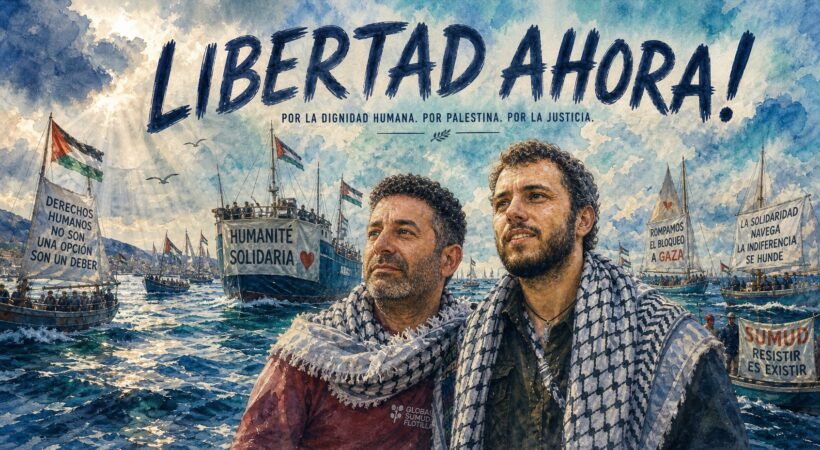
The interception of the Global Sumud Flotilla was not a security operation nor a legal dispute over a naval blockade. Legally, it was an operation of violence and State terrorism in international waters. Applying the Istanbul Protocol to each victim would be enough to verify what the testimonies already denounce with brutal clarity: systematic torture.
It was not an inspection. It was not an administrative detention. It was not a “security check.” It was an armed capture of civilians in international waters, followed by beatings, humiliation, deliberate deprivation of food and water, coercive isolation, and direct allegations of torture. When a State intercepts humanitarian vessels outside its territorial jurisdiction, separates people, temporarily disappears them, subjects them to physical and psychological violence, and then pretends to call that the “legal enforcement of a blockade,” we are not facing a diplomatic controversy: we are facing the classic anatomy of impunity.
The Global Sumud Flotilla reported that 22 civilian vessels were intercepted by Israeli forces less than 80 nautical miles west of Crete, in international waters. According to the organization, 175 participants were forcibly transferred to the Israeli vessel Nahshon, where a systematic pattern of violence began. This is not rhetorical language. The official statement itself speaks of “physical and verbal violence,” deliberate deprivation of food and water, people forced to sleep on floors repeatedly and intentionally flooded, and at least 31 activists injured with varying degrees of severity who required medical attention.
The most serious allegation concerns Saif Abukeshek, a Spanish and Swedish citizen of Palestinian origin, separated from the rest of the passengers before being subjected, according to testimonies collected by the flotilla, to systematic torture. The wording of the statement leaves no room for ambiguity: “Participant eyewitnesses provided harrowing testimony of Abukeshek’s screams echoing throughout the ship as he was subjected to systematic torture.” In other words: eyewitnesses reported that his screams echoed throughout the ship while he was being tortured.
Alongside him, Brazilian activist Thiago Ávila was also detained separately and transferred to Israel. Both were removed from the rest of the group without disembarking with the other participants in Crete. The flotilla defines this as de facto enforced disappearance. Israel presents it as a legitimate interrogation. The distance between these two versions is not minor: it determines whether we are speaking about security or crime. And international law clearly classifies it as crime. A crime against humanity.
Other released participants described beatings with rifle butts, fists, and kicks, point-blank rubber bullet shots, repeated kicks to the genitals, the use of stun grenades at close range, forced stress positions, heads slammed against the ground, and being forced to sleep outdoors while seawater was pumped onto the deck to deliberately flood the place where they were supposed to rest. This is not an improvised scene. It is a criminal methodology.
Faced with this, the United Nations Special Rapporteur for the occupied Palestinian territories, Francesca Albanese, summarized it with a phrase that will remain as the political and legal definition of the episode: “Apartheid without borders.” And she asked something Europe does not want to answer: how can this happen off its own shores?
The right question is not whether Israel denies the accusation. The right question is why the accused is still allowed to be treated as the referee of its own conduct. Because we are not dealing here with a simple dispute of narratives. We are dealing with facts verifiable through one of the strongest medico-legal instruments developed precisely for situations like this: the Istanbul Protocol.
The Istanbul Protocol, adopted by the United Nations in 1999, is neither a political declaration nor a militant pamphlet. It is the Manual on the Effective Investigation and Documentation of Torture and Other Cruel, Inhuman or Degrading Treatment or Punishment. It is the international standard for determining whether a person has been subjected to torture. It is used in courts, international human rights mechanisms, forensic investigations, and processes of State accountability.
Its application does not depend on ideological sympathies. It depends on clinical, psychological, physical, and testimonial evidence. It evaluates bruises, muscular injuries, restraint marks, genital injuries, impact wounds, sensory deprivation, sleep disturbances, signs of asphyxiation, acute trauma, post-traumatic stress, dissociation, extreme anxiety, and consistent patterns between testimony and bodily harm. It crosses testimony with forensic medicine. It dismantles institutional lies through anatomy.
Applying the Istanbul Protocol rigorously to each of the released flotilla victims would be enough to determine the nature of the abuses denounced. It would be enough to examine Saif Abukeshek, clinically document his condition, compare his injuries with witness testimonies, and chronologically reconstruct his isolation and subsequent transfer. An independent medical commission with real access to the detainees would be enough for the word “alleged” to begin losing its diplomatic function and for the correct term to emerge: torture, a crime against humanity within the framework of the systematization demonstrated by the State of Israel, with Netanyahu as the principal responsible party.
That is precisely the problem. The method is not lacking. Political will is.
When torture occurs in a clandestine Latin American prison, Europe condemns it. When it occurs in a Syrian prison, it denounces it rightly. When it occurs in a Russian detention center, it demands sanctions. But when it occurs on a vessel intercepted by Israel off Greece, nuance suddenly appears, caution appears, soft semantics appear, and the need to “wait for confirmation” appears. Geography does not change the crime. It only reveals the moral hierarchy of those who observe.
Spain confirmed that Saif Abukeshek arrived in Ashdod and was transferred to Ashkelon for consular contact. Minister José Manuel Albares acknowledged that the detention was illegal because it took place in international waters. But even there caution persists: they cannot confirm the torture because they have not yet seen him directly. That is precisely why immediate access, independent evaluation, and international forensic documentation must be demanded.
It is not enough to ask for explanations. It is not enough to lament the facts. It is not enough to issue a properly drafted diplomatic statement. If there is a formal complaint of systematic torture, the international legal duty is not to observe: it is to investigate.
The Mediterranean Sea is not a gray zone outside the law. It is not a floating interrogation room where anything can be done away from cameras. If a humanitarian flotilla can be intercepted, its passengers beaten, isolated, and tortured, and then everything reduced to a consular note, then the problem is no longer only Gaza. It is the very collapse of the credibility of international law.
That is why the demand must not be abstract. It must be concrete: immediate access to the victims, full application of the Istanbul Protocol, independent forensic documentation, identification of those responsible, and international accountability.
Because if the world accepts that torture on the high seas can be called a security procedure, then not only is Palestine abandoned. The very idea of legal civilization is abandoned.



