

“The world does not depend only on what it produces, but on how it moves.”
The point where the world compresses
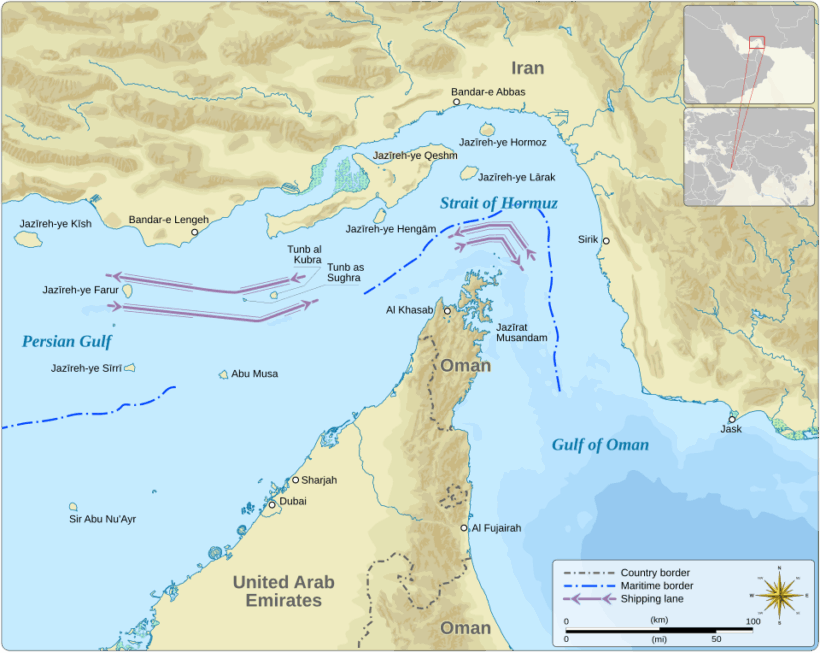
The global system rests on a silent premise. Flows must remain open. Energy, goods, capital, and food move through routes that, though invisible to most, sustain the full functioning of the planet. When those routes tighten, the entire system feels it. The Strait of Hormuz is one of those points where the world compresses. It is not just another place. It is a neck. And when the neck narrows, the whole body feels it.
Roughly 20% of the world’s oil passes through that corridor. In economic terms, that represents energy flows exceeding USD 600 to 800 billion annually. This is not an abstract figure. It is the operational base of entire economies. Industry, transportation, power generation. Everything depends on that flow remaining uninterrupted.
Threat as a tool
Iran’s warnings about potential blockades of the Strait are not isolated gestures. They are moves within a logic of pressure. When a country cannot compete on equal terms within the system, it learns to affect its critical points. It does not need to dominate the system. It only needs the capacity to disrupt it. That is the key difference. Power is no longer measured only by what is controlled, but by what can be stopped. A single incident, a credible threat, an increase in maritime insurance premiums; and the impact spreads. Prices rise. Decisions slow. Economies react.
The United States and control of flows
For the United States, control of strategic routes has historically been a central element of its power. Not only through military presence, but through its ability to ensure that the system functions under certain conditions. Keeping routes open is part of the order it has sustained for decades.
However, that control faces limits. Not every point can be fully secured. And when actors such as Iran introduce uncertainty, the system reveals its vulnerability. It is not necessary to close the Strait to generate impact. The mere possibility is enough.
The chain reaction
The narrowing of a route does not remain local. It propagates. It affects energy prices, transportation costs, industrial decisions, and public policy. A partial disruption can translate into global inflation, social tension, and economic adjustments across multiple countries.
The modern system is efficient, but that efficiency makes it sensitive. The more optimized it becomes, the less margin it has to absorb shocks. In that environment, critical points gain disproportionate power.
The system’s response
Faced with these threats, the system does not stop. It adapts. It diversifies routes, adjusts suppliers, increases reserves. But these responses come at a cost. They do not eliminate vulnerability. They redistribute it.
Here lies the central tension. The system needs to flow, but it does not fully control all the points through which it flows. That gap is where actors operate who seek to influence without dominating.
Major powers respond, but not calmly—urgently. China accelerates land corridors, secures critical minerals, and consolidates alternative routes to reduce exposure. Russia reconfigures its energy flows, redirecting exports and deepening alliances outside the Western axis. India advances pragmatically, buying where it is advantageous and positioning itself without absorbing direct conflict costs. The European Union seeks autonomy, but remains trapped between energy dependence and strategic alignment. Brazil attempts to expand its margin, but operates within a system it does not control.
There is no coordinated response. There is reaction. Each actor protects its own interests, even if that deepens overall instability. And in that movement, the system does not strengthen. It becomes more tense, more unequal, and harder to sustain.
HARD NUMBERS OF A SYSTEM UNDER STRESS
The global system can adapt—but not without cost. Each adjustment redistributes pressure; it does not eliminate it. The numbers do not describe stability. They describe the scale of risk.
Global trade exceeds USD 30–32 trillion annually, close to 30% of global GDP, revealing a level of interdependence that does not tolerate prolonged disruptions. The energy system moves more than USD 10 trillion per year, with roughly 100 million barrels of oil circulating daily, much of it crossing critical chokepoints. More than 80% of international trade depends on maritime routes exposed to geopolitical tensions. China accounts for around 30% of global manufacturing, while the United States maintains control of the main financial systems. India, Russia, and the European Union depend (at different levels) on these flows to sustain growth, stability, and supply.
These figures do not show strength. They show structural dependence. And when that dependence is strained, the system does not collapse. But it stops being predictable.
Beyond Hormuz
The Strait of Hormuz is the most visible case, but not the only one. There are other critical points in the global system—maritime routes, canals, logistics corridors. They all share a defining feature. They are indispensable and vulnerable at the same time.
This redefines geopolitics. It is no longer just about territories, but about corridors. Not borders, but flows. And in that shift, power is redistributed.
Beyond Hormuz, the world does not end. Its true fragility is revealed. If that critical point tightens or is blocked, the impact does not remain contained in the Gulf. It expands into alternative routes, maritime insurance, energy prices, and cascading industrial decisions. Oil does not disappear, but it becomes more expensive. Transport does not stop, but it becomes slower, riskier, and more costly. And in that adjustment, the entire system pays.
For the United States and China, pressure does not decrease. It intensifies. Both depend, to different degrees, on the stability of those flows. Both seek to secure routes, diversify sources, and avoid exposure. But neither can fully isolate itself. Competition continues; but under harsher conditions.
The problem is not Hormuz itself. It is what it represents. A system where a single point can affect everyone. And when that happens, power does not disappear. It becomes more aggressive, more direct, and less willing to concede.
The geopolitics of geopolitics
At this level, the deepest layer of analysis emerges. It is not only who dominates, but who can affect the functioning of the system. Cuba shows how pressure can be applied to a country. Hormuz shows how pressure can be applied to the world. Power takes different forms: economic blockade, route disruption, military deterrence. All respond to the same logic; conditioning without the need to destroy.
At this same level, actors appear who are not always explicitly named but operate with high influence capacity. Israel acts as a permanent pressure point in the Middle East, where security becomes both argument and tool, altering regional balances without territorial expansion. North Korea pushes deterrence to the extreme, reminding that the system’s ultimate limit is not economic or logistical, but existential. Pakistan emerges as a balancing and mediating actor in a region where nuclear and territorial tensions can escalate without warning.
What this means goes deeper than the sum of cases. The global system is no longer defined by single centers of power, but by multiple nodes capable of disrupting, conditioning, or escalating. It is not about controlling everything, but about having the capacity to affect enough. And when several actors reach that threshold, equilibrium ceases to be stable. It becomes fragile, dynamic, and above all, unpredictable.
A system operating under pressure
The global system does not collapse. It tightens. It continues operating, but under more demanding conditions. Each actor adjusts its position, measures its moves, calculates risks. In that unstable balance, the margin for error shrinks. Decisions carry broader consequences. And critical points like Hormuz become decisive.
For the United States, the tension is not only external. It is about sustaining leadership in a system that no longer responds automatically. For China, it is maintaining growth and internal stability while projecting global influence under constant scrutiny. Russia operates under prolonged pressure, where each move seeks to break constraints without complete isolation. India advances with strategic caution, expanding its space without becoming trapped in direct confrontation. The European Union tries to maintain cohesion while managing energy dependence, external pressure, and internal fractures.
The tension is systemic. It does not distinguish between political systems or levels of development. It affects all because it emerges from the system itself. This is not a moment of rupture. It is a phase of accumulated strain where every decision carries more weight and every mistake becomes more costly. In that context, stability is no longer a condition. It becomes a permanent task.
Power facing its own limit
In the Strait of Hormuz, two narratives are not confronting each other. Two necessities are. The United States seeks to sustain control over the flows that structure the system. China needs those flows to remain uninterrupted to sustain its own functioning. This is not an ideological dispute. It is a tense interdependence where each move by one redefines the margin of the other.
The United States can project power, but it cannot stop the system without affecting itself. China can expand, but it cannot dispense with routes it does not fully control. At that intersection, neither is absolute. Both are dependent. And that dependence is the real limit.
For decades, power presented itself as stability, as order, as guarantee. Today it reveals what it always was: capacity, pressure, conditioning—without a sufficient narrative to sustain it.
But even there, a deeper truth emerges.
Because behind routes, flows, decisions, and tensions, there are no eternal structures. There are human decisions. Temporary leadership. Strategies that change. Every projection of power, no matter how vast it may seem, is contained within time. History does not stop at Hormuz. Nor in Washington. Nor in Beijing. And when power forgets that, it begins to erode.
In the rivalry between the United States and China, that condition becomes visible. Both project strength, but neither controls the entire system. One dominates finance, technology, and alliances. The other dominates production, infrastructure, and supply chains. But that duality does not guarantee stability. It strains it. Each advance by one redefines the margin of the other. Each attempt at control exposes new vulnerabilities. This is not a struggle for an endpoint, but for sustaining position within a balance that is not permanent. And in that shared erosion, the system reveals its most uncomfortable limit.
“Because all domination is temporary. And all glory, inevitably, is fleeting…”
Bibliography (economic and geopolitical)
- International Energy Agency
- World Energy Outlook (latest editions)
- Key report on global energy supply, demand, and flows, including oil, gas, and energy transition in USD.
- U.S. Energy Information Administration
- International Energy Statistics & Outlook
- Hard data on production, consumption, and critical routes such as the Strait of Hormuz.
- World Bank
- Commodity Markets Outlook
- Analysis of prices and projections for critical minerals, energy, and food in global markets.
- International Monetary Fund
- World Economic Outlook
- Assessment of the global financial system, growth, debt, and structural tensions in USD.
- United Nations Conference on Trade and Development
- Review of Maritime Transport
- Data on global trade, maritime routes, and global logistics dependence.



