

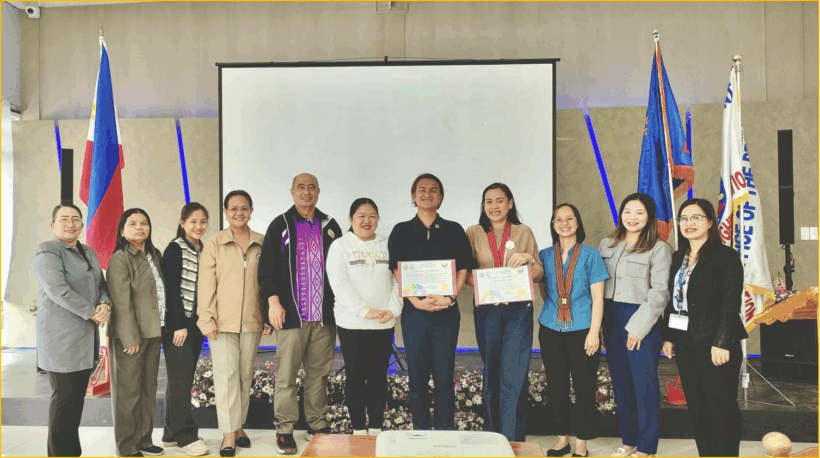
By Genevieve Balance Kupang
The Cordillera Association of International Relations Officers (CAIRO) participated in the Stewardship, Timeliness, Research, Excellence, Alignment, and Management (S.T.R.E.A.M.): Achieving a Regional Expanded and Integrated Data, held at Admirals Park and Events Center, La Trinidad, Benguet, on April 7-8, 2026. CHED-CAR, through the leadership of OIC Director Serafin L. Ngohayon, initiated the two-day gathering.
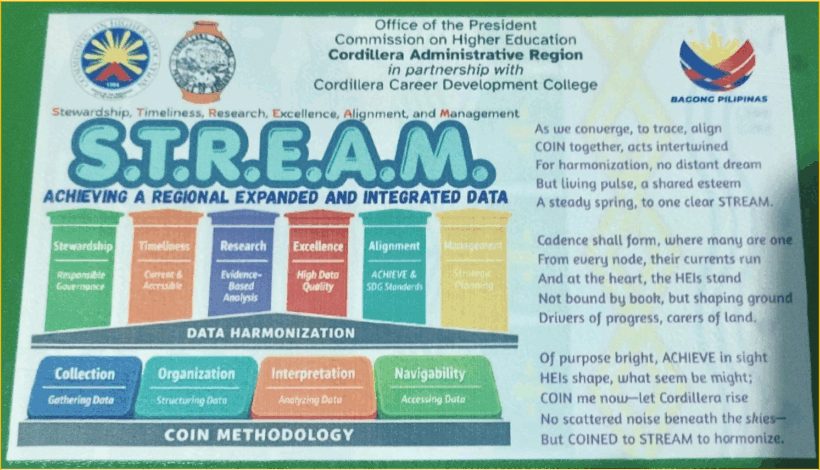
STREAM 2026: Achieving a Regional Expanded and Integrated Data. Credit: CHED-CAR
CAIRO President Saro Presents at S.T.R.E.A.M. 2026
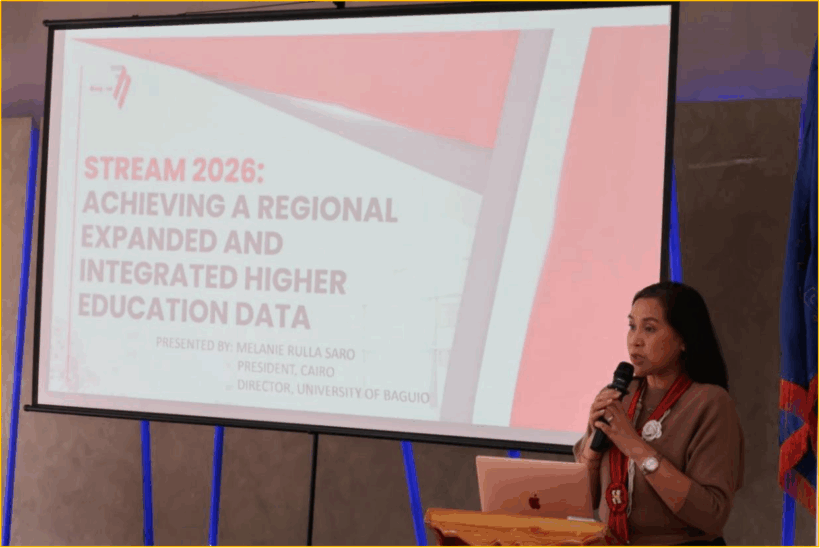
CAIRO President Ms. Melanie R. Saro makes the case for evidence-driven internationalization, urging Cordilleran HEIs to treat data readiness as a strategic imperative.
Ms. Melanie R. Saro, the CAIRO president, presented “Data Readiness as the Engine for Global Visibility in the Cordillera.” Her central argument was direct: for Cordilleran HEIs, international recognition is no longer a peripheral goal. Data readiness is the prerequisite for institutional survival.
Saro anchored her discussion in CHED CMO No. 55 s. 2016, the framework for internationalization in Philippine higher education, emphasizing that Cordilleran HEIs must develop localized strategies directly aligned with CHED’s goals for global engagement. She walked participants through a data readiness primer organized into four harmonized categories: institutional identifiers and governance, student and research data, HR and international staff profiles, and internationalization and industry links. Data must move from being seen as a compliance checkbox to being treated as a strategic institutional asset.
Her benchmarking guidance was equally precise. She introduced a three-pillar comparison model: near peers in the Philippines and ASEAN for relatable baseline comparisons, international exemplars for extracting methodological lessons, and indicator-level focus for achievable incremental goals. Benchmarking, she said, is not an obsession with a final rank. It is a clinical evaluation of methodology.
She closed with a roadmap to data readiness, urging each institution to audit its data against the requirements of WURI, THE, QS Stars, UI Green Metrics, and AUN-QA; adopt a harmonized regional dataset; initiate a living collection process across all institutional domains; and build a comprehensive repository of impact case studies, partnership records, and SDG mapping to back every institutional claim.
“Data,” she concluded, “is the universal language of global visibility. By mastering data readiness, HEIs gain the power to narrate their unique innovations and contributions, ensuring that the excellence of the highlands is recognized and respected by the global community.
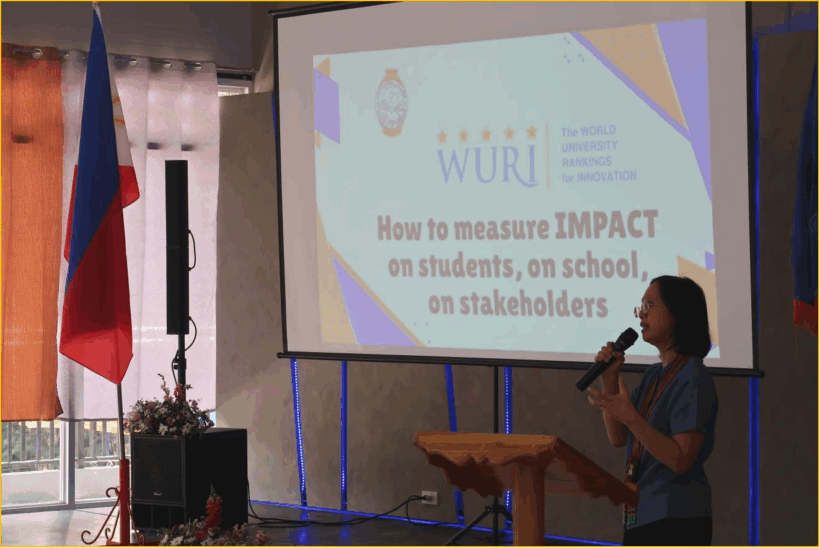
Dr. Sherry Junette Malaya-Tagle presents CCDC’s journey in international visibility and data management, spotlighting WURI impact indicators, THE Impact Rankings, and Green Metrics as tools for measuring meaningful institutional outcomes.
CAIRO Officers Join the Conversation During Q&A
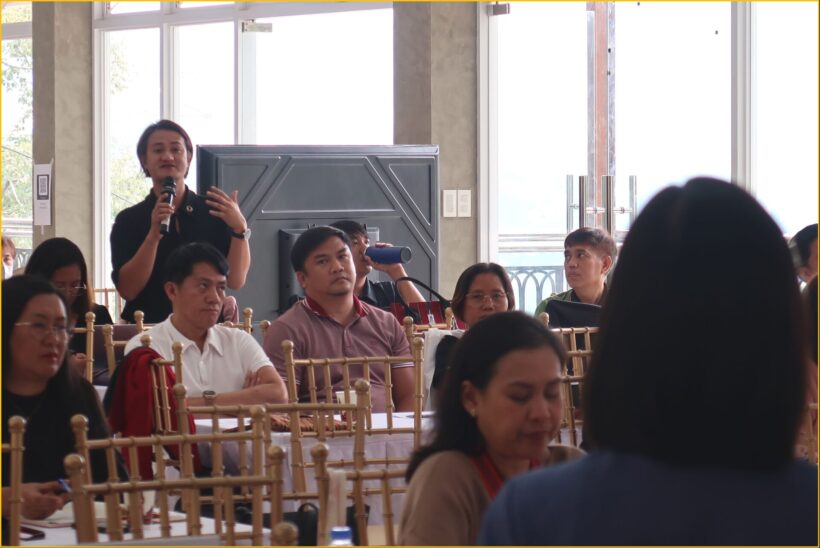
CAIRO officer Clyde B. Pumihic, IFSU’s IRO, shares IFSU’s experience in building international visibility and navigating the demands of institutional data management for global engagement.
The open forum that followed Saro’s presentation drew active participation from CAIRO officers and member IROs. The exchange reflects the culture of shared practice that CAIRO has cultivated across its member institutions. The sharing ranged from practical concerns about extracting institutional data from management information systems that remain fragmented or person-dependent, to broader queries about how internationalization data can be meaningfully integrated into local policy conversations.
CAIRO officers raised the challenge of convincing institutional leadership to invest not only in international programs but in the data infrastructure that makes those programs legible and reportable. One recurring theme was the gap between what institutions actually do and what they are able to document and demonstrate. Many internationalization activities remain undercounted because post-activity reports are inconsistently produced or unevenly archived.
The discussion also touched on the role of IROs as institutional data stewards, a framing that resonated across the room. For many in the audience, Saro’s presentation reframed their work. International relations officers are not simply event coordinators or exchange facilitators. They are custodians of information that, when gathered well and shared strategically, can shape how Cordillera presents itself to the world.
A Regional Gathering to Strengthen Impact
ST.R.E.A.M. 2026 brought together higher education institutions, government agencies, and national bodies in a shared commitment to move Cordillera’s higher education data from fragmented silos into a coherent, accessible, and impactful regional system. OIC Director Ngohayon anchored the event on the principle that CHED-CAR does not create data. The HEIs do. The Commission depends on the reliability of its partner institutions to build the kind of data architecture that can serve governance, scholarship, and regional development.
That architecture begins with the spreadsheet the HEIs fill out, the agreement they file, the partnership they report, and the activity they document. These are not administrative tasks. They are acts of institutional citizenship, contributions to a regional record that, when made visible, can carry the Cordillera into the global conversation with the credibility it deserves.
CAIRO’s presence at STREAM 2026 was itself a testament to this conviction. In gathering, in speaking, and in asking questions, its officers demonstrated that internationalization and data governance are not separate domains. They are, as Saro put it, a single strategic imperative: to move the highlands not just outward but upward, powered by data that speaks.
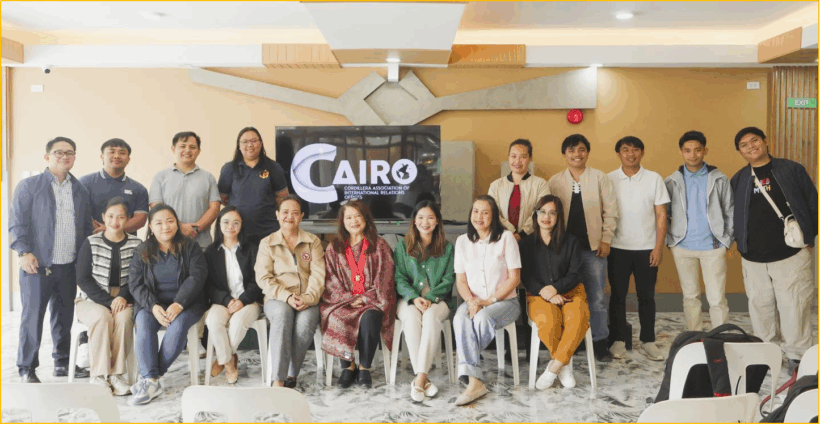
CHED-CAR IAS officers and CAIRO representatives join the resource speaker, Atty. Cheryl L. Daytec-Yangot, OIC Regional Director of the Department of Migrant Workers (DMW-CAR) and human rights lawyer, with Dr. Godfrey Mendoza, Education Supervisor II and Internationalization Focal Person, CHED-CAR; Ms. Quennie Lelina Rumbaoa, Project Technical Staff III and Regional Transnational Higher Education Officer, CHED-CAR; and CAIRO officers and members.
The Internationalization Focal Persons Breakout Session on April 8, 2026, gathered international relations officers, data managers, and institutional focal persons from across the Cordillera Administrative Region, drawing a broad and representative cross-section of the region’s public and private higher education institutions.
Baguio Central University sent Dr. Genevieve B. Kupang, who serves concurrently as IRO, Dean, Graduate School, and CAIRO’s Board of Directors. Abra State Institute of Science and Technology sent Mr. Patrick A. Benedito, General Education Chair. Ifugao State University sent Mr. Rolly Keth B. Nabanalan of the Information Office, while Apayao State College sent Mr. Dennis Dizon of the Internationalization and Linkages staff.
Benguet State University sent Ms. Decimae G. Carantes as its Internationalization Focal Person, with the IRO team led by Director Dr. Rex John G. Bawang. Kalinga State College sent Mr. Errol Alfonso Dulin from the administrative staff. Easter College sent its IRO Dr. Jessica W. Balag-ey, while St. Louis College of Bulanao sent its IRO, Ms. Daffne Joy A. Dalugan.
Saint Louis University sent Dr. Hector L. Martin, Director of the Office of Internationalization and Development for Quality Assurance. Cordillera Career Development College sent Dr. Corazon L. Ocden, its IRO Research and External Quality Assurance Officer. The University of Baguio sent Ms. Melanie R. Saro, Director of the Linkages Office. Kalinga State University sent Mr. Bernardo Ganotile of the Internal Audit Office. Star Colleges, Inc. in Baguio City came with two representatives: Ms. Joy Masiang of the Community Relations and Development Services and Ms. Ruby Rose M. Busangan, Economics Director.
Dr. Godfrey Mendoza and Ms. Quennie Lelina Rumbaoa underscored that CHED requires an annual Internationalization Report from all higher education institutions and introduced an additional framework that is set to deepen how HEIs conceptualize and document their international engagements. The framework, titled Inclusive and Impact-Driven Internationalization, is organized along five interconnected dimensions that trace internationalization from policy to lasting national contribution.
It begins with INPUT, which concerns the governance and systems architecture that an institution must establish, covering policies, regulatory compliance, and coordination frameworks that make internationalization possible. From there, it moves to PROCESS, the activation of global engagement through collaboration, benchmarking, and mobility systems that translate policy into practice. The third dimension, OUTPUT, measures the tangible results of this activation: the expansion of partnerships, the growth of mobility programs, and the integration of international perspectives into the curriculum. These outputs, in turn, generate OUTCOMES, the measurable evidence of global engagement and international recognition that institutions can report, benchmark, and build upon.
The fifth and most far-reaching dimension is LONG-TERM NATIONAL CONTRIBUTION. Through the institutionalization of inclusive and impact-driven internationalization, Philippine HEIs are envisioned to strengthen global engagement and collaboration between local and international institutions; expand access of Filipino learners and faculty to international academic and professional opportunities; raise the international credibility and recognition of Philippine higher education qualifications; deepen knowledge exchange and innovation through global academic partnerships; increase the participation of international students and scholars in Philippine campuses; and ultimately position the Philippines as an active, credible, and respected higher education partner within ASEAN and the broader global academic community.
For CAIRO members and IROs across the Cordillera, this framework is both a mandate and a map. It asks not only what institutions do internationally, but what those activities build, whom they serve, and what they ultimately contribute to the nation.
Photo credits: Arlene Bayani, Arabelle Stacy Julian, and Edgar Alambra (STI Baguio OJT interns, CHED-CAR); Danielle y Gadoan Galong (CHED_CAR)
About the Author:
Dr. Genevieve Balance Kupang serves as the International Relations Officer and Dean of the Graduate School of Baguio Central University. In the regional arena, she sits as a Board Director of the Cordillera Association of International Relations Officers (CAIRO). Globally, she carries several concurrent roles: Historian of the World University Rankings for Innovation (WURI), Secretary of the World University Network of Innovation Leaders (WUNI-L), and SIG Chair and Peace Education Coordinator of the World Council for Curriculum and Instruction. She also co-leads the Exceptional Women of Peace Award under Pathways to Peace, an international initiative recognizing women whose lives and work advance the cause of peace across communities and borders.



