

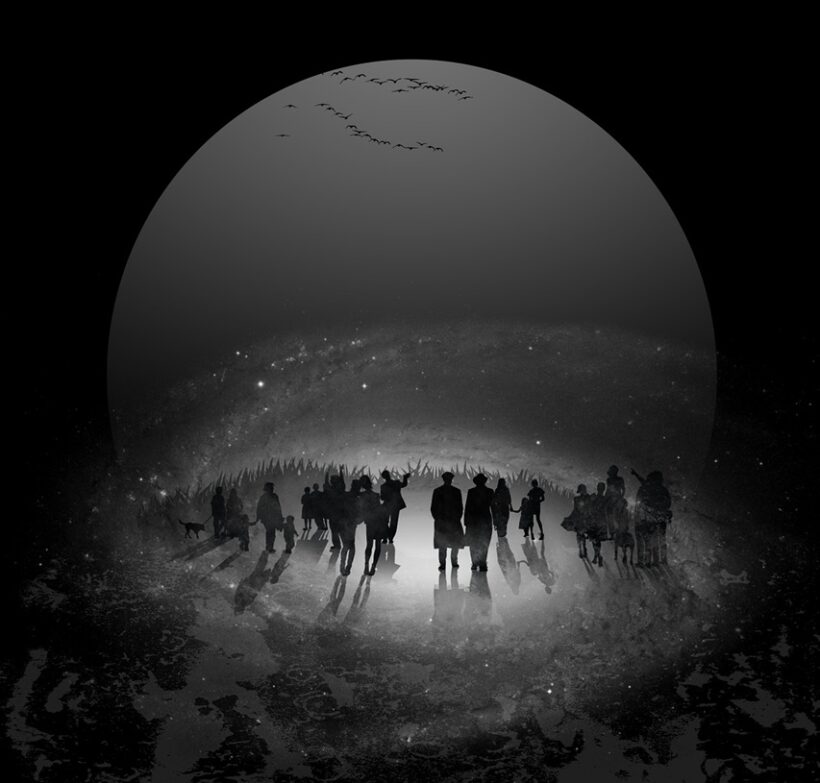
It may be somewhat difficult, under the current circumstances, to believe in the possibility of a more humane civilization emerging. Wars, poverty, climate instability, discrimination, interpersonal violence, cruelty, and the discrediting of the ruling elites are obstacles that seem to nullify any prospect of a dignified future. But it is these very circumstances that signal that something has come to an end and herald the birth of something profoundly new. Radically new.
As in every moment of human history, in a way almost imperceptible to our immediate sensory experience—what some naively and others far less naively call “reality”—there are attempts aimed at building models of the future. These proposals, which the dying system and its adherents dismiss as “utopian,” are nothing less than that: utopias that fervently cry out to demonstrate, as has always been the case, that ultimately nothing can stand in the way of the evolution of human life.
These signs constitute images and practices that speak to the human heart to uplift it and make it possible to overcome defeatism and situational anguish. They are the embryo of the myth that rises from the depths to call upon the peoples to place their unshakable faith in it, opening the way to a new chapter in History.
The Signs
Master Silo, founder of the New Humanism movement, explained some twenty years ago, during a recently rediscovered conversation, that since the most ancient times, human communities, in order to survive and advance toward better living conditions, have had to answer three central questions.
The relationship the community establishes with the environment, the nature of the relationship among human beings themselves, and the relationship with oneself that provides growing satisfaction have been and remain the cardinal questions which, if correctly answered, enable evolutionary development at every historical moment.
To obtain adequate answers, some members of those human groups prepared themselves in different ways to receive signals from unfathomable and sacred realms—signals that, at different stages, formed the core of powerful religious beliefs and, at others, spurred creative waves of scientific, artistic, philosophical, social, and political transformation.
Different cultures, growing separately, provided their answers and gradually forged their models of behavior, their morality, and their social organization, striving to overcome the challenges that their stage of development imposed upon them.
Today we observe how there are commendable, though perhaps fragmentary and reactive, attempts to contribute in that direction—partial responses that acknowledge the decline but do not address the challenge with the all-encompassing power that characterizes the foundational mythical narrative.
By highlighting some indicators of such attempts, we see how the irrationality and disparity in the use of natural resources are denounced, along with the partiality and pettiness of particular interests in the measures taken (or proclaimed) in the face of global environmental degradation caused by capitalist depredation.
In this sense, calls for environmental stewardship represent progress, provided they do not place the natural state of things above human beings, their survival, and their evolution.
In the same vein, we can identify in various cultures the attempt to cloak the need to avoid destruction and to encourage the reproduction of processes beneficial to human health and sustenance in a certain ancient ritualism, preventing a small group from appropriating the environment solely to obtain short-term financial gains. In farming practices such as agroecology, or in the sensitivity—very present today among broad sectors of the youth—to avoid or reduce the consumption of animal meat, we can see a compassionate sign, also present in various spiritual forms that emerged in other historical eras.
As for the relationship between human beings, while the dominant system promotes and normalizes violence, instilling exploitation and individualistic competition, there are numerous experiences of collaboration, cooperation, solidarity, and empathy among people and communities.
In the face of hunger and poverty, unchecked militarism, racism and discrimination, violence against women and children, and the proliferation of hate speech, a vast number of collectives and organizations are rising up and organizing to promote alternatives that provide a better life for people in today’s society. In this field, pioneering proposals stand out, such as the Universal Basic Income, the concept of the Commons, socialist and cooperative models, the defense of free, universal, and high-quality education and healthcare systems, pacifist initiatives, the protection of discriminated-against minorities, and, in general, all those that promote equal rights and opportunities for all.
Human Rights, even though still restricted both in their formulation and application, represent an exemplary step forward for humanity on the path to self-improvement.
At the same time, the demand for definitive decolonization and reparations for acts of violence is being voiced forcefully—an essential step toward forging a path of reconciliation for the wounds that still tear at the social fabric and collective memory. Calls for a new egalitarian framework of geopolitical coexistence and references to a shared destiny for humanity represent significant glimmers of hope in this realm.
In the realm of information and communication, the Internet represents a major achievement toward shared knowledge, despite the aggressive attempts by companies in the sector to appropriate it, seeking to monopolize the accumulated collective effort to serve only their own interests.
Finally, there is a strong quest among individuals and human communities to find an existential meaning that brings satisfaction and direction to their own lives. While disruption, vulnerability, frustration, and an increase in mental health issues become evident, millions of human beings are trying out or repeating—beyond achieving their goal—different approaches in the spiritual realm to cope with the lack of a clear future and the situation of mental suffering in which they find themselves.
All these signs, though they manifest in diverse and even opposing ways, and though they appear as partial responses to the problems faced, reveal the human intention to connect with paths that help free people from the collective and individual hardships they are enduring.
It is a profound intention within every human being and within the collective in which they are immersed, seeking to redirect and place their inner faith in a mental object that provides answers to these great questions. This search, driven by an evident need, lies at the root of the emergence of a new mythical narrative that will lay the foundations for the future.
The Universal Human Nation, the social myth of the first planetary civilization
The current historical moment differs significantly from previous ones.
Today, humanity is deeply interconnected; civilizational processes intersect and influence one another; it is no longer possible to conceive of isolated, compartmentalized developments.
In various fields, a much more holistic perspective on the issues to be resolved is emerging. Science and thought, despite the specialization and fragmentation of much research, and beyond the dominance of certain utilitarian techniques driven by corporate interests, will necessarily tend to take on an increasingly interdisciplinary and complex character.
On the other hand, despite the structural nature of the problems, there is strong resistance and a significant failure in any attempt at centralization. Diversity is making headway by seeking to explore new territories, developing multiple tactics, thus emulating the development of Life itself.
Hence, the new founding myth, far from concentrating energy on a rigid and unitary image, must possibly be inclusive and multifaceted, allowing for the experience of a convergent symphony with the best elements developed by each cultural process.
That could be the emerging meaning in a Universal Human Nation, one that enables the contribution—without exclusion—of the positive attributes of every people and recognizes diversity as a source of enrichment, thereby overcoming any hint of discrimination.
A Universal Human Nation that guarantees equal rights and opportunities for personal and social development for all, that expands freedom and reciprocity through human action, that decentralizes power by returning sovereignty to the social base, and promotes the restoration of the fabric destroyed by others—these are themes at the core of that mythical image.
Similarly, it is central to affirm interpersonal and social nonviolence as a model of righteous conduct to follow. Accompanying interaction in the world with an intimate reflection on the meaning of life within a novel, humanized spirituality—free from impositions, dogmas, and open to free interpretation—and fostering reconciliation with oneself and with other people or groups are essential conditions of an attitude that recognizes the intimate unity that connects us.
Consciously embracing rebellion against death as the ultimate act of defiance against apparent fate and affirming the construction of immortal transcendence through coherent action is an existential feature of the myth that provides certainties in daily life, regardless of one’s psychosocial background.
Beyond this faint outline, an immense sea of creative possibilities opens up—images that guide action in every sphere of human activity and, above all, strengthen the impulse for the myth to manifest itself and radiate with a powerful brilliance upon the species.
Therein lies our task. To achieve this, we must abandon the mediocre temptation of realism and the short-sightedness of the moment, which are insufficient for the human condition. Just as our predecessors have done, the path we must collectively retrace is to imagine and make the impossible possible. Aligning ourselves in that direction to transform the contingent and create the new is a course worthy of our species.



