

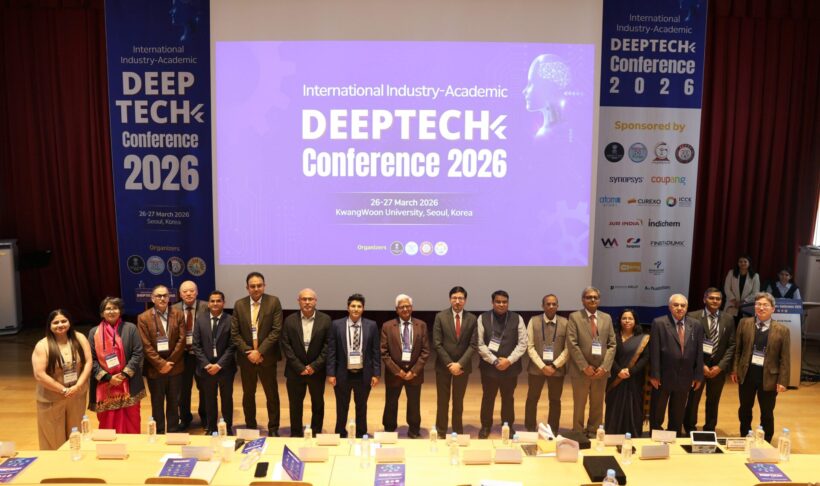
DeepTech Conference 2026 at Kwangwoon University Draws 250+ Participants from 18 Countries, Signaling a New Era of Bilateral Collaboration
Seoul, South Korea · March 28, 2026
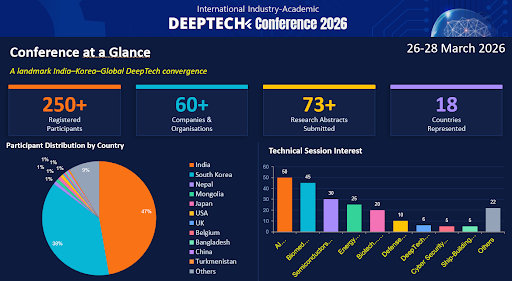
SEOUL — The Industry–Academia DeepTech Conference 2026, held from 26–28 March at Kwangwoon University in Seoul, concluded after three days of impactful dialogue. The event brought together over 250 registered participants from more than 60 companies and organizations across 18 countries. Featuring 73 research presentations and sessions spanning artificial intelligence, semiconductors, cybersecurity, defense, biomedical technology, and energy, the conference was widely recognized as a major international platform advancing collaboration at the intersection of industry, academia, and government in Korea.
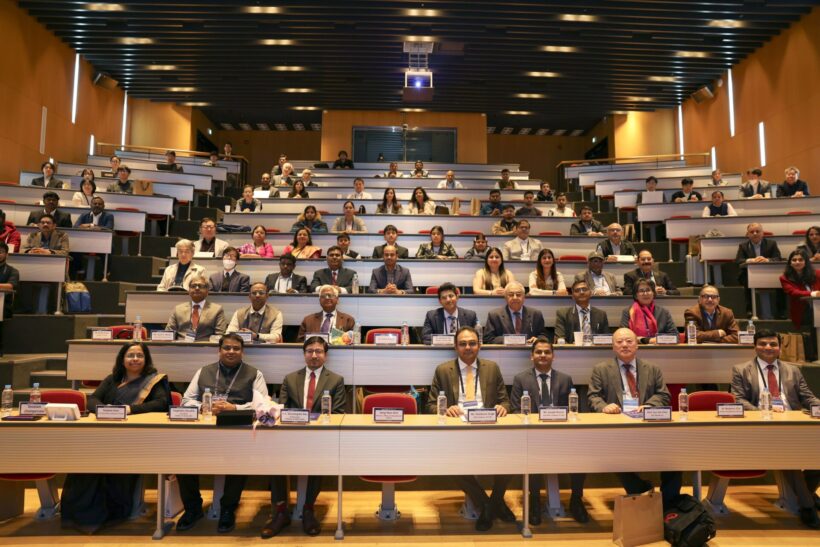
The Conference Hall.
A Coalition of Institutions and Industry
The conference was jointly hosted by the Embassy of India in Seoul, Indians in Korea (IIK), Sanatan Dham Foundation (SDF), and Kwangwoon University, with sponsorship from the Embassy of India, IIK, and leading corporations, including Synopsys, Gintel, Atomy, Indichem, Air India, Well-Matix, and FinstadiumX. IIK’s annual sponsors—CUREXO, Coupang, Hanpass, WeBring, Hustation, and PersolKelly—also actively participated. This strong coalition of public institutions, diplomatic partners, and industry leaders underscored a shared recognition among Korean and Indian stakeholders that deep-tech collaboration is both timely and strategically essential.
Ambassador: ‘A Partnership Built for the Future’
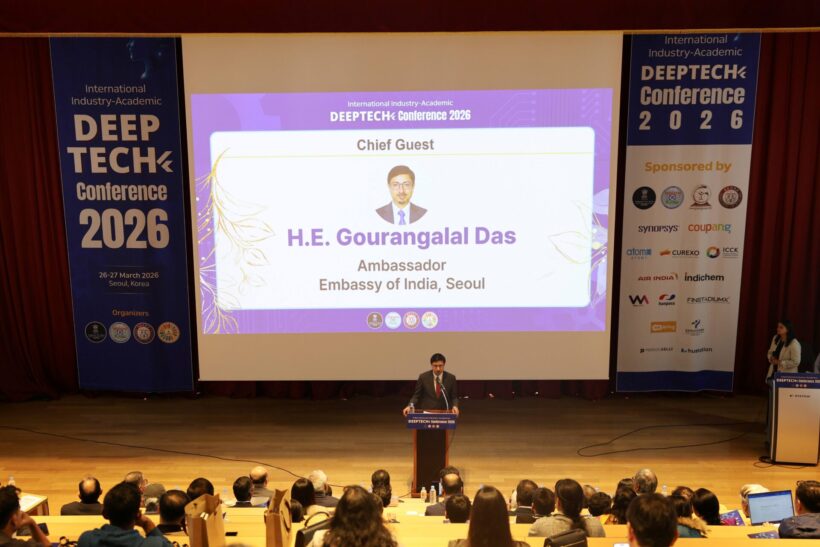
The Ambassador’s Address.
The Ambassador of India to South Korea delivered a welcoming address that set the intellectual and diplomatic tone for the entire event. Speaking to an audience of scientists, entrepreneurs, policymakers, and academics, the Ambassador stressed that the Korea–India relationship has entered a transformative phase — one in which shared technological ambition must be matched by concrete institutional partnerships.
“India and Korea are not merely trade partners — we are natural allies in innovation. The technologies being discussed at this conference will define the next decade of global competitiveness, and there is no better time than now for our two nations to build these bridges together. Events like this are not a beginning; they are proof that the foundation is already being laid for a partnership that will benefit not just our two peoples, but the world.” — Ambassador of India to the Republic of Korea, DeepTech Conference 2026 Opening Ceremony
The Ambassador highlighted the complementary strengths of the two nations — Korea’s world-class manufacturing, semiconductor leadership, and R&D infrastructure alongside India’s vast engineering talent base, software prowess, and rapidly scaling startup ecosystem — and called for the institutionalization of collaboration channels that go beyond bilateral trade into joint research, co-innovation, and talent exchange.
The Vision Behind the Conference
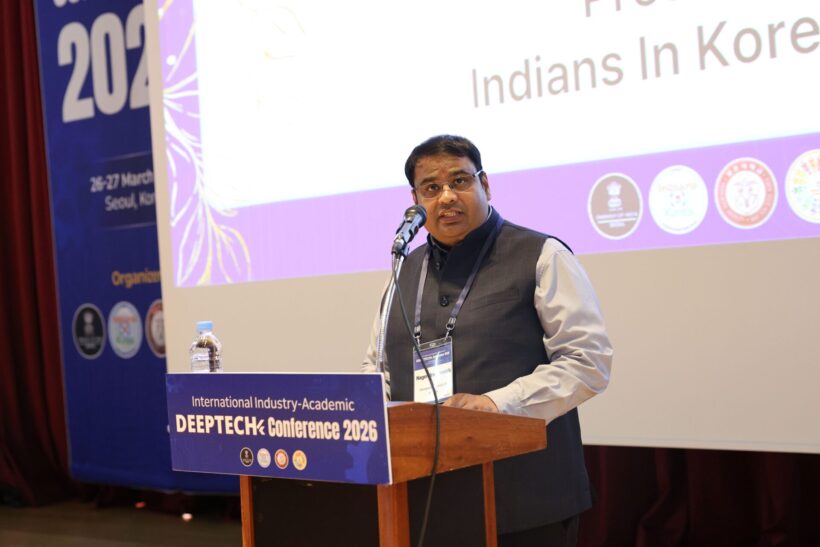
Prof. Nagendra Deeptech2026 Chairman.
Professor Nagendra Kumar Kaushik of Kwangwoon University and IIK, who served as the Chairman of the conference, was the driving force behind the event’s ambitious conception and meticulous execution. Drawing on deep ties across the Korean and Indian industry-academic communities, Professor Kaushik worked to assemble a program of international scope and intellectual rigor—one that matched the significance of the bilateral moment. Supporting this vision were the Co-Chairmen: Mr. Suresh Kumar, Consular at the Embassy of India; Dr. Benjamin Cho of Kwangwoon University; Dr. Nitish Katoch of IIK; and Mr. Sunil Mishra of Gintel/SDF whose leadership and coordination were instrumental in the conference’s success.
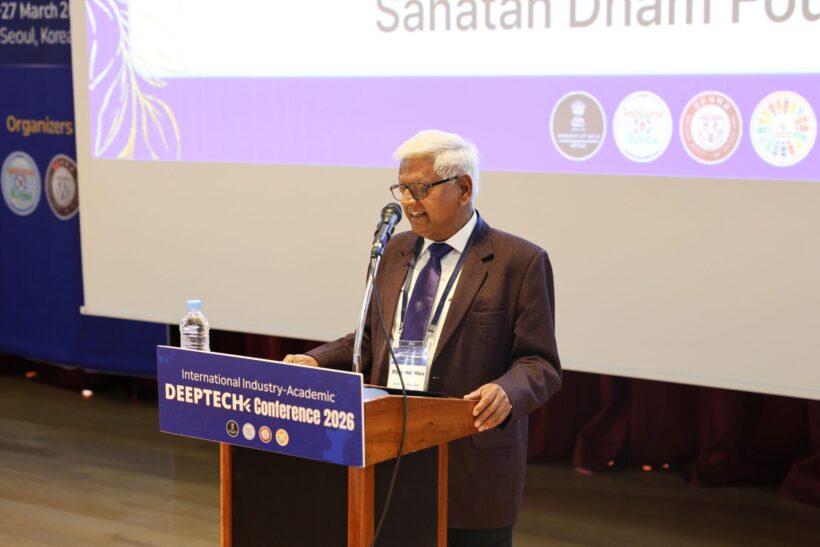
SDF Chairman.
Attendees and co-organizers widely credited the organizing team’s commitment, their ability to bridge institutional boundaries, and their shared focus on creating a conference that would deliver meaningful and lasting outcomes for both nations.
Cultural Diplomacy on the Stage
The conference cultural night beautifully blended cultural expression with academic spirit. Professor Richard Rho of Kwangwoon University performed a moving saxophone rendition of India’s “Vande Mataram” and Korea’s “Aegukga,” symbolizing unity between the two nations. This was followed by an elegant Odissi dance by Hiranmayi Dipti and a captivating harmonium performance by Saurabh and Shruti. Together, the performance highlighted the importance of cultural appreciation in fostering meaningful international collaboration.
Special Keynote: Two Nations, One Spirit
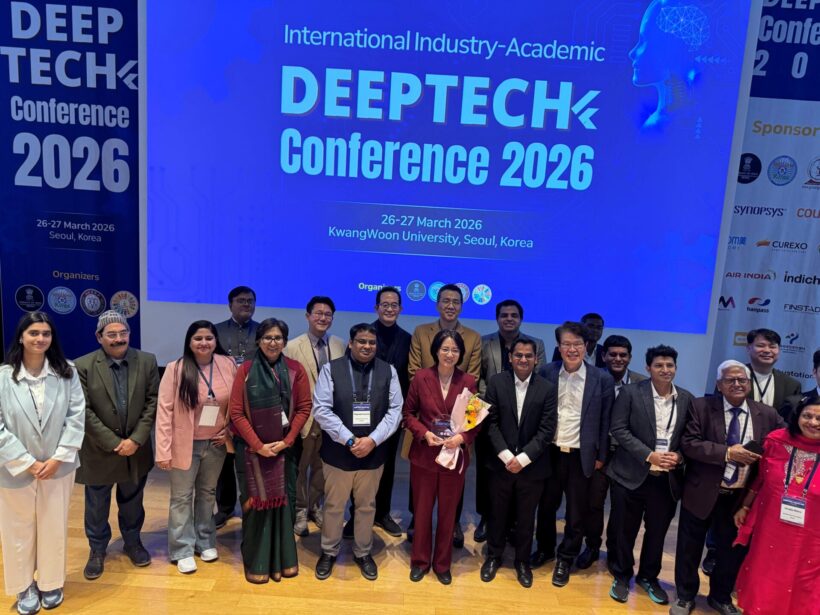
Group photo of special address by Ms. Young Lee.
Young Lee, former Minister of SMEs and Startups of South Korea, delivered the conference’s special keynote address on the second day to a highly receptive audience. Drawing on her extensive experience shaping Korean industrial and entrepreneurial policy, Minister Lee articulated a compelling vision of Korea–India complementarity.
“Koreans and Indians share similar spirits and complement each other in many ways.” — Young Lee, Former Minister of SMEs and Startups, Republic of Korea
Minister Lee pointed to the structural alignment between Korea’s technology manufacturing base and India’s software and human capital strengths, arguing that the two economies are not in competition but in a position to form a deeply productive alliance — one that could accelerate both nations’ ambitions in AI, semiconductors, and next-generation industries.
From Visionary Speakers to Seamless Execution
The conference was driven by an outstanding lineup of speakers and the dedication of its organizing teams. Six keynote addresses were delivered by Dr. Ravi Ganapathy (International Vaccine Institute), Dr. Abraham Lee (Atomy India), Mr. Keshav Hasur (TCS Korea), Woo Jung Jang and Myunghoon Lee (Synopsys), and Jay S. Han (Indichem), complemented by plenary lectures from Prof. Eun Ha Choi (Plasade Inc.) and Prof. Markandey Rai (IGTAMS & GPF), along with 18 invited talks and numerous oral and poster presentations. A dedicated industry panel, led by Mr. Nishikant Singh (Deputy Chief of Mission, Embassy of India) and Mr. Sunil Mishra (CEO, Gintel), brought together stakeholders from India and Korea to address collaboration opportunities and key challenges for future business engagement. Behind the scenes, the seamless execution of the event was made possible by the tireless efforts of the IIK team—including Legal Chair and Board of Directors Mr. Sanjay Yadav—and Kwangwoon University members, whose professionalism, enthusiasm, and warm hospitality were widely recognized as central to the conference’s success.
A key highlight of the conference was the signing of 6 Memoranda of Understanding (MoUs) focused on strategic areas, including artificial intelligence, energy solutions such as green hydrogen and battery energy storage systems, semiconductors, and smart city development—reinforcing the commitment to tangible industry–academia collaboration.
A Foundation for What Comes Next
Organizers and participants alike left the conference with a strong sense that a lasting foundation had been established. Connections formed over two days of dialogue—bringing together entrepreneurs, policymakers, and researchers from 18 countries—are expected to lead to joint innovation initiatives, industry partnerships, and bilateral programs in the months ahead. On the third day, participants joined a cultural tour to Namsan Seoul Tower and Gyeongbokgung Palace, enriching their experience of Korea’s heritage. The DeepTech Conference 2026 has thus positioned itself not as a one-time event, but as the beginning of an enduring Korea–India deep-tech collaboration journey.
As the Ambassador noted in his address, this conference is proof that the foundation is already being laid — and those who were present in Seoul on March 26-28, 2026, can say they were there at the beginning.
For media inquiries and accreditation:
Email: deeptech2026@indiansinkorea.com
Hand Phone: +82-1041878618; Landline: +82-02-940-8618; Fax: +82-2-940-5664
Webpage: https://deeptechseoul.com



