

by GM Forhadul Mojumdar (Dhaka Bureau)
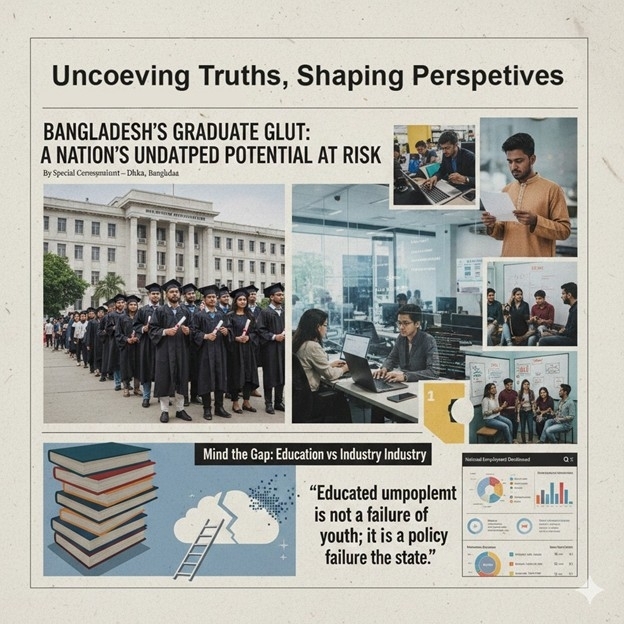
Bangladesh is grappling with the heavy burden of unemployment. The educated youth of the country are failing to find work after completing their studies. Today, educated unemployment has become one of the most complex socio-economic crises in Bangladesh. Notably, the rate of unemployment among educated women is higher than that of men, exceeding 20%. Furthermore, the number of long-term unemployed, those seeking work for at least two years without success- is also on the rise. According to the latest Labour Force Survey conducted by the Bangladesh Bureau of Statistics (BBS) in late 2024, the unemployment rate is lowest (1.25%) among those with no formal education; conversely, the rate increases with higher levels of education. Among the highly educated, the unemployment rate is at its peak, reaching approximately 13.54%. This implies that out of every 100 graduates, about 14 are unemployed.
Following the political transition in 2024, this scenario has turned even direr. Recently, when asked about this issue, Wahiduddin Mahmud, the Planning Adviser to the interim government, stated, ‘Stagnation is visible in the national economy due to political uncertainty. Desired investment is not happening, which is hindering employment generation.’
After the political shift in August 2024 (the student-people uprising), an interim government led by Nobel Laureate Dr. Muhammad Yunus took charge of the country’s administration. Following the uprising, the nation’s law and order had completely collapsed. Upon assuming power, the primary challenge for the interim government was to restore this broken system. Consequently, they were unable to take the necessary steps for creating new employment. However, over the past year and a half, with the assistance of the Army, the interim government has achieved a visible improvement in law and order and has announced a roadmap for a free and fair national election. If everything stays on track and no unforeseen complications arise, a general election (the 13th National Parliament) will be held in Bangladesh on February 12, and a newly elected political government will take over the responsibility of running the country.
However, in the altered political landscape of 2026, the biggest test for the newly elected government will be ‘educated unemployment.’ Thousands of youths are roaming with bachelor’s and master’s certificates, but the current labor market is unable to absorb them. According to analysts, this crisis is not merely economic but signals deep-seated social and political instability. While certificates exist, where is the skill? A massive gap has emerged between the education system and the labor market in Bangladesh. Although millions of youths earn degrees every year, a significant portion of them are not suitable for the modern corporate or technology sectors. Domestic and international analysts believe that unless the government immediately ensures industry-academia partnerships and modernizes the curriculum, this educated manpower will become a ‘Demographic Disaster’ instead of a ‘Demographic Dividend.’ Reports on the obsession with civil service jobs and the uncertainty of the private sector show that a vast number of educated youths spend years solely preparing for government jobs. The primary reasons behind this are the insecurity and lack of social status in private sector employment.
When consulted, Dr. Rizwanul Islam, a former Associate Professor of Economics at Dhaka University and currently a teacher at North South University, said that the situation of educated unemployment is not just a personal frustration; it damages national productivity, social stability, and political trust. According to this development economist and labor market researcher, the first task of the elected government should be to solve this crisis on a priority basis. The elected government must strengthen the minimum wage structure and social protection in the private sector to encourage the youth to become entrepreneurs or work in private institutions.
Experts have identified seven key pillars for the elected government to overcome this crisis:
- Bridging the Gap between Education and the Labor Market: The disconnect between university degrees and market demand must be closed. Curriculum updates, industry-academia partnerships, and mandatory internships based on national labor market demand are essential.
- Skill-Based Employment Policy: Along with increasing the number of jobs, youth must be equipped with marketable skills. State-guaranteed quality short-term training in sectors such as IT, Data Analytics, AI, Cyber Security, Green Energy, and the Care Economy is crucial.
- Breaking the Government-Job Centric Mindset: Unemployment rises when everyone pursues government jobs. Private sector jobs must be made respectable by ensuring minimum wages, job security, and social protection.
- Tangible Support for Entrepreneurs and Startups: To turn youth into entrepreneurs, the state must provide easy-term loans, tax breaks, second chances after failure, and incubation centers at the district and upazila levels. The state must share the risk with the youth.
- Transparent Recruitment and Meritocracy: If partisan influence, quota corruption, and opacity are not stopped, the meritorious will lose hope. A technology-based, transparent, and accountable recruitment system must be ensured.
- Initiatives to Export Skilled Manpower: Instead of degrees, skills should be exported. Through government-to-government (G2G) agreements, educated youth should be sent abroad as skilled workers after providing language and technical training.
- Data-Driven Planning: Effective policy is impossible without data on the number of educated unemployed, their specific skills, and their locations. A national employment dashboard should be launched to align supply with demand.
In conclusion, educated unemployment is not a failure of the youth; it is a result of the state’s policy failure. If the elected government can ensure political will, transparency, and continuous reform, the educated youth will no longer be a burden—they will become the nation’s greatest strength. Only by utilizing this vast educated population in productive sectors through political will and consistent reforms can Bangladesh achieve its true economic potential.
The Author:
 GM Forhadul Mozumder: Contributor, Pressenza- Dhaka Bureau.



