

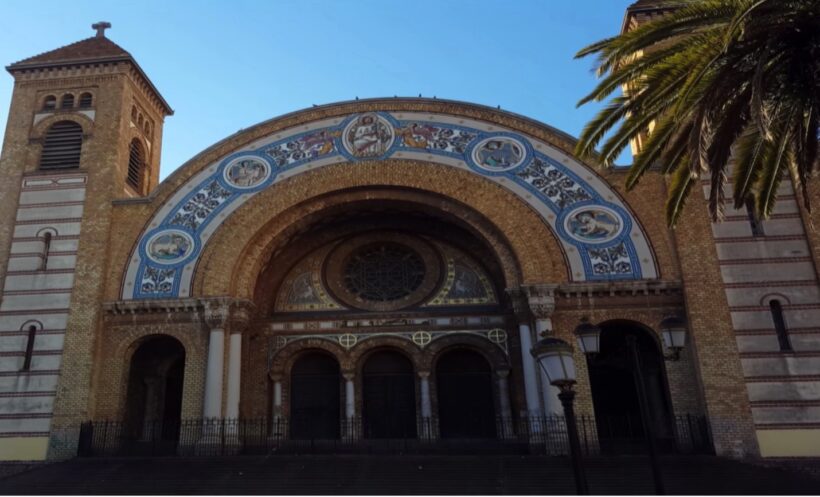
Despite their long history in the country, Christians in Algeria today constitute a religious minority that faces significant discrimination in the public sphere. Although the Constitution proclaims freedom of conscience and worship, the concrete experience of Christian communities reveals the existence of many state constraints, primarily indirect, which limit the effective practice of their faith. These restrictions manifest through legal, administrative, and symbolic mechanisms, particularly visible in certain regions such as Kabylia. The study of the situation of Christians thus allows questioning the reality of religious pluralism in Algeria and the gap between officially affirmed principles and their concrete application.
Christianity was established in North Africa as early as the first centuries of the Christian era. Present-day Algeria was one of the major centers of ancient Christianity, producing prominent intellectual and spiritual figures such as Saint Augustine of Hippo (Annaba). This presence gradually weakened from the 7th century onwards with the Islamization of the region, without completely disappearing. The French colonial period marked a numerical resurgence of Christianity, mainly linked to the settlement of European populations, before a massive new decline after independence in 1962.
Legally, Algeria formally recognizes freedom of worship. However, this recognition falls within a restrictive legal framework, notably through legislation governing non-Muslim cults. The opening, organization, and functioning of churches are subject to strict administrative authorizations, while any form of proselytism toward Muslims is prohibited. This legal framework, presented as a means of regulation, is in practice an instrument of state control over religious minorities.
Christians in Algeria face institutional discrimination that does not translate into an explicit prohibition of Christianity but rather an accumulation of indirect constraints. One of the most significant manifestations of this situation lies in the closure of numerous churches due to the absence of official authorization. In many cases, these authorizations are denied or remain unanswered, placing Christian communities in a de facto illegal situation.
This administrative strategy allows the authorities to legally justify the closure of places of worship while avoiding an open challenge to religious freedom. It helps to force Christians to practice their faith discreetly, often in private spaces, to avoid sanctions. This gradual rendering invisible limits their social recognition and reinforces their marginalization.
Kabylia occupies a particular place in the analysis of Christianity in Algeria. This region, marked by a strong Amazigh identity and a long tradition of cultural and political mobilization, has a more visible Christian presence, especially in its Protestant form. Since the 1990s, a significant number of conversions have been observed there, attracting the attention of state authorities.
It is in Kabylia that church closures have been the most numerous, officially for non-compliance with legal standards. However, the repetitive and systematic nature of these closures suggests selective application of the law. This situation reveals a desire to limit the expansion and visibility of Christianity in a region already perceived as politically and culturally sensitive by the central power.
The discrimination of Christians also expresses itself through the management of religious heritage. Many ancient churches, some existing for several centuries, have been closed, abandoned, or converted, notably into mosques. This process, when not accompanied by a policy of equitable preservation of Christian heritage, is experienced by the faithful as a negation of their historical legacy.
At the same time, the Algerian state actively supports the construction of new mosques, including in regions where their multiplication appears disproportionate relative to local needs. This policy helps reinforce the religious hegemony of Islam in the public space and accentuates the imbalance between confessions, thus weakening the reality of religious pluralism.
Beyond institutional constraints, Algerian Christians, especially converts, may face administrative, and social pressures. However, several observations highlight the existence of a generally peaceful coexistence at the local level, notably in Kabylia, where community solidarities remain strong. The marginalization of Christians thus appears less as a generalized social rejection than as the result of restrictive state policies.
The case of Christians in Algeria thus reveals tensions between the desire to preserve a dominant religious identity and the demands of pluralism in a historically diverse society. It highlights the limits of a model of religious freedom based on formal recognition but weakened by asymmetrical administrative practices.
The analysis of the situation of Christians in Algeria shows that religious pluralism remains largely theoretical. Despite the historical antiquity of Christianity and the constitutional recognition of freedom of worship, Christian communities face state constraints that limit their visibility, organization, and effective practice of their faith. These restrictions, based on indirect legal and administrative mechanisms, reflect structural religious discrimination.
The case of Kabylia illustrates these dynamics particularly clearly, revealing how the control of religious space is part of broader issues of power, identity, and national cohesion. Ultimately, the situation of Christians in Algeria raises the question of the real respect for religious pluralism and invites broader reflection on fundamental freedoms in contemporary Algeria.