

To understand the nature of a war and be able to make an informed decision, it is not enough to rely on what is happening internally within societies engaged in armed conflict. A state may be considered democratic in its internal functioning and still behave like a rogue state in its external relations with other countries. Conversely, an internally authoritarian state that denies the rights of minority groups may still have legitimate security concerns about external aggression.
There is a strong temptation to judge a conflict involving Saddam Hussein, Muammar Gaddafi, or Bashar al-Assad solely on the corrupt or tyrannical nature of these regimes. Focusing on these figures and the violence they have demonstrated toward their own populations can lead us to overlook violent intrusions from third countries and their aim to dominate. For example, the United States can use the negative image it has instilled in the general population about a leader to effect regime change, generate chaos, or dismember a country. In Syria, for example, it can even partner with a terrorist group like al-Qaeda, help it seize power, establish friendly relations with its leader afterward, and avoid reluctance or concern by public opinion about the role of the United States government. The proxy war the Americans have waged against Syria, with armed jihadist groups as proxies, can thus fly under the radar. The United States can even occupy a third of the country and not have this occupation perceived negatively.
The humanitarian perspective
Another requirement is necessary to fully understand the nature of an armed conflict. It is necessary to be able to broaden an analysis motivated exclusively by humanitarian issues. Empathy, compassion, and care for each other must be complemented by a geopolitical understanding of the issues at stake. It may seem at first glance that geopolitics is not necessary to take a position on the tragedy experienced in Gaza. Emotions are running high and increasingly shared throughout the world. Everyone is exposed to the atrocities committed, the decimated civilian populations, the mutilated bodies, the imposed famine. World public opinion is now overwhelmingly favorable to the Gazans, and it may seem pointless to enter into inextricable twists and turns that go back to historical sources, and more pertinently, to Zionism and imperialism, whether British or American.
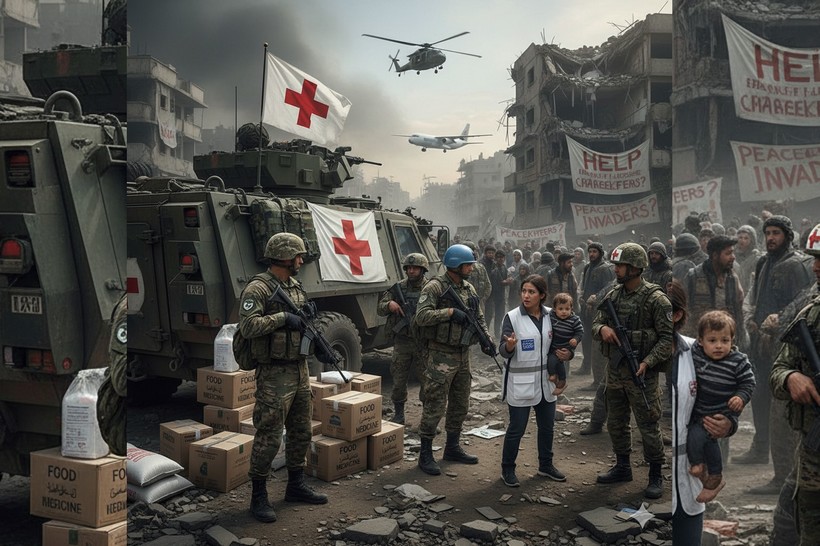
Humanitarians may be tempted to respond that, in any conflict, we must never lose sight of the human aspect of things. They will therefore insist that NGOs play an essential role because they help civilian populations engaged against their will in a war. Their role on the ground is indispensable. The flotilla heading to Gaza offers a fine example of absolutely essential humanitarian aid. The best NGOs are capable of accomplishing remarkable work, but it is not enough. Conflicts include a humanitarian reality, often terrible, but they go beyond it. Humanitarian aid addresses the human consequences of conflicts; it is not designed to resolve them.
In humanitarian law, the primary concern is human beings. Some may even resent debates about the presence or absence of ‘genocide’. These debates may seem to them to be over words. They may feel that this takes us away from sympathy for those who are the direct victims of war.
A missing piece in the puzzle
The humanitarian dimension of a conflict must certainly not be ignored; indeed, it is of primary importance. But it must not be presented as the only possible perspective, and certainly not as sufficient. Sympathy is only a first step, not the only or the last step. In any conflict, there is more than what unfolds before our eyes. There is more than a continuous thread of events involving aggressors and victims, war crimes and crimes against humanity, dead and wounded, rescuers and stretcher-bearers, ceasefires and prisoner exchanges.
In the current context of the war in Ukraine and the genocide in Gaza, a strictly humanitarian perspective risks offering only a truncated view of reality. We must zoom out, step back, escape the tyranny of events and not be guided solely by the compass of our feelings, to be able to grasp the ins and outs of these conflicts. There are determining factors that can only be grasped by rising above the fray, in a vertical, historical perspective, unfolding over the long term. Without this, we cannot see clearly.
The United States, Russia’s aggressor
Too often, the United States is in the blind spot of our thinking. This is a result of the media’s obscuring of its role. And yet, isn’t American Machiavellianism everywhere, as much in Ukraine as in the Middle East? The statements of senators and representatives already spoke volumes about American involvement in Ukraine. Representative Adam Schiff, Senator Lindsay Graham, Secretary of Defense Lloyd Austin, and many others rejoiced at the idea of weakening Russia without losing American lives (while bleeding Ukraine dry).
The proposed plan for a proxy war could also be perfectly documented based on the publication in 2019 of a text written by the Rand Corporation (” Extending Russia “). In any case, Secretary of State Marco Rubio himself has closed the debate on this subject. Upon taking office, he admitted that the United States, with the help of Ukraine, had waged a proxy war against Russia. What more is needed to cast a critical eye on the role played by the United States in unleashing this war? Can it be portrayed as a purely spontaneous action by Russia against innocent adversaries?
To fully grasp the entirety of a conflict, one must move away from a strictly humanitarian approach. By ignoring context and history, and by limiting oneself to the immediate and to appearances, this latter approach risks seeing the war in Ukraine as nothing more than an unexplained aggression from Russia. To avoid being blinded, humanitarians may need to reserve judgment and accept that causes other than immediate ones may have come into play. They must admit that distant causes may have played an important role. Most people thought that “sanctions” had been implemented as a response to the inexplicable Russian intervention into Ukraine., but it’s the other way around. The Americans had long ago decided to end trade of Russian oil and gas in Europe. They also promised to include Ukraine into NATO and to install missiles there. These measures were meant to provoke Russia into a military intervention. This, in turn, would justify as “sanctions” the commercial decoupling of Russia from the rest of Europe.
Considering that Russia was provoked does not imply an obligation to approve of its intervention in Ukraine, but it is still important to recognize the existence of a proxy war waged by the United States against Russia. The Americans used Ukraine to provoke a Russian intervention. This is what risks falling out of the purely humanitarian approach.
United States imperialism
American responsibility is even more evident in Palestine. Without the 80,000 tons of bombs and the planes capable of dropping them on the entire population of Gaza, Israel would never have been able to commit such carnage. NGOs have been forced to acknowledge the presence of genocide. However, they have been much more reluctant to denounce the genocidal complicity of the United States in this entire affair.
They have been even less able to detect a global American imperialist strategy. And yet, the United States is waging a proxy war via Ukraine right up to Russia’s doorstep, via Taiwan right up to the China Sea, and via Israel right up to Iran. The conflict in Ukraine did not begin on February 24, 2022. The conflict in Palestine did not begin on October 7, 2023. And US imperialism did not begin on January 20, 2025. Humanitarian tragedies are unfolding in specific contexts that cannot be forgotten.
The conflicts in Ukraine and Palestine are fundamentally different. In Ukraine, Russia is intervening to ensure its own security in the face of NATO’s advance to its borders and to stop the persecution of the Russian-speaking population by a Russophobic regime with neo-Nazi connections, which is heavily supported by the United States and other NATO countries. In Gaza, Israel is intervening to perpetuate the oppression of a population and commit genocide, all with the support of the United States and other Western countries.
Conclusion
The concealment of the role played by the United States in most conflicts, both in Ukraine and in Palestine, is very telling. It may be natural from a humanitarian point of view to stick only to events, as well as to the feelings they arouse, and to rely on empathy, sympathy and compassion. But doing so risks sparing the American state, the sponsor of a genocide, as well as the vassal states that kowtow to it.