

Fortunately, nobody could read my mind, especially when I am hungry. “Just order something, anything, I’m paying!” I grumbled with my mouth shut. I saw stars swirling as I listened to the back-and-forth chatter between the China-born owner waiting on us and my host in Cuba. She wanted to eat noodles, but not just any noodles. She went through every item on the menu three times with him but could not decide. She insisted that it was NOT Chinese, if the noodles were NOT made of rice. “It would just be pasta, like Italian pasta,” she said in the only language she used with me – Cuban Spanish.
A senior scientist at the botanical garden in Havana, my lunch date had just given me a behind the scenes tour. She took me to every corner of “Quinta de los Molinos” and explained in detail their educational programs — the reason for my visit in 2017. Out of gratitude, I offered to take her to lunch. But she arrived an hour and a half late for our appointment to go see the garden. So, it was midafternoon when we sat for lunch. Listening to her waffle on, all I could think of were the blasphemous words: “Who cares if it is NOT rice!”
I did not expect to see any Chinese restaurants in downtown Havana. We found one and walked in after she told me that locals ate there “only for special occasions.” And yes, food was relatively expensive. But the dandy owner said they mainly catered to tourists. More specifically, they welcomed Filipino sailors on shore leave. For them, they set aside whole fish cooked Chinese style because Filipinos would pay any price for them. Filipinos, like most Asians, cared for restaurants that served them fish and rice.
United by Rice
Filipinos often say that their cuisine is a patchwork of colonial influences. But to describe Filipino food simply as a product of Spanish and American legacies misses its deeper roots. At its core, Filipino cuisine is anchored in indigenous traditions shaped by the Pacific. Cooking with fish, seafood, coconut milk, root crops, rice, and preserving food by drying, salting, souring with vinegar, and fermentation remain central.
Filipino culinary traditions also overlap with its Southeast Asian neighbors. Filipinos share with them common ingredients from similar growing conditions. The rice cultures of river delta nations like Thailand and Vietnam have found a home in the Philippine Islands.
Malaysia and Indonesia may have retained much of the Indian culinary influences in their traditions. And like the Philippines soaking up Spanish, they too have incorporated British and Dutch colonial cuisines, respectively. Vietnam similarly assimilated French cuisine. Still, distinctly, Southeast Asian heritage persists. And all five, including Thailand, undoubtedly adapted and naturalized Chinese cuisines.
Chinese Influence Worldwide
Centuries of pre-colonial contact with Chinese merchants have layered onto Philippine indigenous traditions the flavors and cooking techniques of coastal China. Chinese settlers brought with them Cantonese, Hokkien (Fujian), Teochew, and Haka cuisines. They adapted them to local ingredients. Today, nobody regards “lumpia” and “pancit” as foreign. In fact, everyone knows them as Filipino.
“Lumpia”, the generic Filipino name for spring rolls, derives from the Hokkien words, “lun” for moist and “pia” for pastry or flatbread, referring to the wrapper. The popular version with ground pork and shrimps in the Philippines is called “Lumpiang Shanghai.” The qualifier helps distinguish it from rolls with other fillings: “Lumpiang Gulay” with mixed vegetables and “Lumpiang Sariwa,” or unfried spring rolls, with bamboo shoots.
“Pancit,” also Hokkien in origin, refers to “convenient or easy to make food.” It is the Filipino take on wheat noodles, stir-fried in a savory broth of sautéed meats and vegetables. The Japanese call theirs, “Yaki-soba.” And the Chinese American version, “lo mien,” takes the Cantonese name for “tossed noodles.”
The noodle dish present in every Filipino American party is called “Pancit Canton” in the Philippines. Birthday celebrations cannot be without it. Left uncut, the wheat noodles represent everybody’s wish for the celebrant to enjoy a long life.
Filipinos simply add the whole package of dried noodles directly into the savory broth simmering in the wok. By not pre-cooking, the noodles absorb all the flavors from the liquid. This method of cooking noodles, specific to “Pancit Canton”, makes this Filipino adaptation unique. Other Asian recipes require pre-soaking or par-boiling the noodles before stir frying them in a sweet-savory sauce.
A family’s “Pancit Canton” may be topped with as much — or as little– of the sautéed meats and vegetables as they can afford. Substituting bouillon to flavor the broth works too. A small portion of flavored noodles is eaten as midafternoon snack. Meanwhile, the sautéed or stir-fried slivers of pork, chicken, and the hardy vegetables like cabbage, carrots, and snow peas in “Pancit Canton” can be a dish by itself. It is a side to a protein or a meal when served with rice.
Like the “Yasai-itame” in Japan, this pan-Asian prototype of “Stir-Fried Vegetables” popular in the U.S. can be traced back to its roots in Han Dynasty China. But Chinese immigrants to America created another Filipino favorite, “Chop Suey.” The cornstarch thickened vegetable stir-fry and its Cantonese name meaning “odds and ends” were both concocted to suit American tastes.
Noodles made with Rice Flour
Like my friend at the Chinese Restaurant in Havana, I too prefer specific noodles for the pancit I crave. In the Philippines, the more commonly served “Pancit Bihon” is made with rice vermicelli. For stir-frying, Filipinos cook this dried rice noodles in the savory broth without pre-soaking. Bihon noodles softened this way has a delicate, less chewy, texture that is not soggy. The versatility of “Pancit Bihon” accounts for its popularity. Toppings are customizable.
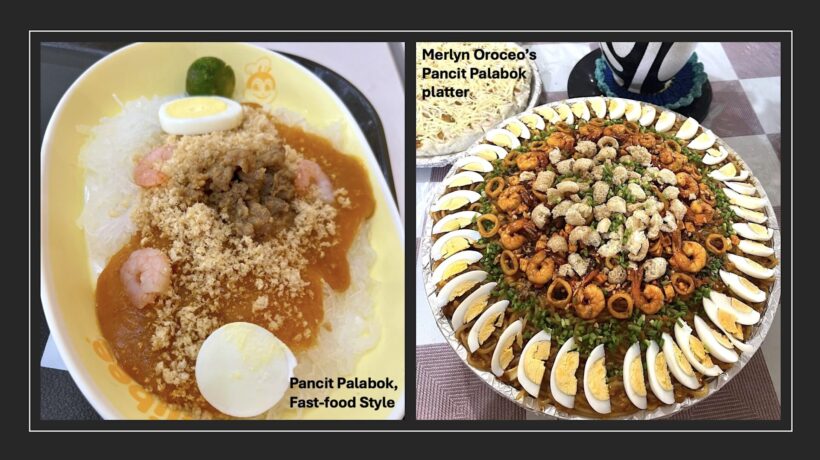
When in need of a quick fix but prefer not to indulge in pork-heavy dishes in Manila, I order “Pancit Palabok.” The Filipino fast-food chain, Jollibee, serves it alongside fried chicken, burgers, and Filipino spaghetti. Perhaps the best example of naturalized Chinese food, “Pancit Palabok” is quintessentially Filipino.
The classic “Palabok” recipe uses blanched bihon noodles topped or mixed with umami rich sauce. Orange in color from “Achuete” or Annatto seed extract, the sauce flavor comes from sautéing aromatics, ground pork, and shrimps. Juices squeezed out of shrimp heads and shells power up its seafood savor. And a slurry of rice flour or cornstarch thickens it to a gravy-like consistency. Shredded “Tinapa” or smoked fish punches in more umami. Extra toppings of hard-boiled eggs, Chicharrón or pork rind, and green onions add depth and texture. As with other pancit, “Palabok” is served with Calamansi citrus slices for brightness.
The qualifier “Palabok”, when used colloquially, means “embellishment.” And the sister recipe, “Pancit Malabon,” packs even more garnishes — squid, mussels, and oysters. Its sauce’s robust flavors derive from crab fat, fish sauce, and seafood broth. It is said that the two dishes originated from Malabon, an old fishing hamlet north of Manila, the capital. Named for the silted delta of the Tullahan river, Malabon, before urbanization, had access to a rich array of ingredients from fresh, brackish, and Manila Bay waters.
Cultural Exchange
After living in Manila for decades, friend Merlyn Oroceo returned to her hometown in Iloilo, Panay Island. Just before the global pandemic, she discovered that not many town folks were familiar with “Pancit Palabok.” They have seen it on menus of national fast-food chains like Jollibee and “Mang Inasal.” But they did not know what to make of it. So, they asked her to cook them some. Putting her own spin, she combined the accessibility of shrimp-pork “Palabok” with the seafood complexity of “Malabon.”
Now, Oroceo fills orders from municipal government and school employees. She gets the thicker rice noodles for “Pancit Malabon” shipped to Iloilo from Manila. She adjusts the sauce seasoning to local tastes, adding a secret ingredient for creaminess. She takes advantage of the freshest fish and seafood available to her in the coastal town of Banate. She even smokes her own “Tinapa” from “Galunggong” mackerel scad.
It is tempting to assume that rice flour noodles came before those made with wheat flour. After all, rice cultivation around the Yangtze River in Central China began 8,000 BCE, or 10,000 years ago. But Foxtail millet (Setaria italica) and Broomcorn millet (Panicum miliaceum), domesticated around 6,700 BCE in northern China, may have been the source of flour for noodle making there, where it originated.
Many benefits accrue from humans turning grain into flour, and flour into the dough we cut into strips — the noodles we eat. We can portion, store, and cook them in many ways. Likewise, humanity gains from migration, trade, cultural exchange, transfer of technology, and mutual sharing of culinary traditions. Rice noodles or not, let’s hope they continue.



