

I ran the words through my mind as I taught the class. The polite Japanese translation of “today is my last day, I quit” scrolled across my forehead like a TV news ticker. The words streamed as fast as I flipped through the flash cards of English vocabulary. Tutoring a family of five children along with their mother, and occasionally the father, simply became too difficult.
A week earlier, every child gave me a serious attitude. Except for the youngest, all four of her siblings, especially the eldest at 14, acted up for no apparent reason. Little did I know they had just received news that the three-year-old would be returned to her biological parents who wanted her back.
Usually cheerful and participative in my “English Conversation” class, the toddler this time held on to mom, quietly crying. Because all five children looked different and had personalities as unique as their psychological states, I somehow knew they were fostered by my employer, their adoptive mom. But I did not know how emotional they got over the news of the youngest leaving. They apparently bickered before I arrived. So, I could not engage any of them in the lesson or the games we usually played. Exasperated, I asked them instead to talk about their dreams.
The next week, which I thought was my last, their mom had read my mind. She knew I wanted out. She invited me to stay over for special snacks after class to show me appreciation. She said she had freshly dug sweet potatoes cooking away in the kitchen. I figured that would be the time to say goodbye. But she handed me an envelope before she even served me food. She gave me a raise and scheduled the next meeting. I stayed.
Months later, with the youngest gone and the remaining four better behaved, she gave me a copy of the winning essay she wrote about her “Chimera Family.” In it, she relayed the afternoon I asked the kids their aspirations. And how they all said they hoped to meet their biological parents someday. Only then did I realize that they longed for someone to come get them. Not because they were unhappy, but that they needed to feel wanted.
Food, the Love Language
I have forgotten the provenance of the sweet potato she proudly announced to me that day. But I remember how naturally sweet and dense they were. She had lovingly cut them into thick pucks of uniform size. She even made some jam. The mom, conscious of heart-health and food allergies, limited the kids’ consumption of meat. She had stopped using the microwave. She cooked everything from scratch and grew vegetables herself.
But food was not her only love language. She joined her kids in my English class because she wanted them to feel like equals, even for an hour on the floor around the “kotatsu” low table.
Also, back in the ‘90s, I tutored the teacher-owner of a “Juku” located on the outskirts of Fukuoka City. A “Juku” is a fee-based private “cram” school that adds to academic instructions after hours. Her “Juku” was on the third floor of her Western-style house. There, we practiced conversational English, one-on-one, before her students arrived. She wanted to be a better English Teacher for her students, she said.
On holidays, she would ask me to come as a guest English teacher to her 30 or so students of all ages. I explained “Trick or Treating” on Halloween, then led them on a parade around the block. I later chose the winner for the best costume. I had fun.
To show gratitude by the end of the school or calendar year, my employer treated me to dinner. Her husband came along and ordered the fanciest item on the menu. I remember the crab sashimi I hesitated eating at first. I knew from what my mother told me not to eat crabs unless they were cooked, alive. But I certainly saw them swimming in the tank as we came in. So, I ate them anyway.
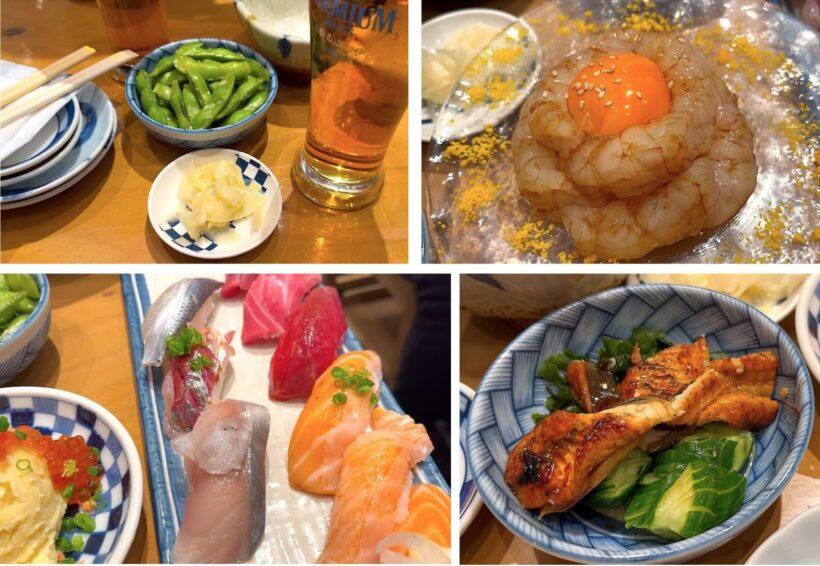
The sweet raw crab meat had zero fishiness or seafood aroma. I may have used soy sauce and wasabi for dipping, but the creamy-rich taste hinted of “Uni” (sea urchin). So, no embellishments were necessary. Those “Otsukaresama deshita,” or “Thank You for your hard work,” dinners came to an end. But the memory of her genuine concern for students and the kids’ eager faces have lingered.
“Otsukaresama deshita” from Police Officers
Aside from English, I and other teachers taught basic Filipino grammar to batches of police officers. They came from all over Japan to Fukuoka. For three months, they learned Filipino like it was their job. They volunteered or were handpicked to learn a language relevant to their locale.
By 1998, the population of Filipinos, many on Entertainment Visas, peaked at 245,518. Entertainers came even before Japan’s economic boom of the ‘50s. But by the 1970s through the 1990s, the number ballooned. Many Filipino musicians and bar girls worked Japan’s nightlife. Not only were police officers learning the Filipino language for effective law enforcement, but they also genuinely cared to protect them.
Enjoying those classes made it hard to say goodbye. Graduating batches often threw a “Sayonara,” or Farewell party. To show appreciation, they invited us teachers to join them. And because public beaches in Fukuoka were easily accessible, we always had “Yaki-niku” parties.
“Yaki-niku” means “grilled meat,” but it also refers to Japanese-style barbecue of thinly sliced meat. Tradition rarely allows diners to touch food with bare hands in Japan. And using chopsticks means more than just maintaining hygiene when taking food from a communal source. Influenced by Buddhism, Japanese etiquette reflects respect and consideration for others, as well as gratitude for the food that nature and human labor provide. So, to make food easy to eat with chopsticks, ingredients are always cut into bite-size pieces prior to cooking.
For “yaki-niku,” raw, unmarinated beef and sliced vegetables are served for grilling. Diners pick the cuts to flash grill on a table-top griddle or a “hibachi,” the Japanese portable charcoal grill. They then dip the seared, but still rare beef in a variety of sweet or soy-savory sauces. Everyone customizes each bite according to preference.
The police officers brought everything — the grill and griddle, the charcoal and liner for the ground, mats, meats, vegetables, sauces, and beverages. After setting up, everybody gathered around the grill and helped themselves to grilling.
Festivities officially began with “Kampai,” the word for “cheers,” in a toast led by the most senior. Together, everybody said it in unison while raising their glasses. Before eating, each individually uttered, “Itadakimasu,” for “I humbly receive this gift.” And after the meal they said, “Gochisousama deshita,” for “Thank you for the feast.” Sayonara parties, like all events ended on schedule — after everybody cleaned up.
“Nomikai” and “Nijikai”
An alternative to barbecue is “nomikai” or the after-hours drinking party. For a member of an office unit, university laboratory group, or the graduating class, attendance is mandatory. Nomikai facilitates team building. Missing a nomikai carries consequences. In Fukuoka, nomikai food centered around the “Motsu Nabe” hotpot of internal organs, “Chanko Nabe,” the hotpot for sumo wrestlers, or “Sukiyaki,” premium beef slices braised tabletop in sweet soy sauce.
Whenever I could not attend the officers’ nomikai, I caught up with them at the “nijikai,” or after-party. “Nijikai” implied going to a second place after eating and drinking at another. Hogging limited seats at cramp Japanese eateries was deemed rude and inconsiderate of those waiting to be served. All parties moved to a “second” place, which also meant a third or fourth.
By the time I joined them, alcohol had worked its magic. Mugs of Asahi, Kirin, Sapporo, or Suntory beer had momentarily disarmed strict codes of rank. Nijikai places in Fukuoka were tiny Karaoke or “Snack” bars presided over by a “Mama San” directing her stable of beautiful entertainers to keep everybody drinking and the atmosphere jolly.
They served “otsumami,” or bar food like “Edamame” young soybeans, “Senbei” rice crackers, or “Karaage” fried chicken. Otsumami went well with “Sake” rice wine, the liquor of choice, or “Sochu” wine from sweet potato. The “Sochu,” popular in Fukuoka, came from nearby Kagoshima, where they grew delicious sweet potatoes.
The time for goodbye arrived with the bill that everyone had to split equally. After countless nomikai and nijikai, I bid farewell in 1999. But no goodbye is ever final. I came back to visit in 2023. No, I did not find any of my students. And a lot has changed in the Fukuoka food scene. Still, I remained grateful for having experienced Japan and the kindness of humanity there.
About the Author:

George Banez is a writer of Filipino descent and is a retired non-profit professional living in Florida.



