

The Canary Islands are known worldwide for their sunny beaches, volcanic landscapes, and pleasant climate. But beneath the beauty and tourism lies a deeper, often forgotten truth. These islands were once home to an ancient people with strong roots in North Africa, the Amazigh, also known as Berbers. Long before the Spanish conquest, the Canary Islands were not empty or undiscovered; they were inhabited by indigenous Amazigh societies that developed their own unique ways of life while preserving ties to the cultures of the North Africa (Tamazgha). Their story, buried beneath centuries of colonization, remains one of the most overlooked chapters in Mediterranean history.
The Amazigh, often referred to by outsiders as Berbers, are the indigenous people of North Africa, with a cultural and linguistic presence stretching back over thousands of years. They have inhabited regions from Morocco to Egypt, across the Atlas Mountains, the Sahara Desert, and beyond. The word “Amazigh” means “free people” or “noble people” in their own language, Tamazight. Though often ignored in mainstream history, the Amazigh have maintained their identity, language, and traditions through waves of colonization, from ancient empires to Arab-Islamic dynasties to modern European powers. Today, millions of Amazigh people live throughout North Africa and in diaspora communities across Europe, continuing to fight for recognition, cultural rights, and the preservation of their language.
The Amazigh presence in the Canary Islands is one of the most remarkable examples of how far their culture reached and how long it endured. Around 3,000 years ago, groups of Amazigh people crossed the sea from North Africa and settled on the islands. Archaeological findings, such as cave dwellings, burial sites, and rock inscriptions, show clear connections to Amazigh cultures on the mainland. DNA evidence confirms this link as well, revealing that modern Canarians still carry strong maternal Amazigh ancestry.
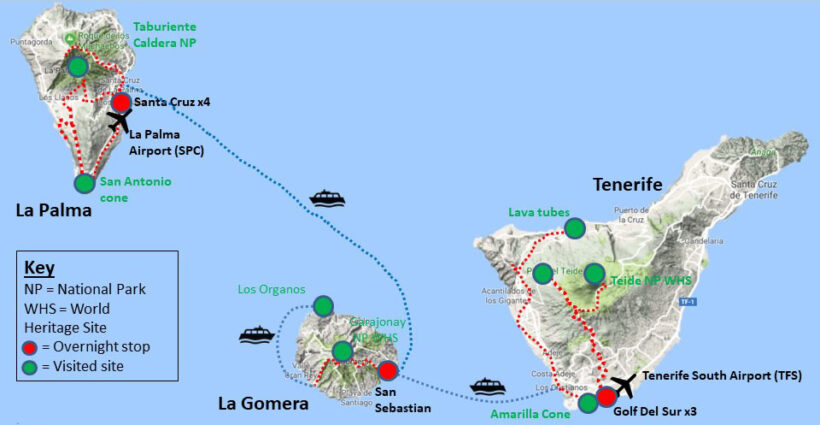
Each island had its own community, with its own name and customs. The people of Tenerife were known as the Guanches, perhaps the most well-documented group. Gran Canaria was home to the Canarii, a society known for their warriors and structured leadership. La Palma housed the Benahoaritas; La Gomera, the Gomeros; and Fuerteventura and Lanzarote were populated by the Majos or Mahos. Though these communities lived in isolation from each other, they shared key cultural elements: a pastoral lifestyle centered on goat herding, a deep spiritual relationship with the land, and oral traditions that preserved history across generations.
The people of the islands worshiped the natural world: the sun, moon, stars, and mountains. Mount Teide, the towering volcano of Tenerife, was seen as a sacred place. In La Gomera, people developed a whistling language called Silbo Gomero, used to communicate across the deep valleys of the island, a cultural innovation found nowhere else in the world. Some groups practiced mummification, carefully preserving the bodies of their dead, in a tradition also seen among ancient Amazigh peoples in Libya.
In the 15th century, the Spanish Crown launched a brutal conquest of the Canary Islands. Over the course of nearly a century, the islands were taken one by one through warfare, enslavement, and forced religious conversion. By 1496, the conquest was complete. Indigenous languages were banned. Traditional beliefs were suppressed. Much of the population was killed, displaced, or absorbed into the colonial society. But resistance was fierce. Leaders like Bencomo of Tenerife, Tanausú of La Palma, and Doramas of Gran Canaria stood against the invasion, their stories remembered today as symbols of strength, dignity, and resistance.
Even after colonization, the Amazigh legacy was not entirely erased. Many rural Canarian families still carry the DNA of the island’s first peoples. Place names across the islands preserve their original roots. The whistling language of La Gomera has survived and is now taught in schools and protected by UNESCO. Some traditional festivals, stories, and healing practices bear echoes of the ancient Amazigh worldview. And in recent years, a new generation of Canarians and North Africans have begun to rediscover and reclaim this shared heritage.
The Canary Islands were not born with the arrival of European ships. They were already home to a civilization, one connected to Africa, to the land, and to the stars. That civilization was Amazigh. Their culture may have been silenced, but it was never extinguished. It survives in the landscapes of the islands, in the hearts of their descendants, and in the memory of a people who still call themselves “free.” The story of the Amazigh in the Canary Islands deserves to be heard, not as a footnote in colonial history, but as a proud and living legacy that still shapes the islands today.