

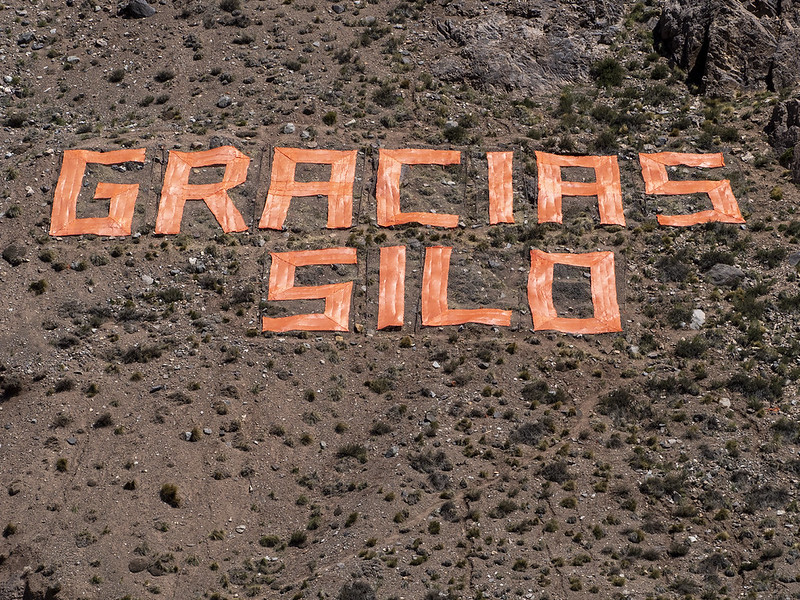
There may be no “ism” more relevant to the present moment than Siloism. At a time marked by deepening global conflict and existential uncertainty, Siloism offers not only a direction for personal life but also a perspective for social transformation and the future of humanity. What appears as crisis could also be an opening—a chance to move in a different direction, away from violence and destruction.
“Remember, even as you gaze at that suffering face, that it is necessary to move forward, and it is necessary to learn to laugh, and it is necessary to learn to love.” — Silo
On May 4, 1969, in Punta de Vacas, Mendoza, Argentina, Silo delivered his first public address, The Healing of Suffering. Under a military dictatorship that had banned public gatherings in cities, people traveled to this remote location in the Andes to hear him speak.
Silo (1938–2010), born Mario Rodríguez Cobos, was an Argentine thinker, writer, and founder of a current of thought known as Siloism or Universalist Humanism. His work centers on overcoming suffering through inner transformation, nonviolence, and the development of human consciousness, while also promoting social change rooted in freedom and meaning.
More than five decades later, his words resonate with renewed urgency. This passage from that first talk could easily describe our present situation:
“Only inner faith and inner meditation can end the violence in you, in others, and in the world around you. All the other doors are false… This world is on the verge of exploding… There are no politics that can solve this mad urge for violence…”
Silo saw clearly the depth of the crisis we now face. Yet if he were alive today, he might also be intrigued—even energized—by the ongoing breakdown of old systems. He predicted the “collapse” of the Western world, but saw it as a moment of instability that cold awaken attention and open new possibilities.
He himself embodied this dynamic approach. A master organizer, he created and evolved diverse forms of collective action: neighborhood groups, publications, and political parties under the banner of the Humanist Movement, and later more fluid spiritual communities centered around Silo’s Message. At the same time, he guided the development of over 50 Parks of Study and Reflection across five continents—spaces dedicated to personal and social transformation.
Silo paid close attention to human energy—its direction, intensity, and meaning. When he spoke about elections, for example, he wasn’t focused on political outcomes alone, but on the quality of the act: whether it was done mechanically or with conscious intention. For him, the difference mattered deeply.
Much of his work explores how to connect with and develop this inner energy—how to direct it toward higher or deeper states of consciousness. Our experience of life depends greatly on this. When we are inspired or in love, we feel expansive, creative, and capable. When we fall out of love, that energy fades and the world can appear closed and heavy. From a Siloist perspective, our reality is shaped by the images and energy that move us.“Love the reality you build,” he wrote.
Silo’s humanism and nonviolence are not abstract ideas; they are meant to be lived. Today Siloism has many faces. The World Humanist Forum coordinates actions across Asia, Africa, South America, and Europe. Pressenza, an international press agency, publishes news and opinion daily in 12 languages. Humanist political parties, Europe for Peace, the World Center for Humanist Studies, and World without Wars and Violence all carry this work forward globally — alongside countless local initiatives and grassroots gatherings, as well as numerous studies and monographs on a variety of themes that continue to be developed at the Parks of Study and Reflection.
Today, many believe that money and technology will solve our problems. Politicians, NGOs, corporations, and ordinary people alike spend the majority of their time seeking or making money — yet the more we rely exclusively on these, the deeper the crisis seems to grow, bringing greater instability, inequality, and violence.
It remains difficult for many to imagine another path, one that gives life a different meaning and direction.
Silo emphasized that true transformation cannot be bought. Everything developed within this movement — from its ideas to its structures — has been built on voluntary participation and free will. He understood not only the personal attachment to money and power, but also how these dynamics operate at social and global levels. He distinguished between pain — which is physical and can be reduced through scientific and social progress — and suffering, which is mental. Suffering cannot be resolved through external means alone — drugs, distractions, or consumption — but require meaning, coherence, and direction in one’s life.
At the core of his vision is a simple but profound truth: human beings are inherently social. We are constantly shaped by our environment, just as we shape it in return. This dynamic relationship carries both responsibility and possibility.
Yet today, fragmentation makes it hard to perceive this interconnectedness. Most people focus on isolated problems without seeing the larger picture — or recognizing that millions share similar struggles. Silo sought the universal in human experience: what all people, across cultures and times, can recognize within themselves.
The strength — and the challenge — of Siloism is that it is a comprehensive proposal. It is at once a philosophy, a way of life, a path of personal development, a commitment to social change, and a spiritual search that transcends individual existence.
Fifty-six years after that first gathering in the Andes, the question Silo posed remains open — and more urgent than ever.



