

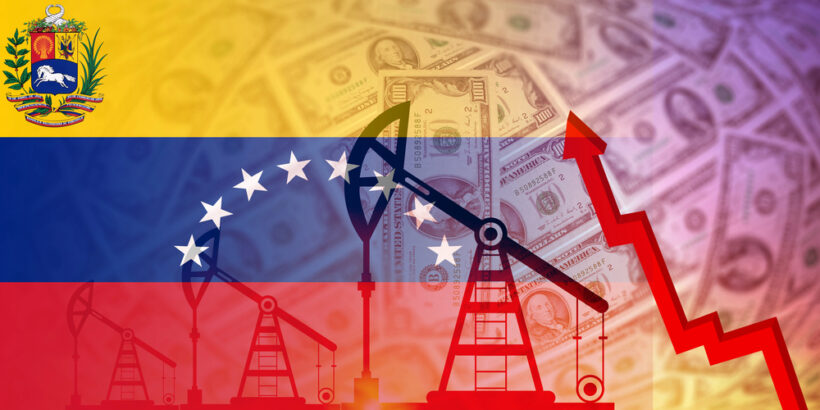
“The oil may belong to a country.”
“But power begins where that oil can be authorized, validated, and converted into system.”
Venezuela is not an isolated case nor a regional anomaly, but a point of convergence where the United States exerts structural influence over the country’s ability to transform its oil into economic value. The resource lies within Venezuelan territory, production occurs within its borders, and the infrastructure formally belongs to the State, but the possibility of converting that oil into revenue depends on an architecture where the United States controls access to markets, financing, and the legality of transactions. Formal sovereignty exists, but operational sovereignty is conditioned by a system where final validation does not reside in Caracas.
The value of Venezuelan oil is no longer determined solely at the wells, nor at PDVSA, nor in Caracas. It is determined in the license, in the banking route, in the insurer, in the shipping company, in the authorized refinery, and in the OFAC permit issued by the United States. Part of the value remains in Venezuela as production, employment, operations, and indirect income; part is captured by authorized companies, creditors, intermediaries, traders, transportation, refining, and debt; and a decisive portion remains under the political control of the United States, not necessarily because it physically receives all the money, but because it decides who can convert that oil into dollars, contracts, and market access within the global system.
The United States does not require direct territorial control over Venezuelan oil to define its economic destiny. Controlling the license is sufficient. The oil may be extracted in Venezuela and exported from its ports, but its international value depends on authorization issued outside the country.
This extends into the financial architecture. Revenues do not circulate freely. They are channeled through supervised accounts and released under specific conditions, within a system where the United States retains the capacity to authorize, delay, or restrict access to funds.
That is where real power resides: not in ownership of the resource, but in controlling whether it can be converted into money, contracts, and influence within the global system.
The financial system linked to Venezuelan oil is structurally intervened by the United States. PDVSA must channel revenues through externally controlled accounts before being able to use them within the country, turning every transaction into a conditioned process. The United States can even retain control over those revenues, and official statements have indicated that it maintains the capacity to manage those funds until a government deemed representative is established.
The United States does not act on Venezuela solely as a political or economic problem, but as a strategic node within a broader competition in which China appears as a determining variable. Venezuela represents oil, debt, ports, infrastructure, telecommunications, and geographic access to the Caribbean, elements that make it a potential platform for power projection. If China were to consolidate a structural presence in that environment, the United States would lose strategic depth in its own hemisphere, which explains the intensity and persistence of its intervention at multiple levels.
In this context, China has operated under a different logic, based on financing, energy agreements, and infrastructure development, but its capacity for expansion has been conditioned by the regulatory environment in which the United States maintains control over global access mechanisms. China can participate, invest, or purchase, but it does so within a system where the final validation of many transactions still depends on rules defined by the United States.
The current architecture demonstrates that the United States does not need to physically control Venezuelan oil to exert power over it. It controls the system that determines its value, its circulation, and its conversion into revenue. This redefines the classical notion of energy sovereignty and shifts the axis of power from territory to financial, regulatory, and commercial networks.
Venezuela has not lost its oil in physical terms, but it has seen its ability to decide over the value that resource generates limited. The combination of sanctions, financial control, regulatory authorizations, and capacity for intervention has configured a system where national room for maneuver is conditioned by external decisions. The United States acts as the regulator of access to the global market, while China adapts to that framework seeking participation without directly challenging the existing architecture.
The result is an unstable balance in which Venezuela remains relevant due to its energy capacity, but does not fully control the conditions under which that potential is transformed into economic power. The United States maintains the ability to regulate the system, China operates within it, and Venezuela stands at the point where both interests converge. It is not a scenario of absolute control, but one of asymmetric structural influence that defines the functioning of the Venezuelan energy sector.
This return does not represent a free-market reopening, but a regulated reentry conditioned by U.S. authorization, where each company operates under licenses that define the scope, scale, and limits of its activity.
In geopolitical terms, Venezuela has become a laboratory where the evolution of international power in the 21st century can be observed. It is no longer about controlling territories, but about controlling the systems that allow resources to be converted into value. The United States represents this model of systemic control, while China attempts to expand within it without breaking it. Venezuela, in the midst of this dynamic, shows that modern sovereignty is not necessarily lost through occupation, but through forced integration into structures designed by others.
The conclusion is direct and unambiguous: power over Venezuelan oil is not defined in the wells nor in local institutions, but in the international architecture that determines its value. The United States controls that architecture, China partially challenges it, and Venezuela operates within it with limited margins. In this system, to dominate does not mean to possess the resource, but to control the conditions that allow it to be converted into wealth. And at that point, control remains outside Venezuela.
Venezuela is not an exceptional case: it is a warning. It clearly shows that in the current international system, natural wealth no longer guarantees sovereignty, and that control of resources has been replaced by control of the systems that give them value. The United States does not need to directly manage Venezuelan oil to exert power over it. It is enough to define the conditions under which that oil can be sold, financed, transported, and transformed into real income.
China appears as a balancing variable, but not yet as a force capable of fully reconfiguring the system. Meanwhile, the United States continues to occupy the point where the resource becomes power: authorization. That is the core of the conflict, and alto its limit. Because in a system where control depends on external structures, stability is not permanent. It is managed.
Guyana appears to have moved beyond the burden of the Essequibo, under the protection of international law and the emerging energy order. But that freedom is conditional. Its waters host not only Western companies, but also Chinese interests within the same system that sustains it. The conflict has not disappeared. It has been rebalanced.
HARD DATA — OIL AND GEOPOLITICS OF VENEZUELA
Venezuela holds the world’s largest oil reserves (303 billion barrels), yet production collapsed from ~3.2 million bpd (1998) to roughly 0.9–1.1 million bpd in 2025–2026. This translates into annual oil revenues of around USD 18 billion, a fraction of its historical capacity. Oil still accounts for over 90% of exports, confirming extreme structural dependence on a single resource
Under sanctions, revenues are partially controlled, delayed or redirected through licensed channels, limiting direct state Access. Global oil trade remains anchored in the U.S. dollar (~80% of transactions), reinforcing external control over flows and payments
Companies such as Chevron, Repsol, and Eni operate under specific authorizations, while global oil trade continues to function within a system dominated by the U.S. dollar, which represents roughly 80% of global energy transactions
China and the broader BRICS framework represent a latent strategic alternative in Venezuela: a pathway to financing, oil commercialization, and partial de-dollarization. With over USD 60–70 billion historically committed, Venezuela remains embedded in Beijing’s energy strategy, with oil flows that still link both economies
However, this potential depends on something more structural. It requires China and the BRICS bloc to develop autonomous financial, logistical, and commercial mechanisms capable of operating beyond U.S.-regulated systems.
China does not confront the system directly.
It expands within it, accumulating position without triggering rupture.
The future of Venezuela will not be defined solely by its internal politics nor by its productive capacity. It will be defined by its position within this global architecture of power. And that architecture, for now, still has a clear center.
“Not in Caracas. Not in the wells.”
“But in the place where oil ceases to be matter… and becomes system.”
“And today, in the grammar of Venezuelan oil, validation carries an American accent…”
BIBLIOGRAPHY
- Daniel Yergin – The New Map: Energy, Climate, and the Clash of Nations
- Graham Allison – Destined for War
- Joseph Nye – The Future of Power
- Robert D. Kaplan – The Revenge of Geography
- Barry Buzan – People, States and Fear



