

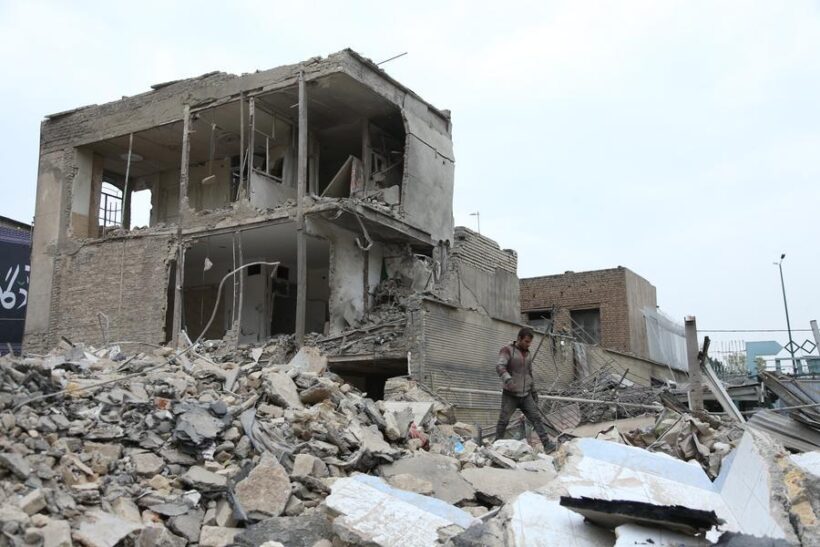
Far from curbing nuclear proliferation, the offensive against Iran and the strategic impunity of armed powers are consolidating a brutal conclusion for the rest of the world: those who do not possess extreme deterrent power are exposed to coercion, punishment and devastation.
No serious non-proliferation policy is possible when the international order punishes the weak and shields the armed. That is the harsh truth laid bare by the current war. What we are witnessing is not a coherent defense of international law nor a universal concern for collective security. What we are witnessing is the obscene display of a global hierarchy in which some States can attack, bomb, invade, kill civilians, possess undeclared arsenals and violate international norms without paying a proportional price, while others are required to show absolute obedience, total transparency and a permanent renunciation of any real deterrent capacity.
The question is no longer whether this war is curbing nuclear proliferation. The far more uncomfortable question is whether it is not, in fact, accelerating it. And the answer, in light of the facts, is becoming increasingly difficult to evade: it is not curbing it. It is reinforcing its logic.
For decades, the official discourse of major powers has repeated a promise as solemn as it is hypocritical: fewer nuclear weapons mean greater security for all. But that promise could only be credible within an international system governed by common rules, reciprocal guarantees and consistent sanctions for all violators. That system simply does not exist. What does exist is something else: a selective, punitive and deeply asymmetrical order, where legality is often invoked against adversaries and relativized when it inconveniences allies.
In that context, the war against Iran does not teach the world that defying non-proliferation has consequences. It teaches something far more dangerous: that not having the bomb can leave a country defenseless in the face of the violence of those who do possess military superiority, political backing and diplomatic cover. That is the real message. That is the geopolitical pedagogy being transmitted in real time.
One does not need to share the Iranian political model nor romanticize any State to understand the central point. It is enough to observe the sequence. Iran signed the Treaty on the Non-Proliferation of Nuclear Weapons. For long periods, it accepted inspections, control systems and verifiable limits. The debate over the degree, continuity and quality of that compliance may be technical and complex, but there is something that admits little dispute: there was a supervisory architecture. There was an institutional framework. There was, at least, a common language of inspection, negotiation and control. Today that framework is damaged, eroded and pierced by war. Opacity has increased. Distrust has surged. The incentive to maintain a strictly contained program has weakened. If the final outcome of military pressure is less visibility, less cooperation and more reasons to seek irreversible deterrence, then the strategy has failed in its own supposed objective.
The logic that emerges is devastating. A country observes that another possesses nuclear weapons outside the treaty, is not subject to the same inspection regime and yet retains strategic impunity. It also observes that powers with a proven record of massive violence against civilians continue to present themselves as legitimate guardians of order. It observes, furthermore, that those who lack a sufficient deterrent shield can be threatened, suffocated, sabotaged or attacked. What rational conclusion does a state apparatus that thinks in terms of survival draw from all this? Not the moral conclusion that official discourses would wish. It draws a much colder one: the bomb does not only serve to destroy; it serves, above all, to prevent you from being destroyed.
That is precisely what makes this historical moment so alarming. Proliferation no longer appears solely as an ideological ambition or a prestige project. It begins to re-emerge as a defensive doctrine. As an insurance policy. As the last argument of sovereignty in a world where the law does not protect evenly. The case of North Korea, so often cited with discomfort, becomes in this sense a brutal warning. One can condemn its regime, denounce its abuses, isolate it diplomatically and sanction it for years. But no one ignores the lesson that other States draw from its mere survival: a nuclear country is feared, contained, encircled, sanctioned; a non-nuclear country can be punished in ways that would be unthinkable in the former case.
The tragedy is that this lesson is not limited to Iran. It is radiating toward other capitals, other military establishments, other national security apparatuses. It is discussed in low voices or in technical language, but it is discussed. If the international system cannot guarantee security to those who renounce the ultimate weapon, then renunciation loses strategic appeal. And when renunciation loses appeal, proliferation ceases to be an anomaly and becomes a temptation.
Here lies the core of the Western contradiction. Non-proliferation is demanded at the same time that it is demonstrated, through facts, that the true guarantee of inviolability remains brute power. International law is invoked while being selectively violated. Stability is spoken of while the incentives that made it possible are destroyed. Trust is demanded while the very mechanism that made it verifiable is bombed. It is a policy that is not only immoral, but stupidly counterproductive.
It is also worth saying something more. The problem is not only that this war may push Iran, or others, to seriously consider the nuclear option. The problem is that it reorders the strategic imagination of the planet. It normalizes the idea that security does not come from legality, multilateralism or control bodies, but from the capacity to inflict intolerable damage. In other words, it destroys the ethical and political foundation of non-proliferation and replaces it with a pedagogy of fear.
That is the deep effect of impunity. It does not only kill bodies, cities and economies. It also corrupts the categories with which the world decides how to protect itself. If rules do not restrain the strong, the weak stop believing in rules. And when that happens, the entire system enters a zone of historical degradation.
That is why the question of whether this war is reinforcing the logic of nuclear proliferation is neither secondary nor academic. It is central. Because it forces us to look beyond the rhetorical theater of chancelleries and ask what the rest of the world is actually learning. And what it is learning is terrifyingly simple: law is not enough, inspections are not enough, commitments are not enough. In a hypocritical international order, the only thing that seems to suffice is the capacity to deter through terror.
That is not a victory for global security. It is its defeat.
The great irony is that those who claim to want to prevent another bomb may be working, with every illegal attack, every double standard and every gesture of impunity, so that more States conclude they need one. Not to use it first. Not necessarily to ever launch it. But to exist without being crushed. And when the bomb begins to be seen not as a tool of conquest but as a last safeguard against the abuse of the powerful, the world does not become safer. It becomes far more fragile.
The current war, then, is not curbing nuclear proliferation. It is reinforcing its logic. It is legitimizing it in the minds of those who observe, with horror and attention, that in this century survival favors not those who comply more, but those who deter more. And that is one of the gravest pieces of news of our time.



