
The Overwhelming Assessment
The reconstruction and renewal of this educational system appear today as an immense challenge, given the scale of the destruction and damage suffered by school and university infrastructures.
For several decades, education has occupied a central place in Palestinian collective consciousness, particularly within the Gaza Strip society. Far beyond a simple school path, it constitutes for many families a fundamental pillar, a bearer of hope, dignity, and social mobility.
In a context marked by displacement, political constraints, and successive crises, education has always been perceived as one of the safest means of building a future. For Palestinians, education represents both an individual emancipation tool, a social ascension lever, and a path to professional integration. Obtaining a diploma, acquiring skills, and developing recognized knowledge remains for many a source of personal and family pride, as well as a value widely recognized beyond borders.
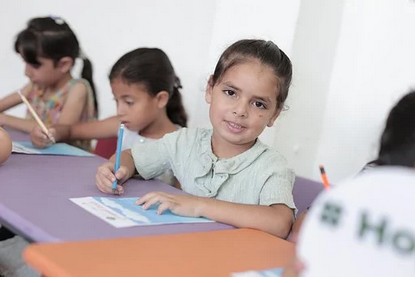
Credit Pixabay: schoolchildren in class; the joy of learning before the war.
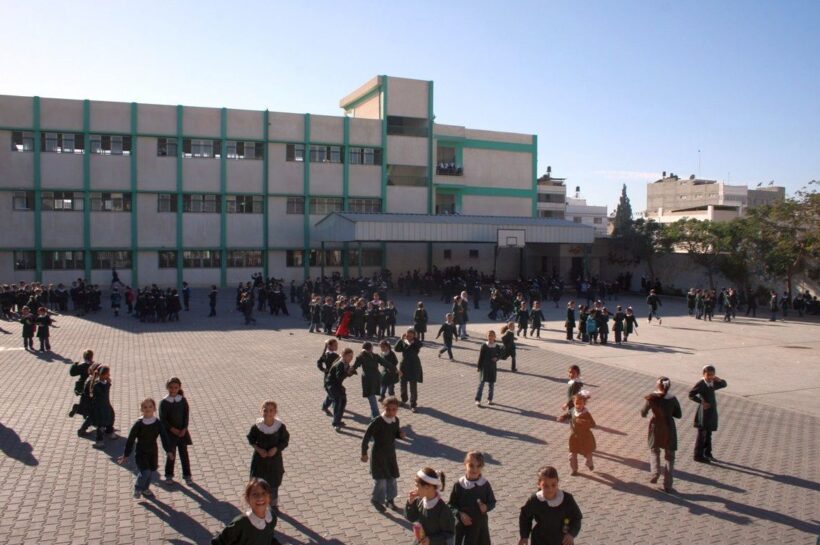 Credit Flick: Shejaeea-Girls-School-Gaza-City.
The figures confirm this deep attachment to education. Despite decades of conflicts and structural constraints, Palestinians have long presented one of the highest literacy rates in the Arab world. According to data published by UNESCO and UNRWA, the literacy rate in the Palestinian territories exceeded 97% during the 1970s and 1980s, testifying to society’s deep attachment to learning and knowledge transmission.
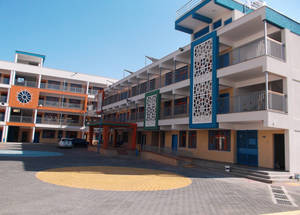
Credit UNRWA.org: UNRWA school before the war – 2021
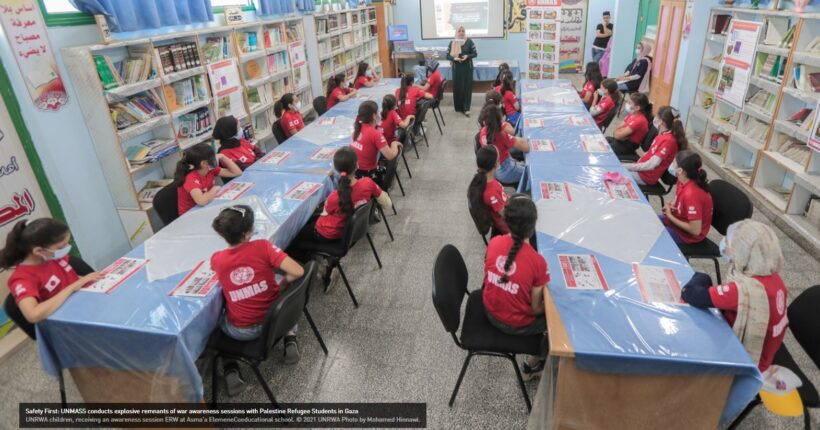 Credit UNRWA: a study class before the war – 2021.
This educational tradition has also, over the decades, translated into a notable presence of Palestinian professionals and teachers. From the 1960s and 1970s in particular, many Palestinian teachers and professors worked in various Arab world education systems, notably in Algeria and several Gulf countries, where their pedagogical skills and academic level were widely appreciated. Many contributed to training generations of students in schools and universities across the region.
Beyond the Arab world, Palestinian graduates have also distinguished themselves in various fields internationally: medicine, engineering, research, journalism, or management—holding academic and professional positions in several Western countries. This presence testifies to the value placed on education as a driver of personal development, but also as an essential resource for Palestinian society.
Thus, for many Palestinians, education goes beyond the academic dimension: it represents a promise of future, an emancipation instrument, and, in many contexts, a form of collective resilience.
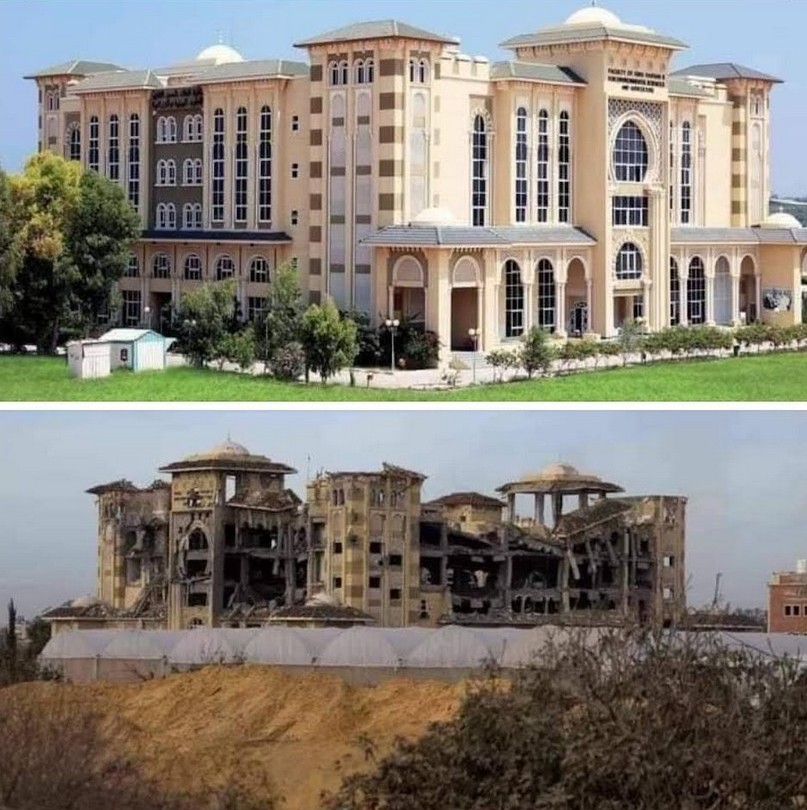
It is in the light of this historical and social reality that the current situation of the educational system in the Gaza Strip should be understood. The reconstruction and renewal of this educational system appear today as an immense challenge, given the scale of the destructions and damage suffered by school and university infrastructures.
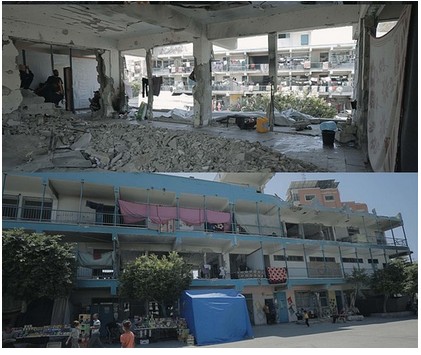
Credit Pixabay: school in ruins after destruction – Gaza
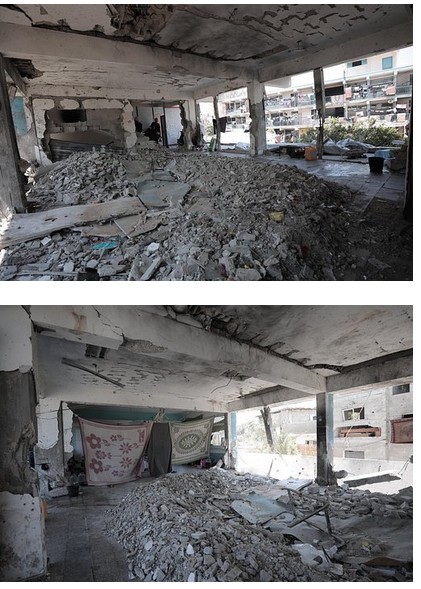
Credit Pixabay: the impact of destruction – Gaza
However, the resilience and determination of Palestinian youth remain remarkable. Despite the trials and extremely difficult conditions, many young people refuse to abandon their will to learn and pursue their education, convinced that knowledge remains one of the essential foundations of their future and a source of dignity and hope for their lives.
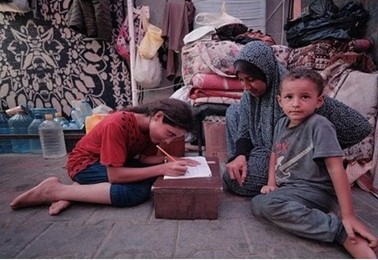
Credit Pixabay: an applied child, conditions matter little.
According to an article published by L’Humanité at the end of 2025, France is called upon to implement a real welcome policy for Palestinian refugees, particularly exiled students, currently blocked by inexplicable restriction policies while their files are complete, and insists on the importance of access to education as a condition of dignity and resilience.
Link: https://www.humanite.fr/en-debat/bande-de-gaza/association-education-avec-gaza-33-nous-demandons-une-vraie-politique-daccueil-des-refugies.
Dr. Bousri Saleh’s Report on Gaza’s Educational System
It provides a rigorous analysis of the educational system’s situation in the Gaza Strip, distinguishing three periods: before the war, collapse, and after the war.
“School, more than knowledge: a shield for survival.”
A Fragile but Resilient Educational System Before the War
Before October 7, 2023, Gaza’s educational system operated under difficult but relatively stable conditions. Despite a context marked by economic precariousness, structural restrictions, and political tensions, it demonstrated remarkable cohesion.
Schools, organized in double shifts to accommodate the high number of students, enabled strong educational participation. Approximately 630,000 students were enrolled, supervised by nearly 45,000 teachers, with a favorable ratio of one teacher per 14 students. Academic performance remained high, with a success rate exceeding 90% in national exams.
However, this apparent stability rested on fragile bases. The system heavily depended on international aid, suffered from chronic under-equipment, and partially damaged infrastructure from previous conflicts. Access to modern educational technologies remained limited.
The report thus highlights a first essential point: even before the war, education in Gaza already relied on a precarious balance between human commitment and lack of resources.
The War: Material Destruction and Human Rupture
The military offensive caused a total disorganization of the educational system. Hundreds of schools were destroyed or severely damaged, and many were transformed into shelters for displaced populations.
The consequences are not only structural. The report insists on the human dimension of the crisis:
- teachers and students directly affected by violence,
- human losses, injuries, massive displacements,
- collapse of living conditions.
More than 50% of educational infrastructure suffered major destructions, and over 740 schools have become unusable. Nearly one million children are deprived of regular access to education.
Beyond the figures, the report highlights a determining element: collective trauma. Children suffer from deep psychological disorders (chronic fear, insomnia), while teachers themselves need support to resume their role.
In this context, school ceases to be a place of learning to become a survival space. This shift is one of the report’s most striking findings.
Immediate Priorities: Restoring Minimal Learning Conditions
In the face of this collapse, the revival of the educational system is organized around four essential priorities.
- Support Students, the First Victims of the Conflict
Children are at the heart of concerns. Having often lost loved ones, their home, or their social environment, they require urgent psychosocial support.
The actions aim to:
- create temporary and secure learning spaces,
- provide basic school materials,
- encourage gradual return to school,
- restore a form of normality.
The report emphasizes here a strong idea: returning to education is also a psychological reconstruction process.
- Rehabilitate Educational Infrastructure
Physical reconstruction is a major challenge. Over 90% of facilities require repairs or material support.
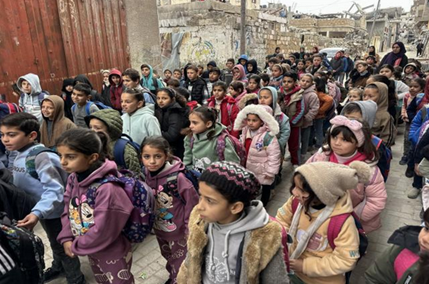
Credit Pixabay: educational urgency at the rendezvous.
In the meantime, learning conditions remain extremely precarious:
- overcrowded classes (sometimes over 90 students),
- teaching under tents or in shelters,
- limited access to water, electricity, and sanitation.
The report underscores that rebuilding schools is an indispensable but not sufficient condition for resuming the educational system.
- Ensure Learning Continuity
Even in crisis, educational continuity is considered essential. Alternative solutions are implemented:
- distance learning (radio, simple digital tools),
- distribution of pedagogical kits,
- teacher training for emergency education.
The goal is clear: avoid a total break in the educational path, whose consequences would be lasting.
- Support Teachers
The report pays particular attention to teachers, described as key actors but deeply affected.
Their support relies on:
- psychological support,
- training adapted to the crisis context,
- burnout prevention measures.
The rapporteur insists on a fundamental point: without teachers able to act, no sustainable educational revival is possible.
A Medium-Term Reconstruction Vision
Beyond urgency, the report proposes a structured revival strategy around several axes.
- Coordinated National Planning
Reconstruction requires close coordination between the Ministry of Education, international organizations, and local actors. The goal is to build a coherent educational system capable of functioning despite instability.
This planning includes:
- curriculum overhaul,
- monitoring mechanisms,
- strengthening educational governance.
- Rebuild and Modernize Infrastructure
The reconstruction of schools, universities, and training centers is presented as a national priority. It must integrate:
- reinforced safety standards,
- durable infrastructure,
- increased technological dimension.
The report mentions the need to rebuild or rehabilitate over 500 facilities, with indispensable international funding.
- Reform Educational Content
Revival is not limited to buildings. It also involves transforming pedagogical content.
Programs must integrate:
- peace and human rights education,
- resilience skills development,
- technical training adapted to local needs.
The goal is to train a generation capable of actively participating in society reconstruction.
- Collective and International Responsibility
The report emphasizes that educational revival rests on shared responsibility:
- local authorities,
- civil society,
- international community.
Financial, technical, and political support from external partners is presented as an indispensable condition.
School as a Space for Protection and Human Reconstruction
One of the report’s major contributions lies in redefining school’s role. It is envisaged not only as a learning place but also as:
- a protection space,
- an emotional reconstruction place,
- a social cohesion vector.
Returning to school depends on essential conditions:
- infrastructure safety,
- access to care,
- psychological support,
- stable environment.
The report particularly insists on recreating social ties through cultural, sports, and community activities.
Fundamental Principles of Recovery
Finally, the report relies on five structuring principles:
- The fundamental right to education, inseparable from the right to life and dignity.
- Preservation of the Palestinian educational system as an identity pillar.
- Investment in infrastructure as a development lever.
- International solidarity, based on moral responsibility.
- Justice and memory, through documentation of violations of the right to education.
These principles translate the rapporteur’s deep intention: make education an instrument of reconstruction, but also social transformation and prevention of future conflicts.
Conclusion
This report highlights a double reality. On one side, massive collapse of the educational system due to war; on the other, persistence of a reconstruction will.
Education in Gaza thus appears as a central issue, both humanitarian, social, and political. More than a simple sector, it constitutes a collective resilience lever and an essential condition for envisioning lasting stability.
In the background, the report reminds that guaranteeing access to education in a conflict context is not only a public policy matter, but a fundamental commitment to future generations.
Dr. Saleh Basri is Under-Secretary of the Palestinian Ministry of Higher Education and Scientific Research of the Palestinian Authority.
To consult the full report, click on this link:
https://drive.google.com/file/d/17l4U1h7k151L1ADVRuGKNL2R-gDBYcYD/view?usp=sharing