

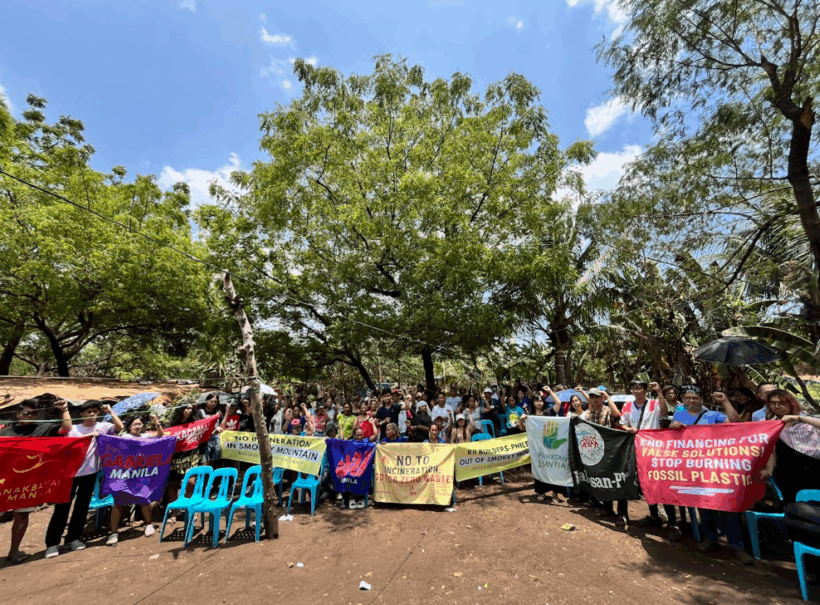
Manila, Philippines — Hundreds of residents, environmental advocates, and urban poor groups gathered in Smokey Mountain, Tondo, as part of Earth Month actions to oppose the proposed waste-to-energy (WTE) incinerator, warning that the project threatens community health, livelihoods, and the right to a clean and safe environment.
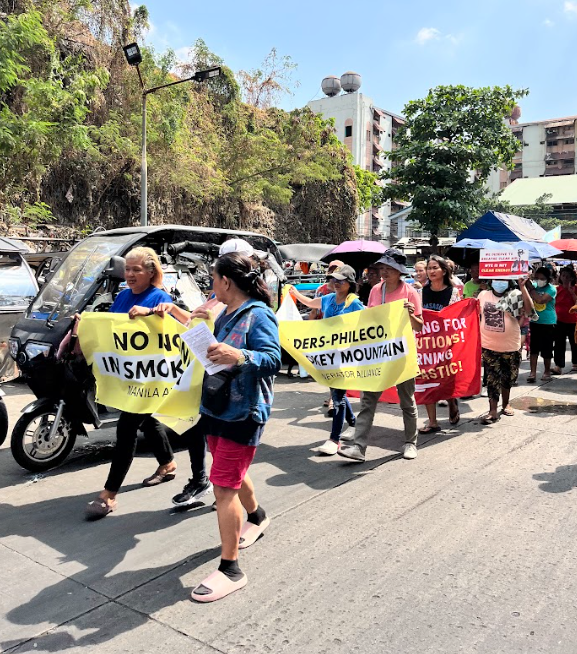
Affected communities and allies raise calls of “No Incineration in Smokey Mountain” and “RII Builders-PHILECO, Out of Smokey Mountain” during a silent protest, opposing the proposed waste-to-energy incinerator. Credit: Global Alliance for Incinerator Alternatives (GAIA) Asia Pacific (April 15, 2026)
The Earth Month mobilization featured a silent protest and a town hall (pulong bayan) in Smokey Mountain against the WTE incinerator, which they described as a false solution to the country’s waste and energy challenges.
Speakers stressed that the WTE incinerator is not an isolated local issue, but part of a wider national and global push by governments and corporations that are unwilling to make transformative shifts to abate climate change, pollution, and extractive economic systems.
Environmental groups warned against relying on band-aid, harmful, and illegal solutions such as WTE incineration, pointing to landfill crises in Cebu, Rizal, and Navotas as evidence of systemic failures in waste management. They stressed the need to hold governments and corporations accountable for failing to implement the Ecological Solid Waste Management Act, particularly its hierarchy of waste reduction, segregation at source, collection, reuse before recycling, and the prohibition of incineration.
They also pointed out that WTE incineration is not only corporations that are selling the technology, but their allies in government agencies, as a renewable energy alternative and a flooding prevention technology.
“Hindi buong matutugunan ang dambuhalang isyu sa enerhiya, klima, at kalikasan, hangga’t patuloy na pinagkakakitaan ang krisis at paghihirap ng ordinaryong mamamayan,” said Mark Dorado of Kalikasan People’s Network for the Environment. (The massive crises in energy, climate, and the environment will not be fully addressed as long as the suffering of ordinary people continues to be exploited for profit.)
Community members underscored that the impacts are immediate and personal, especially with ongoing threats of displacement and loss of livelihood.
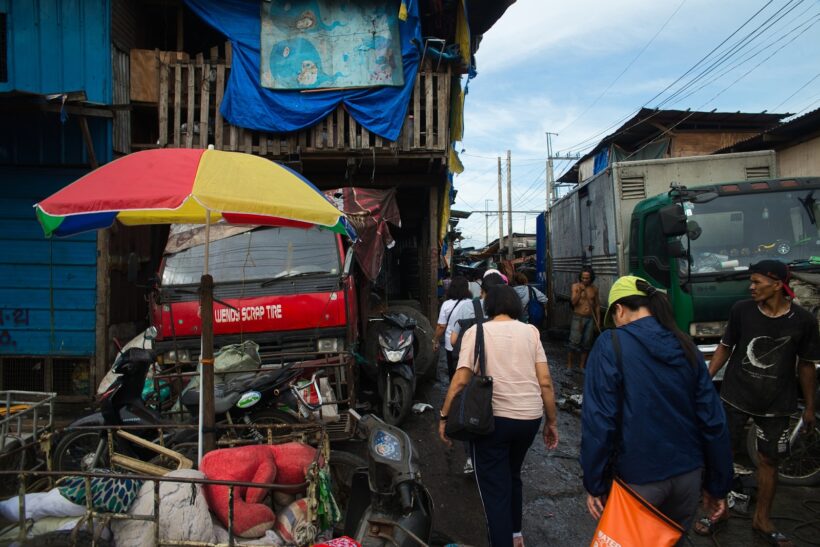
Waste work and recycling remain key sources of livelihood for communities in Smokey Mountain, where residents depend on materials recovery, including scrap-tire collection, to meet daily needs. Credit: Climate Change Network for Community-based Initiatives (Photo taken last November 2025)
“Dapat tayo ang unahin, tayong mga maralita. Sana pakinggan ang panawagan naming itigil ang waste-to-energy at tiyakin ang tirahan, kabuhayan, at kalusugan,” said Mariafe Hulipaz of Sama-Sama sa Maayos na Tahanan at Hanapbuhay (SMTH). (We, the poor, should be prioritized. We hope our call to stop waste-to-energy will be heard and that our rights to housing, livelihood, and health are secured.)
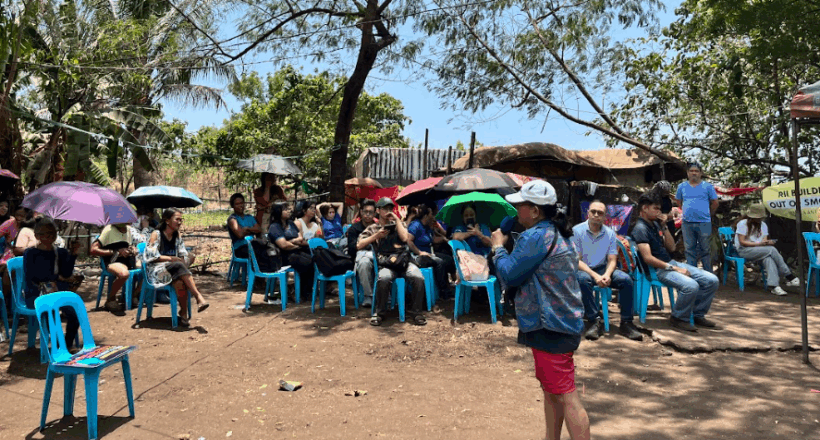
Mariafe Hulipaz of Sama-sama Para sa Maayos na Tahanan at Hanapbuhay (SMTH) speaks before community members and advocates, calling on the government to prioritize housing, livelihoods, and health over projects that threaten displacement. Credit: Global Alliance for Incinerator Alternatives (GAIA) Asia Pacific (April 15, 2026)
Residents also emphasized their determination to remain in their community despite mounting pressures.
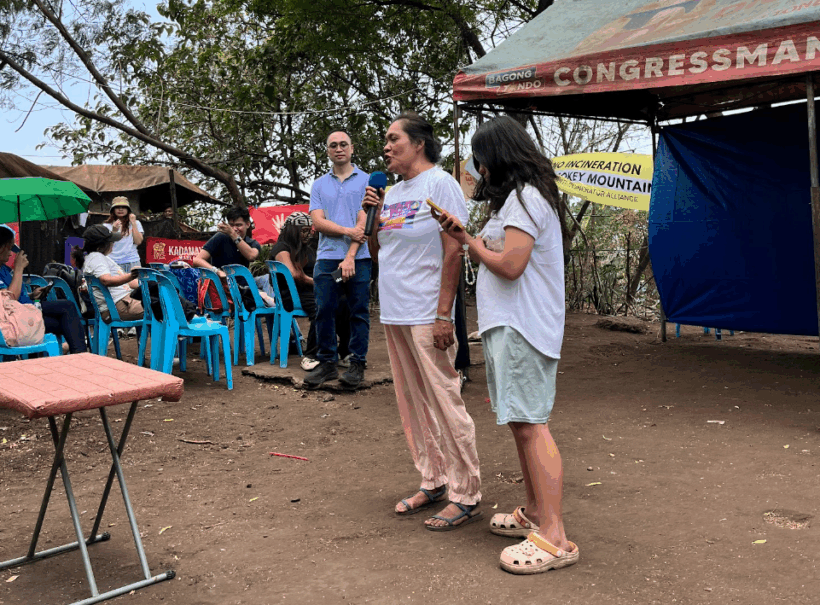
“As is, where is.” Lenie Banting of Samahan ng Magkakapitbahay sa Upper Smokey Mountain (SMUSM) affirms the community’s stand to remain in their homes, asserting their rights to livelihood, security, and a future for their families. Credit: Global Alliance for Incinerator Alternatives (GAIA) Asia Pacific (April 15, 2026)
“Hindi kami papayag na aalis kami dito. Dito kami mananatili. Paano na ang aming kabuhayan at ang kinabukasan ng aming mga anak?” said Lenie Banting of Samahan ng Magkakapitbahay sa Upper Smokey Mountain (SMUSM). (We will not agree to leave this place. We will stay here. What will happen to our livelihoods and to the future of our children?)
Advocates linked these local realities to global patterns where WTE incinerators displace vulnerable communities and delay real climate solutions in favor of big corporations.
“The global crisis and war for dirty oil expose the impacts of our dependence on polluting systems. But solutions should not come at the expense of vulnerable communities already facing economic and climate risks,” said Mela Llamado of Youth Advocates for Climate Action Philippines (YACAP).
Participants called for the immediate halt of the WTE project, an end to displacement and harassment, and the full implementation of zero-waste solutions centered on reduction, reuse, and community-led systems.
In December 2025, House Resolution No. 592 was filed by Kabataan Party-list Representative Renee Louise Co, Gabriela Women’s Party Representative Sarah Jane Elago, and ACT Teachers Party-list Representative Antonio Tinio. The resolution urges the House of Representatives to investigate, in aid of legislation, the anti-democratic demolition of communities in Smokey Mountain and the proposed WtE facility, citing violations of environmental laws and the rights of urban poor residents.
As Earth Month continues, communities in Smokey Mountain emphasized that their call goes beyond rejecting a single project. It is a demand for justice, dignity, and development pathways that protect both people and the planet.
Participants came from urban poor communities and organizations including Samahan ng Magkakapitbahay sa Upper Smokey Mountain (SMUSM), Nagkakaisa at Nagdadamayang Maralita Organization (NANAMOR), Sama-sama Para sa Maayos na Tahanan at Hanapbuhay (SMTH), SMGK, HELPING, BASECO community, Parola community, alongside allies from BAYAN Manila, Anakbayan Manila, Anakbayan UDM, League of Filipino Students UDM (LFS UDM), Tondo Union (TU), Kabataan Kontra Polusyon (KKP), Women in Climate Change Action (WICCA), GAIA Asia Pacific, EcoWaste Coalition, Kalikasan People’s Network for the Environment, Panatang Luntian, Reboot PH, Youth Advocates for Climate Action Philippines (YACAP), and media groups Manila Today and Tudla Productions.
Additional statements from community members and allies:
Macoy Cabangon of BAYAN Manila:
“Dapat bigyang prayoridad ng gobyerno ang libreng paninirahan, healthcare, edukasyon, at iba pang demokratikong karapatan ng mamamayan lalo na ngayong nasa krisis tayo.” (The government must prioritize free housing, healthcare, education, and other democratic rights of the people, especially in times of crisis.)
Jenniclear Gamoc of Anakbayan Manila:
“Ngayon pa lang sa nararanasan natin, nahihirapan na tayo. Paano pa kung matuloy ang waste-to-energy? Ang usok nito ay maaaring magdulot ng sakit.” (Even now, we are already struggling. What more if the waste-to-energy project pushes through? Its emissions could cause illness.)
Alyssa Darunday of Panatang Luntian Coalition:
“Any ‘modernization’ that does not include the community’s welfare is just greenwashing.”
Kweyn Tagaduar of EcoWaste Coalition:
“Ang tunay na makatarungang transisyon ay may pagrespeto sa karapatang pantao at pagprotekta sa kalikasan na siyang nag-uugnay sa ating lahat.” (A truly just transition respects human rights and protects the environment that connects us all.)
Brex Arevalo of GAIA Asia Pacific:
“Ang kasalukuyang krisis sa langis ay nangyayari kasabay ng mas matagal nang mga krisis – ang mga krisis sa kalikasan, komunidad, at korupsyon. Karapat-dapat ba na gumastos nang mahigit P26 bilyon para sa plantang waste-to-energy na magdudulot ng dambuhalang dami ng abo, polusyon sa sa hangin, at polusyon sa Manila Bay? Karapat-dapat ba na magtayo ng planta na konektado sa ilegal na demolisyon at panliligalig ng mga komunidad? Karapat-dapat ba na itayo ang plantang ito habang ibinabalewala ang partisipasyon ng publiko at sangkatutak na pondo ang nawawala sa flood control at imprastruktura?” (The current oil crisis is unfolding alongside long-standing crises in the environment, communities, and governance. Is it justifiable to spend over PHP 26 billion on a waste-to-energy plant that will generate air pollution, toxic ash, and harm Manila Bay? Projects like this should not be imposed on communities that have long endured poverty and systemic crises.)
##########
Press contact:
Robi Kate Miranda, Communications Officer for Campaigns, GAIA Asia Pacific, robi@no-burn.org
The Manila Anti-Incinerator Alliance (MAIA)is a coalition of community organizations and advocates opposing incineration and false solutions, and advancing zero waste, environmental justice, and the rights of urban poor communities.
MAIA’s position is firm, unified, and grounded in community-led resistance. MAIA reiterates its demands:
-
Uphold the national ban on incineration as stated in the Ecological Solid Waste Management Act and Clean Air Act.
-
Immediately stop violent evictions and ensure on-site, in-city housing in Smokey Mountain.
-
End intimidation, fencing, and harassment by private security and barangay personnel.
Click this link for the community petition: https://c.org/NsrxPwFJmG