

By Asif Showkat Kallol (Dhaka Bureau)
A concerning picture has emerged from the discussions surrounding Bangladesh’s upcoming national budget. Small-scale industries and ordinary working-class people fear being crushed between the looming clouds of an impending energy crisis and an ever-increasing burden of taxation.
In pre-budget talks with the National Board of Revenue (NBR), business leaders warned that unless appropriate measures are taken, the Bangladesh economy could face extreme instability in the coming months.
Energy Sovereignty and Risks to Employment
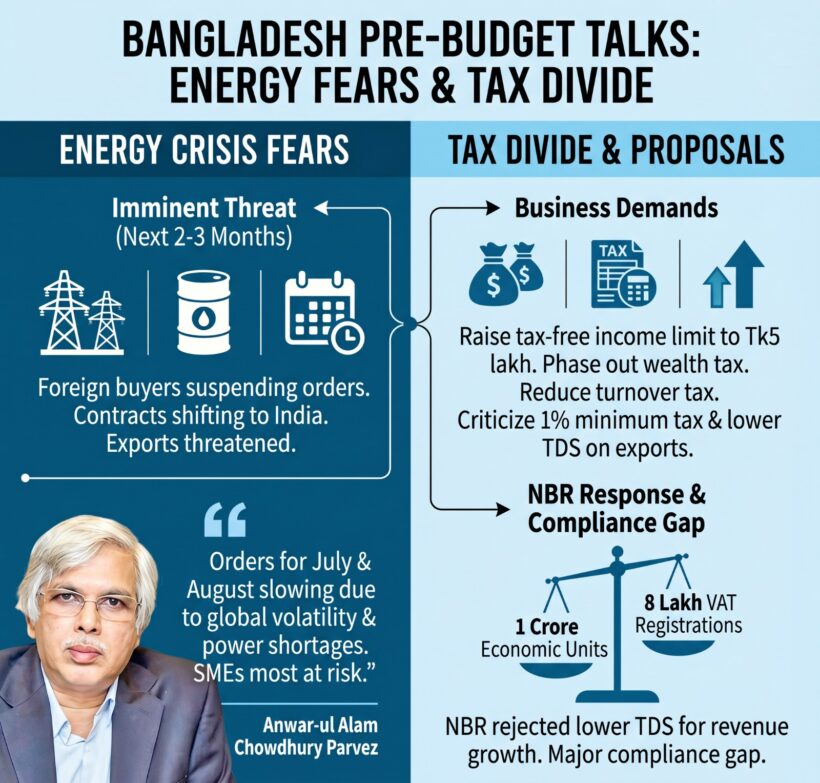
The electricity and energy sectors have been facing severe challenges over the past few months due to global market volatility and domestic management constraints. According to business leaders, the country could face a severe fuel shortage within the next two to three months. The impact is already being felt in the export sector.
Anwar-ul Alam Chowdhury Parvez, President of the Bangladesh Chamber of Industries (BCI), stated that foreign buyers are alarmed by Bangladesh’s energy instability. Many purchase orders have already been suspended and are being shifted to neighboring countries. From the perspective of Pressenza, this is not merely a loss for business but a threat to the job security of millions of workers- a situation that could trigger a massive social crisis.
Inflation and the Tax Burden: The Struggle of the Common Man
While the real income of ordinary citizens has hit rock bottom due to high inflation, the current tax system is placing additional pressure on them. During the discussions, a proposal was made to raise the tax-free income threshold for individuals to Tk 5 lakh. In these inflationary times, keeping cash in the hands of ordinary people is vital for their survival.
Furthermore, the ‘Minimum Tax’ system has become a major hurdle for small and medium enterprises (SMEs). The mandatory 1% tax, regardless of whether a business makes a profit or a loss, has pushed many small businesses to the brink of closure. This is further fueling economic inequality, where large corporations survive while small entrepreneurs perish.
Revenue vs. Social Protection: The Firm Stance of Policymakers
NBR Chairman Abdur Rahman Khan maintained a firm position, emphasizing the necessity of revenue collection for economic development. However, critics argue that instead of widening the tax net, applying pressure on existing taxpayers and rejecting the demand to reduce Tax Deducted at Source (TDS) will ultimately hurt the pockets of the common people.
A Call for a Humanist Economy
Pressenza always advocates for an economy that prioritizes people. The current pre-budget debate in Bangladesh is not just a game of numbers; it is directly linked to the basic right of ordinary people to afford a meal and the struggle for survival of small industries. Unless energy security is ensured and a humane, flexible approach is adopted in the tax system, development will remain confined to paper and fail to reach the lives of the people.
It remains to be seen what steps the government takes in the upcoming budget to mitigate this inequality and ensure energy security.
##########
The Author:
 Asif Showkat Kallol: Works for a German-based online outlet, The Mirror Asia, as Head of News and Contributor, Pressenza- Dhaka Bureau.