

By Masum Parvez Kallol (Dhaka Bureau)
The history of civilization is essentially a struggle between two parallel streams. On one side lies humanity’s eternal aspiration for peace, dignity, and coexistence; on the other is the state machinery’s perennial obsession with power, dominance, and strategic maneuvering. A look back at the long corridor of history reveals that while humanity has repeatedly discovered profound philosophies of compassion, the politics of power have consistently mired those achievements in the quicksand of conflict.
Bridging Ancient Ideals and Modern Rights
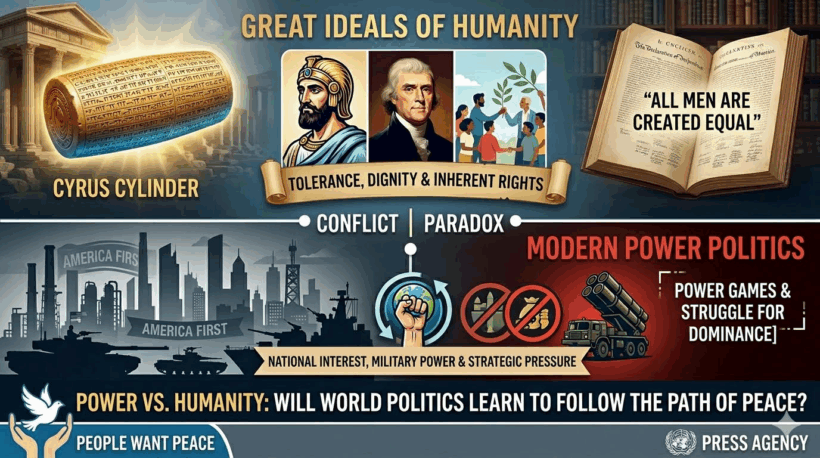
Nearly 2,500 years ago, the Persian Emperor Cyrus the Great introduced a revolutionary system of governance. His famous ‘Cyrus Cylinder’ is still recognized today as the oldest charter of tolerance and respect for diverse beliefs. Even in victory, he chose coexistence over vengeance.
Centuries later, in the modern world, Thomas Jefferson wrote in the Declaration of Independence: “All men are created equal.” Despite the vast temporal gulf between Cyrus and Jefferson, their philosophy remains identical—human dignity is not a gift from the state, but an inherent birthright of every individual.
The Conflict between Power Games and Contemporary Reality
However, the current landscape of global politics tells a story of a starkly different reality. In the policies of global superpowers, strategic priority has often superseded humanitarian concerns. Nationalist ideologies, such as Donald Trump’s ‘America First’ doctrine, have brought the language of power displays, trade wars, and diplomatic pressure back into the mainstream. This is not merely the trait of a single leader but a harsh reflection of the modern state system.
In today’s world, we witness:
- The Arms Race: Billions of dollars spent on weapon competition in the name of “balance of power.”
- Economic Sanctions: Measures that often jeopardize the lives of ordinary citizens.
- Strategic Dominance: A state of affairs where one nation’s security becomes the source of another nation’s fear.
The Success of Non-Violence: Where Ideals are Strength
History has been graced by individuals who proved that strength is not defined by weaponry alone. Mahatma Gandhi, without a single modern weapon, shook the foundations of the British Empire through non-violent resistance. Martin Luther King Jr. chose moral force over the gun in the fight against racial discrimination. Meanwhile, Mario Rodríguez Cobos (Silo) founded the global Humanist Movement, envisioning a non-violent society through a transformation of human consciousness.
These figures did not fail; rather, they succeeded in governance, leadership, and philosophy. They demonstrated that lasting success stems from humanity, not war.
The Unanswered Question
Why then, even today, is there strife instead of peace? Why this aggressive manifestation of competition over cooperation? Perhaps the answer lies in the very nature of power. International politics is often built upon the pillars of fear and uncertainty, where morality frequently bows to strategy.
Facing a Paradox
While technology has brought people closer than ever, politics often creates new divisions. People seek connection, but power structures demand control. Yet, history teaches us a vital lesson: the clamor of weapons eventually fades, but great ideas never perish. The humanity of Cyrus and the rights-based vision of Jefferson live on in the collective human spirit.
The future is not built solely on muscle power or military tactics. It is determined by the values that humanity chooses to protect in the end. Ordinary people do not want war; they seek progress through education, technology, and innovation.
The ultimate question remains: Will politics learn to follow this path of peace desired by the common people, or will humanity remain a prisoner within the ancient cycle of power? The answer rests upon our collective awareness and our courage to stand for humanity.
The Author:
 Masum Parvez Kallol: Humanitarian & Youth Development Activist. Contributor, Pressenza- Dhaka Bureau