

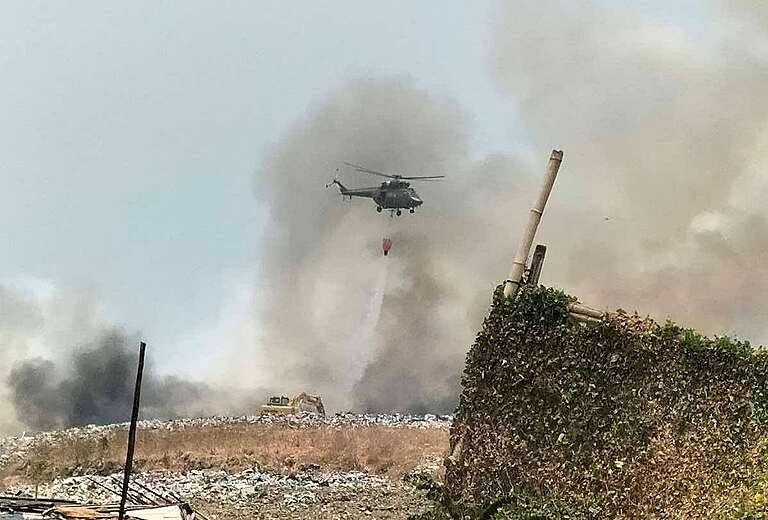
April 22, 2026. Quezon City. On Earth Day, member groups of the EcoWaste Coalition pushed for accountability over the Navotas landfill fire, which continues to emit hazardous smoke, posing serious health risks to families and communities. The groups reiterated the urgency to address the waste crisis at source by prioritizing policies, programs, and projects that prevent and reduce the production of trash, and not through costly end-of-pipe landfills or waste-to-energy incinerators.
A post-incident analysis by the ASMPH Center for Research and Innovation (ACRI) and Breathe Metro Manila shows that by April 18, fine particulate pollution (PM2.5) levels in several cities hit new highs following the landfill fire on April 10. In parts of Northern Metro Manila, air quality has plummeted to “very unhealthy” levels, even worse than when the fire was at its peak.
Community-based Pagkakaisa ng mga Mamamayan sa Barangay Dampalit (PMBD) and the Samahan ng Mamamayan Zone One Tondo, Inc. (SM ZOTO), based in Malabon and Navotas Cities, expressed grave concern over the effects of the lingering smoke on people’s health and safety. “Hindi na simpleng masamang amoy ang nalalanghap; nahihirapan nang makahinga nang maayos ang mga tao,” said Manny Toribio of SM ZOTO. “Sana hindi na maulit ang ganitong sakuna at wala nang landfill na ilalagay malapit sa komunidad,” said Ann Lofranco of PMBD.
Mother Earth Foundation (MEF) drew attention to the apparent lapses in the Navotas landfill closure management, underscoring the urgent need for strict enforcement of Republic Act No. 9003 (the Ecological Solid Waste Management Act) and Republic Act No. 8749 (the Clean Air Act), as well as immediate accountability for the responsible parties.
“More importantly, this is a clear wake-up call to move beyond landfill dependence and fast-track the shift to and investment in zero waste systems,” the MEF emphasized. “This transition requires an urgent commitment that prioritizes waste prevention at the source and enforces strict segregation across all sectors,” adding, “we must institutionalize decentralized collection through the integration of trained waste workers and Materials Recovery Facilities (MRFs), while fully operationalizing efficient organics management and recycling as the essential foundations of a sustainable, climate-resilient waste strategy.”
In a statement, Greenpeace Philippines said: “These recurring incidents persist because the Philippines continues to rely on weakly enforced and inadequate waste policies that focus on disposal over prevention. Existing laws, like the Ecological Solid Waste Management Act, recognize waste reduction and segregation, yet implementation remains poor. Moreover, critical gaps in policies like the Extended Producer Responsibility Act continue to allow corporate overproduction and dependence on single-use products and packaging, which are the main contributors to plastic pollution that is driving the increase in waste volumes.”
“The Philippine government must act on the waste crisis with urgency. Every delay in reducing waste at source and curbing plastic production deepens the health, economic, and environmental toll on Filipinos. The government must implement strong reduction measures, enforce strict segregation at source, and support a just transition to zero-waste systems like reuse, which can significantly reduce waste volumes,” Greenpeace Philippines pointed out.
Echoing the calls of its members, the EcoWaste Coalition urged the authorities to identify and hold accountable all parties behind the toxic landfill fire disaster, reaffirming the urgency of moving away from unsustainable, end-of-pipe, quick-fix false solutions to the waste crisis to protect human health and the environment.
In place of mega landfills and waste-to-energy incinerators, the group demanded priority use of resources to support and strengthen sustainable and people-centered solutions to effectively reduce waste volume and toxicity, and promote environmental justice.
“The main cause of the fire is the presence of methane gas produced by methane-producing bacteria when organic waste is stored under anaerobic conditions. Any small spark or extreme heat can ignite methane gas, which is highly combustible. There is still a great volume of methane being produced in that condition because of the organic waste that has been dumped in the landfill,” explained the MEF. “Vents should be installed in the landfill and flared after the fire has been completely put out by putting inert materials, like soil, over the surface.”
##########
Reference:
https://www.ateneo.edu/news/
https://www.facebook.com/
https://www.greenpeace.org/



