
by Sakhawat Kawsar (Dhaka Bureau)
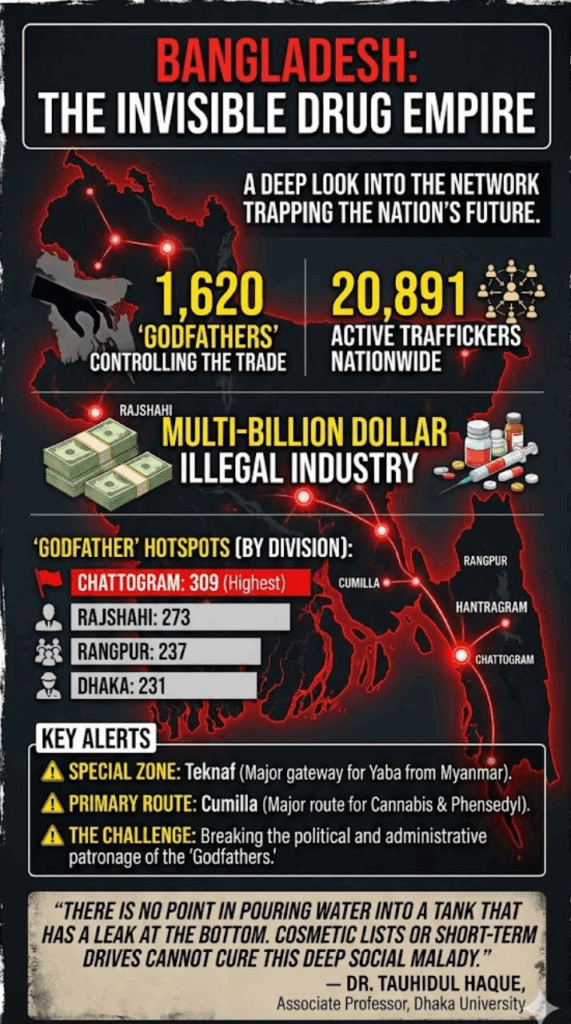
The deadly grip of narcotics has transformed into a grave national crisis in Bangladesh, an emerging economy in South Asia. Following strict directives from the newly formed government, a harrowing picture has emerged from the consolidated reports of various intelligence agencies. It has been revealed that an invisible empire of drugs across the country is controlled by 1,620 influential ‘Godfathers.’
This formidable network operates through at least 20,891 traffickers active across three tiers, facilitating an illegal trade worth billions of dollars annually.
Geopolitics of the Trade: Chattogram at the Top
Data analysis from the Department of Narcotics Control (DNC) and other agencies shows that geographical location plays a pivotal role in the spread of drugs. The distribution of ‘Godfathers’ across various divisions is as follows:
Chattogram Division: 309 (Highest)
Rajshahi Division: 273
Rangpur Division: 237
Dhaka Division: 231
Khulna Division: 228
The report identifies Teknaf Upazila in Cox’s Bazar as a ‘Special Zone’ for drug trafficking, primarily due to the massive influx of Yaba (methamphetamine) from neighboring Myanmar. Additionally, the Cumilla border remains the primary route for smuggling cannabis and Phensedyl.
The Three-Tiered Network
Investigative agencies have categorized the drug trade into three distinct levels:
1. Godfathers (1,620): Operating from behind the scenes, they provide the financing and manage the network under political or administrative protection.
2. Wholesalers (6,227): These are essentially the importers and district-level distributors.
3. Retailers (13,044): They deliver the narcotics directly into the hands of the youth and the general public.
Law Enforcement and ‘Zero Tolerance’
Following high-level government orders, law enforcement agencies have intensified their operations. The Rapid Action Battalion (RAB) currently has 3,076 drug traffickers on its list, with the highest concentration (565) found in the RAB-2 jurisdiction.
Colonel Ifthekhar Ahmed, Additional Director General (Operations) of RAB, stated- “We are working under a ‘Zero Tolerance’ policy regarding drugs. No other identity of the criminal is given priority over their crime.”
Simultaneously, Md. Bashir Ahmed, Director of the DNC, announced a 180-day special action plan aimed at arresting top-tier traffickers and dismantling the supply chain.
While intelligence reports have named several public representatives and influential figures, experts remain skeptical about the results at the grassroots level. Even the Police Headquarters has expressed dissatisfaction over the lack of expected success, warning of exemplary punishment for any official found negligent.
Dr. Tauhidul Haque, Associate Professor at the Institute of Social Welfare and Research, Dhaka University, explained the situation with a metaphor: “There is no point in pouring water into a tank that has a leak at the bottom. A deep-rooted social malady cannot be cured with cosmetic lists or short-term, ‘show-off’ drives.”
The Path Ahead
A significant portion of Bangladesh’s educated youth now stands on the brink of ruin due to addiction. The ultimate challenge lies in bringing the 1,620 Godfathers named in the Ministry of Home Affairs’ list to justice. According to international observers, the only way out of this crisis is to move beyond simple drug seizures and focus on cutting off the primary sources of funding and political patronage.
————————————————————————————————————————————————————————
The Author:
 Sakhawat Kawsar: Special Correspondent, Bangladesh Pratidin and Contributor, Pressenza- Dhaka Bureau.