
by Rita Bhowmick & Maruf Ul Alam (Dhaka Bureau)
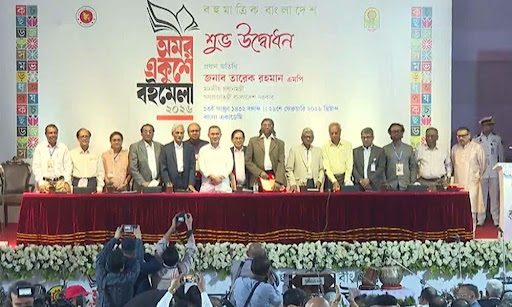
Thursday in Bangladesh presented a dual reality of the linguistic landscape. On one hand, Prime Minister Tarique Rahman was delivering a message of Bengalis’ global triumph at the National Book Fair; on the other, at the opposite end of the capital, indigenous leaders and human rights activists gathered to warn of a ‘silent crisis’- the imminent extinction of dozens of ethnic minority mother tongues.
State Vision: A ‘Multidimensional Bangladesh’
Inaugurating the world’s longest month-long book fair, the ‘Amar Ekushey Boi Mela 2026,’ Prime Minister Tarique Rahman outlined a plan to build a ‘knowledge-based, liberal, and democratic state.’ The Prime Minister reaffirmed strategic efforts to include Bengali as an official language of the United Nations, describing it as the ‘beacon of our intellectual evolution.’
‘Our language is our pride,’ the Prime Minister noted, emphasizing a ‘Multidimensional Bangladesh.’ However, critics argue that this multidimensionality lacks a crucial element: the question of survival for the country’s more than 40 non-Bengali indigenous languages.
Lost Voices: The Ground Reality
In a seminar titled ‘Marginalized Languages, Languages of the Margins, and Languages of the Marginalized: Debates and Initiatives’ organized by the rights-based organization ALRD in Dhaka on Thursday, researchers presented an alarming picture of the country’s linguistic diversity. Development researcher and author Pavel Partha presented the keynote paper. Participants in the discussion included Sanjeev Drong, General Secretary of the Bangladesh Indigenous Peoples Forum; Professor Mahmudul Suman of the Anthropology Department at Jahangirnagar University; and NHRC member Ilira Dewan. The welcome address was delivered by ALRD Executive Director Shamsul Huda.
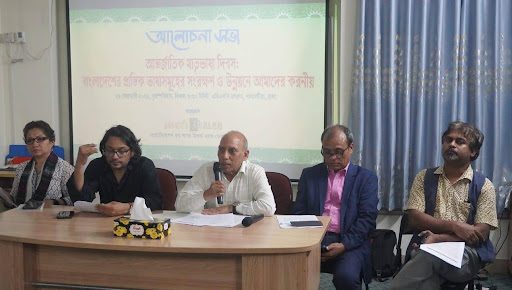
Speakers at the seminar titled ‘Marginalized Languages, Languages of the Fringe, Languages of the Marginalized: Debate and Action,’ organized by the rights-based organization ALRD. Photo: Courtesy of ALRD.
Despite the history of the 1952 Language Movement, which gave birth to an independent state-speaker alleged that the state has failed to protect its own minority languages.
ALRD Executive Director Shamsul Huda stated, ‘We are becoming mentally impoverished. Our struggle for our mother tongue (Bengali) was supposed to champion the rights of all mother tongues worldwide; yet, due to state neglect, indigenous peoples are losing theirs.’
Key Findings of the Seminar:
- Endangered Languages: Languages such as Kond, Kharia, Koda, Soura, and Mundari have been officially listed as endangered. For instance, in Moulvibazar, only two elderly sisters remain who can speak the Kharia language?
- Cultural Aggression: Researcher Pavel Partha noted that the ‘Bengali-fication’ of geographical names—such as renaming the ancient ‘Garo Bazar’ to ‘Muraid-Sirajnagar’—is erasing the historical identity of these ethnic groups.
- Educational Gaps: Despite government policies, indigenous children are still not receiving primary education in their own scripts (such as Ol Chiki or Chakma), forcing them to adopt Bengali for the sake of survival.
Political Apathy
Highlighting a disappointing indifference from political parties, speakers noted that in the recently held 13th National Elections, no major political party included the preservation of indigenous languages in their election manifestos. Sanjeev Drong, General Secretary of the Bangladesh Indigenous Peoples Forum, mentioned that although the UN declared 2022-2032 as the ‘International Decade of Indigenous Languages,’ no major state-level initiatives have been taken in Bangladesh to observe it.
The Test of ‘Inclusion’
NHRC member Ilira Dewan and Professor Mahmudul Suman emphasized that without academic research and state-sponsored linguistic institutes, these languages will remain ‘museum exhibits’ rather than living entities.
As Prime Minister Tarique Rahman speaks of ‘liberal democracy’ and strategic efforts for UN recognition of Bengali at the Bangla Academy, the contrast has become starkly apparent. The success of the Prime Minister’s ‘Multidimensional Bangladesh’ brand now depends on how well the government can protect the 41 mother tongues that carry the country’s true heritage, moving beyond the dominance of a single language.
The Authors:


Rita Bhowmick & Maruf Ul Alam: Staff Correspondents, Pressenza – Dhaka Bureau.