

“Freeloader.” A colleague called me that after discovering that my cousins in Los Angeles fed me for a year, free of charge. But there is more. This new immigrant also got to tag along with them to Las Vegas for gaming. Their kindness extended from providing hot meals daily to including me in weekend family barbecues and parties.
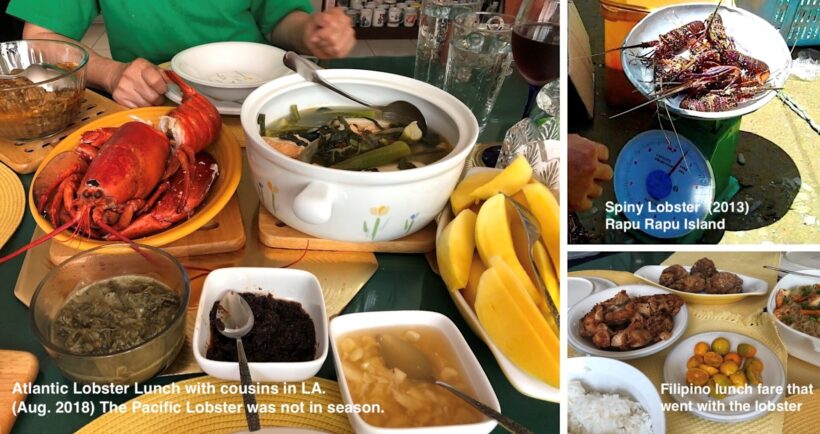
Their generosity peaked on Christmas Day. Cousin Linda presided over the gathering of over thirty extended family members. Weeks ahead, she took out her hand-wash-only fine China from storage. Then prepared in advance her most requested signature dishes. Every year she served “Palabok” Filipino noodles, marinated rib eye, and steam-boiled pacific lobsters. Rib-eye was always a hit, but she herself does not eat beef.
Both Cousin Linda and her husband Jim worked full-time then. So, they woke up at 4 a.m. on a weekend before Christmas to go lobster shopping at San Pedro Fish Market. Wholesale companies sold to the public on Saturdays from 2 or 3 a.m. To get live Pacific lobsters that was only in season from September to March, they go there early. Linda steam-boiled them right away, then froze them for Christmas.
Linda and Jim hosted the gathering for over 25 years before retiring. So, she got serving lobster down to a science. It has always been celebratory food to her. “I grew up in Guimaras Island (Philippines), where my father was the head keeper of the lighthouse.” She explained. “We had lots of people around and lobsters outside our doorstep.” She called them “Banagan,” the clawless spiny lobsters (Panulirus spp.).
In L.A., she insisted on buying Pacific lobster, instead of the bigger New England clawed lobsters (Homarus americanus). She thought the California lobster (Panulirus interruptus) was more tender and tastier.
Pacific Versus the Atlantic
My late friend Nath, a volunteer and donor to the international internship program I managed in Sarasota, Florida, delighted in inviting me to dine with her and her friends at their exclusive clubs. Nath, born to an East Coast establishment enjoyed civilized conversation almost as much as Vodka before dinner– served to her specifications: in a short glass with two onion pearls.
Some avoided her kindness for fear of the dress code, but I happily embraced it. Luckily, I came prepared for those jacket-required dining when I moved from L.A. to Florida in 2000. At the University Club, the maître d‘hôtel, who addressed everyone in the party by name and title, sometimes acknowledged my presence, too.
Depending on his mood, the young and impeccably dressed host may or may not remember my pre-dinner drink preference. But he always brought up the “plat du jour” with great enthusiasm. One lunchtime, his description of that day’s chicken noodle soup with handmade pasta sounded so irresistible.
That was why Nath always wanted to go there whenever lobster season in New England came around. As it got cooler in fall, the now closed club likely transported live lobsters to Florida by air. We went with Nath’s friend Kay, another supportive volunteer, and Bill, her husband, a retired math professor. Nath would ask Bill to show me how to eat a whole Atlantic lobster using a cracker while wearing a branded paper bib. I enjoyed pretending it was all new to me.
The University Club was not the only place I had lobster. Nath once invited me to join the day trip of her organization to Bok Tower Gardens. Her all-women group supported Marie Selby Botanical Gardens. And one member of the Associates could not make it. So, I took her spot.
The trip started with our choice of red or white wine as we left Sarasota. For lunch, we stopped at the historic Chalet Suzanne in Lake Wales. Closed in 2014 after 83 years, the Chalet was famous for their creamy mushroom-spinach “Soup Romaine.” Nicknamed “Moon Soup,” it went to space on the Apollo 15, 16, and Apollo-Soyuz missions. After the amuse-bouche of liver over grilled grapefruit and the famous soup, one of the organizers became apologetic. My main course was picked by the member who paid for my lunch.
Instead of their Beef Filet with Béarnaise sauce, I had Lobster Newburg. Cooked to perfect tenderness and sauced just to the right creaminess, it tasted familiar. It reminded me of the creamier Lobster Thermidor I had in Leuven, Belgium.
Lobster Gratinéed with Heavy Cream and Gruyère Cheese
On the eve of the Treaty of Maastricht, in 1992, before the European Community (EC) of 12 members became today’s European Union (EU) of 27 countries, I spent a week in Leuven. Only 27 km (34 mi) from Brussels, the heart of EU governance, it was home to the Irish College, a hub for international education. Together with a Filipino lawyer, a Thai journalist and scientist, we learned the history, political structure, and future of EU.
The program’s mindful coordinator and lecturer anticipated Asian food restrictions. They did not serve us pork or beef in case any of us were Muslims or Hindus. They offered us seafood instead, and once served us Lobster Thermidor, albeit slightly overcooked, for lunch. Since Leuven was 80 km (50 mi) inland from the coast, I applauded the effort.
Our time there shortly overlapped with a big group of American university students who, our coordinator said, decided to skip lunch to find a place that served burgers. Ironically, the residential Irish College was also where I tasted the divine Stilton cheese which instantly became my favorite. I showed appreciation by telling the coordinator that they need not go all out. I kept me from joking that all Asians were lactose intolerant.
Connecting Through Food, Lobster in Particular
Many Japanese nationals showed me kindness when I spent the first lonely winter away from family as a teacher trainee at Tsukuba University. I went there to study how university students perceive and value nature. I dug references to their cognition of nature. Amidst newfound affluence, what remained of their Shinto and Buddhist belief systems as regards nature? The last thing I expected was an invitation to a fancy dinner.
Towards the end of my stay, I met an elderly Japanese couple who insisted on taking three of us international students to dinner. Likely to be in their early seventies, neither spoke a word in English. But they managed to pick us up and take us to a seafood restaurant. More upscale than Japanese family restaurant chains like Denny’s or Royal Host, the restaurant served whole lobsters likely flown in alive.
Aided by hand gestures, the kind lady asked us to choose between “American (Boston) Lobster” and the smaller but more delicate “Ise Ebi,” the clawless Japanese Spiny Lobster (Panulirus japonicus). Both were prized delicacies, eaten on special occasions. I ordered the bigger-looking but cheaper American lobster (Homarus americanus).
Smaller is Better
I know now that seafood size matters. Growing up surrounded by tropical seas, I often heard my mother equate big to rubbery texture in seafood. I got to prove that for myself when my turn came to be generous. In 2013, I treated my field assistants and fellow researchers to a lobster dinner in the Philippines.
Tasked to find plants that grow on soils contaminated by harmful heavy metals, we sailed to Rapu Rapu Island. After days of collecting plants from different parts of the island, we chanced upon a tiny hamlet. There, the wholesale fish vendor offered us freshly harvested “Uni” sea urchin roe in a To Go box and live spiny lobsters. The fisherman who caught them the previous night kept them alive in submerged cages. He packed the 8- to 10-inch-long lobsters in a cardboard box after rolling them in sand to immobilized but keep them alive for transport.
The only woman of our three local guides cooked the lobsters in thick coconut milk and shredded green jackfruit flesh. We feasted on “Uni” roe for an appetizer, the unbelievably tender and tasty cuttlefish I bought from the fish vendor, and the lobsters.
Today, the warming seas and overfishing have caused the decline of lobster populations in the Pacific and Atlantic. Vietnam has developed techniques to farm spiny lobsters from the spawning stage to growing juveniles to market size. The demand in China for this symbol of status, luxury, and good fortune has increased. And it is not without problems like pollution or economic drawbacks.
But it would be unthinkable to allow this ancient crustacean to become just a memory. This opportunistic omnivore and prey to bigger fish or marine mammals is more than human celebratory food. It reminds me of those who were kind to me.
About the Author:

George Banez is a writer of Filipino descent and is a retired non-profit professional living in Florida.