

by George Banez
Picture our destination — the tiny island of Rapu Rapu, just 22 mi (36km) from the port of Legazpi City on the western shores of Albay Gulf. In 2013, it took us over three hours to reach it across the gulf’s mouth facing the vast Pacific.
Perched on the eastern edge of the Philippines, Rapu Rapu sat precariously on the rim of the 34,580 ft (10,540 km) deep Philippine Trench. As if to keep it from falling in, the island’s eastern bluff stood defiantly still against the waves of the Pacific Ocean. And like a wall, it blocked our view from the rough waters below. There, beyond the bluff, the originally Australian-owned mining company, Lafayette Philippines Inc. (LPI), extracted copper.
We traveled to Rapu Rapu, some 232 mi (374 km) southeast of the capital Manila, to find plants that could grow on soils contaminated with heavy metals. In high concentrations, heavy metals like lead can destroy life. We wanted to know if plants that thrive there can be used elsewhere to clean up contamination.
The LPI mining company’s lease agreement granted it access not only to copper but to gold, silver, and zinc heavy metals too. So, we faced many challenges to start with. And then, a toxic spill had washed into the sea October of 2005, almost eight years before we got there.
Anger may have settled over the fish kill blamed on cyanide found in the overflow. Still, tensions remained high. Among the island’s 29,000 or so residents, opinions were divided. Some wanted the mining operations gone; others insisted they stay.
Ironically, despite industrial mining in the island, the town center only had intermittent electricity, power came on only from noon to midnight. To us, this remote island, only 25.8 sq mi (66.82 sq km) in area, felt like a world unto itself. Governed by its own rhythm and ways of life, Rapu Rapu rarely welcomed outsiders with open arms, much less those curious about their environment.
Rapu Rapu: the last place I expected to have the best “Halo-Halo”
On the third day, after sailing and disembarking multiple times to gather data around the island, the only other male in our team decided to walk around for a little break. The town center near the port was only several blocks small and roads were not wide enough for cars. The place seemed perfectly safe. Still, I worried; the towns folks did not appear friendly.
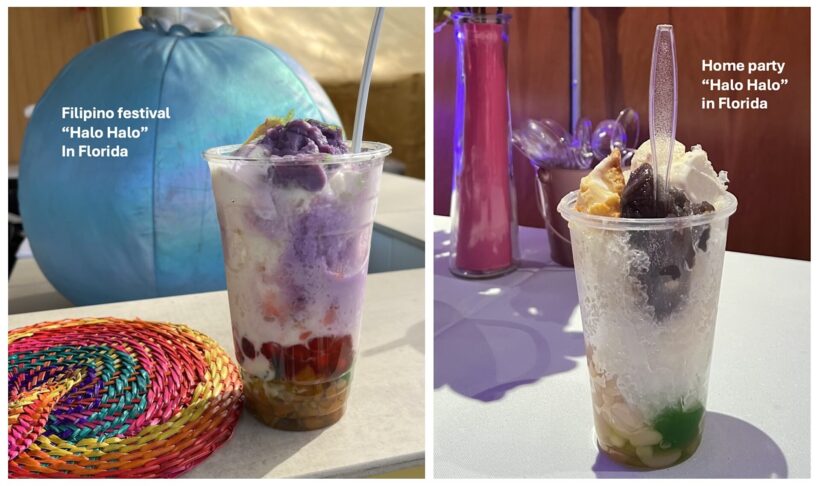
When my teammate returned, he had a smile on his face and a cold treat in his hand. He brought me what appeared like shaved ice melting on diluted evaporated milk. I could see that it was “Halo Halo” in the small plastic cup. At the bottom were a few shreds of young coconut meat, bits of bananas, and some “pinipig” glutinous rice flakes.
All three ingredients tasted fresh. The coconut and bananas were not pre-cooked nor candied. They were delicious that way. Out of habit, I expected each plastic spoonful to have small cubes of sweet potatoes or sweetened beans of some sort. But missing the embellishments typical of “Halo Halo” soon gave way to delight. I started savoring the richness of coconut sugar from underneath the melting slush. The ice-milk-coconut sugar combination made this “Halo Halo” divine! Other ingredients came as a bonus.
Ode to “Terroir”
Looking back, that “Halo Halo” experience aligned with the “I-get-it-now” moment from eating a baguette in Paris. I heard others rave about it before, but I never thought French bread on a pre-made ham and cheese sandwich from a stand at the Louvre tasted so good. And I had the same epiphany after relishing barbecue sauce in Kagoshima, Japan.
In the ‘90s, a kind tutor to us international students invited me to his house for “Yaki-Niku,” a tabletop Japanese barbecue dinner. His mother came in to bring us a bottle of the neighbor’s homemade sauce. And it was spectacular.
I already had my fill of all three before — “Halo Halo,” baguette, and “Yaki-niku” sauce — but thought nothing extraordinary of them until those life-changing moments. It felt as if I were tasting each one of them for the first time.
Was my enjoyment of “Halo Halo” in Rapu Rapu heightened by our stressful circumstances? Were the flavors enhanced by the environment? Terroir, maybe?
The pared-down “Halo Halo” certainly offered relief from sun exposure, heat, and exhaustion. We were wet from wading in and out of the sea. Sticky sweat from high humidity aggravated our discomfort from ant and insect bites.
So, the unembellished, fresh-tasting “Halo Halo” served its intended purpose of cooling us down. Had it been piled high with toppings, it would have been cloying from sweetness. In a place with no air-conditioning, a fully loaded “Halo Halo” would have made us thirstier.
More Than Dessert
Filipinos often use “Halo Halo,” to represent their culture and society. After all, the name translates to “mix-mix.” What could be more iconic of the blending of influences? Core Filipino culture reflects the country’s tropical location. The amalgam of indigenous Pacific, Malay, and Chinese traditions serves as the foundation. Layered on them are Spanish, American, and Japanese colonial legacies.
Typically served in a footed parfait glass or dessert bowl, today’s “Halo Halo” is built on a base of sweetened red or white beans, caramelized “Saba” or sweet plantain, and candied sweet potatoes. Piled on them are jelly-like treats like “Nata de Coco” from coconut water, “Macapuno” gelatinous coconut flesh, “Kaong” fruit of sugar palm, and “Sago” pearls from tapioca starch. A sprinkling of “Pinipig” rice flakes adds the crunch.
Sweetened jackfruit or strips of young coconut can be added before the glass is topped with heaps of shaved ice – the more the better. Finishing with evaporated milk adds creaminess and moistens ice for easy mixing. Scoops of ice cream, “Leche Flan,” and “Ube Halaya,” the jam from purple yam, make the best topping.
“Halo Halo” Stories
Dubbed the “unofficial national dessert,” this quintessential summer treat is also a favorite mid-afternoon snack in a country that experiences 240C – 320C (750F – 900F) temperatures year-round. But the shaved ice desserts’ forerunner — snow collected from mountains and sweetened with honey — could not have originated from the Philippines.
The Japanese migrants before the Second World War likely brought their “Kakigori” tradition to the country. The Japanese shaved ice dessert, “Kakigori,” is topped with sweetened beans, jellies, and fruits. But instead of dairy milk, flavored syrup is added.
In the ‘90s Japan, I enjoyed traditional “Kakigori” topped with green tea powder, “anko” sweetened red bean paste, and “mochi” or “dango” rice balls. Today, “Kakigori” is still popular. Thanks to visual marketing on social media, it has also evolved. Chefs now use high-quality ice and artisanal, sometimes savory, toppings in unique and complex combinations.
China may have been the origin of shaved ice recipes popular in tropical Southeast Asia. The Chinese “Bao Bing” made with snow is said to have been enjoyed by the elite in the 7th century. But shaved ice desserts may not have been accessible to all until mechanical ice-making became widespread in the early 20th century.
Shared Among Neighbors
In the ‘90s, while visiting Bangkok, I sought relief from the searing heat in a mall. There I stumbled on “Nam Kang Sai.” I discovered that this “Halo Halo” looking shaved ice dish was customizable. Asked to choose three add-ins, I picked the most colorful bits from an array of ingredients in the glass case.
The most appealing red berries turned out to be rather salty and sour. A friend later informed me that they were likely candied star gooseberry (Phyllanthus acidus). But they reminded me more of the Filipino “champóy,” the salted, dried Chinese bayberry (Myrica rubra). Apparently, Thais prefer not to add coconut milk to their “Nam Kang Sai” when sour elements, like pineapple, are included.
On a trip to Da Nang City in 2018, a kind hotel staff invited me to sample “Chè” from an eatery that specialized in it. When I asked what “Chè” meant, he said, “It’s soup but not soup.” I laughed out of confusion. So, he treated me to a glass of “Chè thập cẩm,” which translates to “Mixed Sweet Soup.” It had beans, taro, jellies, tapioca pearls, and shaved ice. Scrumptious with coconut milk sauce, it reminded me most of “Halo Halo.”
Rapu Rapu Wins
In hindsight, nothing could match the watered down “Halo Halo” of Rapu Rapu. It embodied the island’s chaotic blend of contrasts – shaved ice delivered on barely sufficient electricity.
Emblematic of its trench rim location, the island is composed of both oceanic crust fragments and volcanic arc deposits. Yet, its rich polymetallic ores are among the natural endowments that inhabitants hardly benefitted from. Still, they thrived. Like the plants we sought, humans there adapted to endure.
About the Author:

George Banez is a writer of Filipino descent and is a retired non-profit professional living in Florida.



