

“This cooking competition streams globally. I feel like the time and platform have come to showcase Filipino dishes that have yet to hit mainstream.” Bohol-born Rex Alba said. “I wanted to show Filipino grit and our resilience under pressure. That is why I took risks in the food I cooked.”
During the first episode, eight participating home cooks took the challenge to execute the “perfect dish,” one that best represented who they were. Rex Alba, a 46-year-old Physical Therapist from Ohio, cooked “Dinuguan,” the Filipino pork blood stew. And to go with it, he steamed “Putong Bigas,” rice cake. Alba used a blender to mix coconut milk with the rice he soaked overnight to make the batter.
A foil to the rich blood stew, the rice cake impressed the judges. Chef Tiffany Derry joked that she would steal Alba’s recipe for her restaurant. All three judges enjoyed the silky smooth “Dinuguan” topped with bits of pork cracklings. Francis Lam, a chef and food magazine editor well acquainted with international food called it the best he ever had. The judges, including Chef Tim Hollingsworth, named it the top dish of the first round. They liked Alba’s bold move right out of the gate.
No dish embodies Alba’s passion than this stew. He began cooking “Dinuguan” in Tagbilaran City, Bohol, where he grew up. But he did more out of circumstance than intention. Like many, he did not practice physical therapy after graduation. Instead, he worked as the manager of his cousin’s used car dealership in Metropolitan Cebu, a regional hub in the Visayan Islands. He was the president of the University of Bohol Supreme Student Government, so management skills came easy. He was just getting started with some side business of his own when the call came.
“I had to go back home to Bohol from Cebu when my mother suffered a stroke. She was 48 when she died from low cardiac output on my birthday, December 2004. I sacrificed my personal ambitions. I had to help my father and three siblings get by. I decided to stay (home) and set up a small four-seater cafeteria, doing mostly To Go business. I figured that would help the family with food expenses.”
Hard Work Continued
“I woke up at 4:30 am every morning to shop for ingredients. We served “Dinuguan,” the blood stew, “Paklay” or beef tripe stew, and crispy chicken. They were a big hit. Even without social media back then, patrons lined up before we opened for lunch and dinner. We always sold out “Dinuguan,” our best seller. But that’s why I needed to get up early. I had to buy the freshest pig blood and pork intestines. I didn’t get much sleep because we didn’t close until 9 pm.”
Alba named the cafeteria, “Ani Ta Bai,” a play on his mother’s name “Annie” and “bai,” which meant buddy. Altogether, it sounded like an endearing invitation, “come over buddy,” in the dialect. Alba paid tribute to his first cooking mentor, Annie. But he credits the cook he hired for lessons on bulk cooking. He remembers making Dinuguan on huge “kawa,” or wok-like vessels every day.
“Dinuguan is well-loved all over the Philippines. But in Bohol, we are never without it for parties or fiestas. That and ‘Inatayan,’ a pork liver dish, come as a set, like a package, when ‘Lechon’ (or the whole pig roast) is on the fiesta menu.”
In this public television (PBS) show, however, he utilized pork belly and jazzed it up with tenderized pig ears and cheeks, instead of organ meats. Alba shared that Filipinos utilize every part of the animal, so nothing edible is ever wasted.
He made a side dish of chicken liver adobo from the bird he butchered to make “Arroz Caldo,” the Filipino chicken rice porridge flavored with ginger. For this episode on “comfort and care,” Alba served arroz caldo with Calamansi, Filipino citrus fruit, and toppings like hard-boiled eggs to add variety in every bite – the way Filipinos want it.
“I noticed that here in the U.S., everyone knows adobo, lumpia, and pancit. So, in my casting interview, I reminded producers that the Philippines has over 7,000 islands, and every region cooks staples like “adobo” differently. That is why I waited until asked to cook adobo. And I made it the way we did in Bohol — until the braising liquid has dried up.”
“Coming to the show, I had so many ideas. I thought of making ‘Lechon Belly’ (rolled pork belly), or ‘Lechon Kawali’ (deep, fat-fried pork belly), or ‘Crispy Pata’ (deep, fat-fried pork leg). But I needed to think of the time constraint. We were given only 60 minutes to cook multiple portions. So, I had to use pressure cooker hacks. I ‘sous vide’ the chicken leg for the marinade to penetrate through when I made ‘Bacolod Inasal’ (Bacolod-style grilled chicken). For ‘Kare-Kare’ (peanut stew), I gave very specific instructions on the diameter and the thickness of the slices of oxtail.”
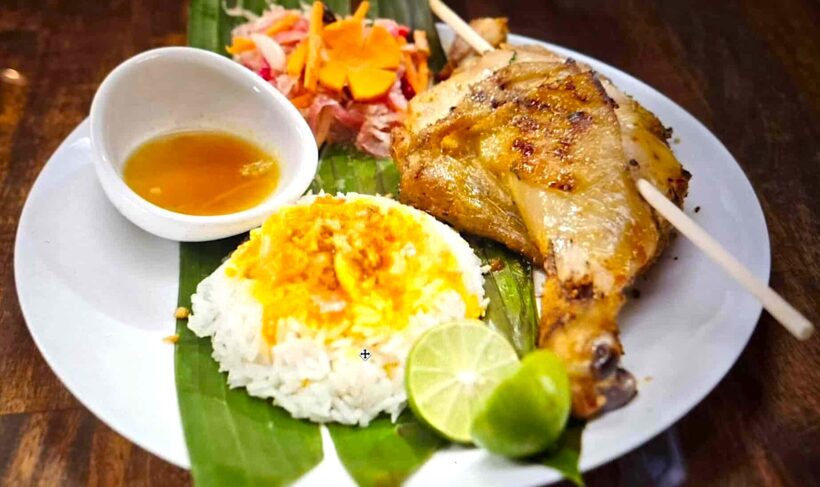
Atchara, Chicken Inasal, Garlic Rice.
Strategy and Hard Work Pays Off
“I got to cook food representing Bohol. I baked ‘Torta de Argao.’ In the Tagalog dialect, ‘Torta’ means something else (like eggplant omelet). But in Bohol, it refers to dessert, like a muffin.”
“We love fiestas. In May, we celebrate every day. We serve ‘Torta’ at these fiestas. It is baked with the lard (shortening) from the previous year’s hog slaughtered for ‘lechon.’ We use ‘Tuba’ as the leavening agent. ‘Tuba’ is coconut wine. In the show, I used self-rising flour because I didn’t have ‘Tuba.’ And I called it ‘Torta de Argao’ after the town of Argao in Cebu; they have the most famous version. In Bohol, we just call it, ‘Torta.’
For this baking episode, home cooks were given 75 minutes. Hardly enough time for Alba to bake two dozen “Silvannas,” the frozen cashew meringues, famously made in the City of Dumaguete, also in the Visayas. Alba’s “Silvanas” were crunchy and chewy cookie sandwiches filled with pineapple, durian, and mango buttercream. But he also prepared “Sikwate.”
“Sikwate” hot chocolate drink is traditionally made with “Tablea,” the paste of roasted cacao molded into disks or tablets. Alba went even further by turning “Sikwate” into a dip for dunking “Torta.” He added heavy cream.
“Tablea is very close to my heart. Growing up, whenever my mother and I went to the market, we stopped by to get a breakfast of ‘Puto Maya,’ steamed sticky rice with coconut milk and ginger, served in banana leaf. We ate it with ‘Sikwate,’ from ‘Tablea’ beaten with a ‘batirol,’ (wooden whisk).”
Heart and Passion
Typical of any Asian meal table of multiple small plates, Alba’s entry for each round consisted of many sides. Alba said his goal was to show how hardworking Filipinos really are through food. When he moved to the U.S. in 2005 with wife, Bernadette, Alba could not work as a physical therapist. Bernadette, who was from Leyte, another island in the Visayas, worked as a nurse in Ohio.
“I started from scratch. My only goal was to make $10 an hour. At Macdonald’s, my first job, I got paid $6.15. Then they gave me $7.15 an hour after a month. Eventually, I became a Patient Care Assistant and a nursing assistant with a lot of side jobs. Meanwhile, I studied for the board examination to get my license. In the beginning, I had to work as a traveling physical therapist in Indiana while I worked on other requirements for Ohio.”
“I wanted my food to reflect this hard work and make judges see that my dishes were thought through and beautifully presented. I made all the components of Halo-Halo, rather than relying on store-bought ingredients. The Flan I made was smooth because I strained the custard twice. I boiled the black pearls myself and made ube ice cream. The producers offered me an ice-cream maker, but I decided to go with my double Ziploc method to show that it can be done at home. I had to shake it by hand for 10 to 15 minutes.”
Although Alba had help from his wife for the final cook, he had to teach Bernadette how, on camera. Still, they managed to complete the three-course meal. They even made “Atchara,” the Filipino tangy-sweet relish to counterbalance rich fatty flavors. They shredded unripe, green papaya, then added carrots and raisins into a vinegar-based pickling liquid. “Atchara” stood out to the judges as much as Alba’s valiant effort to grill “Chicken Inasal” without charcoal.
Rex Alba said it helped that he worked at Macdonald’s. It was from becoming sick of fast food that solidified his passion for recreating and sharing the taste of home.