

The first time I crossed a border by road, I realised how little I understood about movement across Africa. I had prepared as many travellers do, with documents in order, a clear route in mind, and the assumption that crossing from one country to another would follow a predictable process. Instead, I encountered a system that functioned in ways I had not anticipated. Queues did not follow a clear structure; instructions varied depending on who was asked; and trucks carrying goods stretched for kilometres, with their drivers settling into waiting periods that could last for hours or even days. Movement slowed, paused, and resumed without a clear explanation, creating a rhythm that was unfamiliar but clearly understood by those around me.
What stood out was not the delay itself, but its normality. People adjusted without resistance, navigating the process with a level of familiarity that suggested this was not an exception but a routine part of movement. In that moment, it became clear that mobility across much of Africa cannot be fully understood through schedules or systems alone. It is shaped by a combination of infrastructure, administration, and human adaptation, all of which interact in ways that are not immediately visible from a distance.
Seeing Africa Versus Moving Through It
Air travel has significantly improved connectivity across major African cities, supporting economic activity, tourism, and regional engagement. However, it often presents a limited perspective of the continent, one that is largely confined to airports, business districts, and controlled environments that tend to look similar regardless of location. While this form of travel is efficient, it removes the layers that connect places and communities.
Road transport, by contrast, remains central to how movement occurs across much of the continent. According to the African Development Bank road networks carry the majority of both passenger and freight traffic, making them critical to economic and social interaction. Travelling by road brings these connections into focus. Borders are experienced not simply as lines on a map but as processes shaped by infrastructure gaps, administrative systems, and policy realities. Towns and cities are revealed as part of a connected network, linked through trade, language, and everyday movement rather than existing as isolated points.
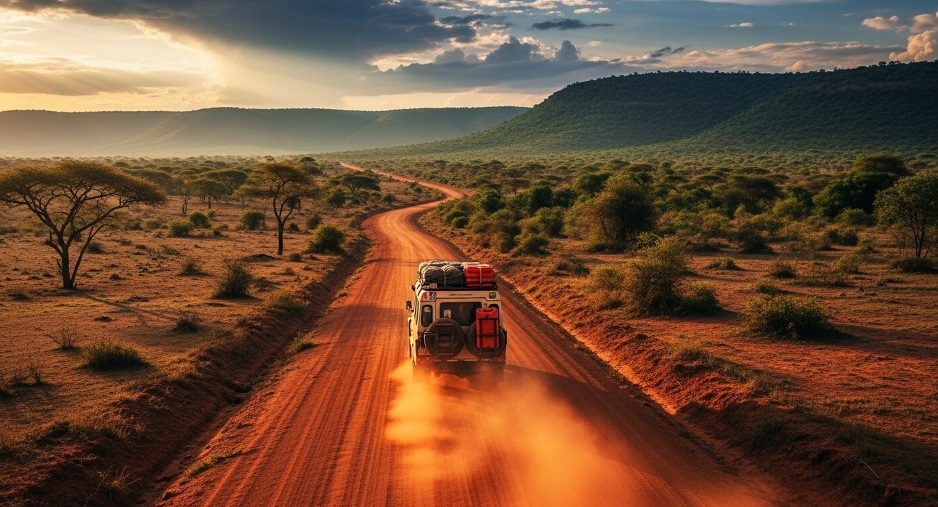
A vehicle travels along a long stretch of road across East and Southern Africa, where movement is shaped by distance and terrain. / Source: Google Labs
This form of travel challenges the idea of Africa as a collection of separate destinations. Instead, it reveals a continent that is interconnected, even when its systems are not fully aligned and where movement is shaped as much by human interaction as it is by formal structures.
The Road as a Site of Learning
Long-distance travel across countries such as Zambia offers a form of learning that is not structured or immediate but develops gradually through experience. It requires a willingness to engage with uncertainty and to observe systems as they function in practice rather than as they are described. In doing so, it reshapes assumptions about control, efficiency, and what it means to move from one place to another.
Delays, for instance, are not occasional disruptions but an embedded part of the system. Infrastructure limitations, administrative bottlenecks, and logistical inefficiencies all contribute to slower movement, a reality that institutions such as the World Bank have identified as a constraint on trade and mobility. Experiencing these delays firsthand transforms them from abstract challenges into lived realities, where waiting for extended periods without clear timelines becomes a routine aspect of travel rather than an exception.
On the ground, these constraints are experienced in practical and immediate ways. Waiting for long periods without clear communication becomes something that travellers learn to navigate rather than resist. Over time, this waiting begins to take on a different character, as people start to interact and respond to their shared circumstances. Conversations develop naturally, food is shared, and information circulates through informal but effective networks. What initially appears as unproductive time often becomes a space of interaction, where strangers form temporary communities shaped by the conditions they are navigating together.
Resilience, in this context, is not expressed through dramatic moments but through consistency. Many of the people undertaking these journeys do so regularly, not as an exception but as part of their daily lives. Observing this shifts the understanding of resilience from something exceptional to something embedded in routine behaviour. It is reflected in the ability to continue despite discomfort, uncertainty, and delays, without framing these challenges as extraordinary.
Adaptability is equally central to the experience. Transport systems across many parts of Africa operate through a combination of formal and informal mechanisms, a reality highlighted by the United Nations Economic Commission for Africa. As a result, plans are rarely fixed and travellers must respond to changing circumstances as they arise. Routes may shift, vehicles may break down, and timelines may extend without warning. In this environment, adaptability is not a secondary skill but a necessary condition for movement, influencing not only how journeys unfold but also how individuals approach uncertainty more broadly.
Encounters Beyond the Itinerary
While infrastructure and systems shape the structure of travel, it is people who define its meaning. Road journeys create conditions that allow for interaction in ways that are less common in more controlled forms of travel. Time and space are shared, often for extended periods, creating opportunities for conversations that develop organically rather than through intention.
Acts of generosity, such as sharing food or offering guidance, are not unusual within this context. They reflect broader social norms that prioritise community and mutual support, particularly in environments where cooperation becomes practical as well as cultural. These interactions challenge the idea of travel as an individual activity and instead highlight its collective dimension, where experiences are shaped not only by movement through space but by engagement with others.
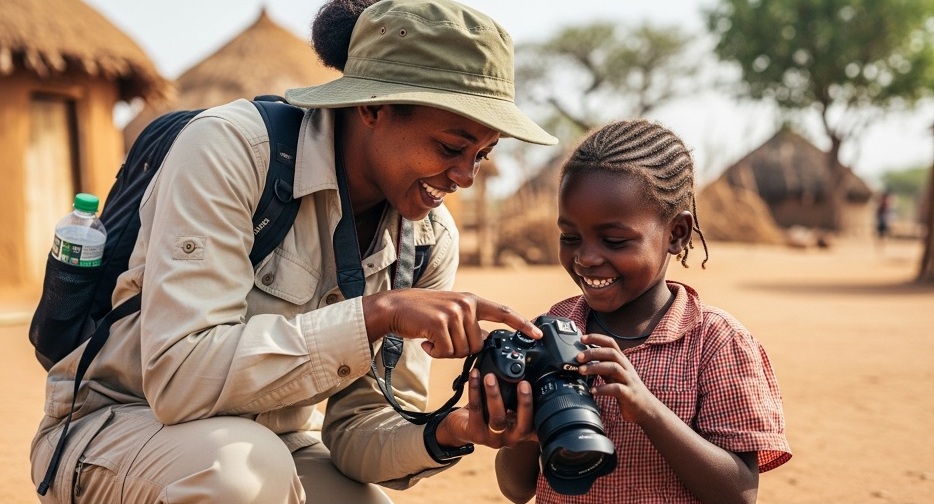
A child interacts with a camera during a field visit in a remote village, reflecting moments of curiosity and exchange. / Source: Google Labs
Borders, Systems and Uneven Progress
To travel across Africa by road is to encounter the realities of its borders in a direct and often unfiltered way. Crossing from one country to another involves multiple layers of verification, administrative processes, and, at times, inconsistencies that can extend waiting periods significantly. These challenges reflect broader structural issues, including infrastructure limitations and fragmented regulatory systems that continue to shape movement across the continent.
In a previous journey from Tanzania to Zambia, I experienced these complexities firsthand, from unclear procedures to prolonged delays that made movement feel unnecessarily difficult. I later documented this experience in my article, “What If the Borders Were Just Lines on a Map,” published by Pressenza, where I explored how borders can both connect and constrain movement within Africa. These experiences are not isolated but reflect wider patterns that continue to affect travellers and traders alike.
Efforts to address these challenges are ongoing.The African Union has prioritised regional integration through initiatives such as the African Continental Free Trade Area, which aims to facilitate smoother movement of goods and people across borders. However, implementation remains uneven, and the gap between policy and practice is still evident in many parts of the continent. Experiencing these systems firsthand provides a clearer understanding of both the progress being made and the limitations that remain.
Why This Form of Travel Matters
Road travel across Africa offers more than a means of moving between locations. It provides insight into how systems function in practice and how individuals navigate them on a daily basis. It challenges assumptions about efficiency and development by revealing forms of organisation that do not always align with standardised expectations but nonetheless sustain movement and connection.
This form of travel also shifts perspective, encouraging a more nuanced understanding of the continent. Africa emerges not as a collection of destinations but as a network of relationships, economies, and lived experiences that are interconnected in ways that are not immediately visible from a distance. Engaging with this complexity requires time and attention, but it offers a depth of understanding that cannot be replicated through more controlled forms of travel.
Choosing Between Speed and Depth
Air travel and road travel serve different purposes, each offering distinct advantages. Air travel prioritises speed and predictability, making it possible to cover large distances within a limited time. Road travel, however, provides depth and exposure, allowing travellers to engage more fully with the environments and systems they move through.
The choice between the two is often shaped by practical considerations, including time, cost, and convenience. However, for those seeking a deeper understanding of the continent, road travel offers insights that extend beyond the destination. It reveals not only how people move but also how systems operate, how communities interact, and how resilience is sustained in everyday life.
The distinction, ultimately, lies in what each form of travel makes visible. Flying allows movement across Africa, but it often removes the context that gives that movement meaning. Travelling by road restores that context, exposing the complexities, challenges, and connections that define mobility across the continent. For those willing to engage with that reality, the road offers a more complete and grounded understanding of what it means to move within Africa.