

In the run-up to the 2024 election, Donald Trump promised, “We will close the border. We will stop the invasion of illegals into our country.” A year later, it was a promise he claimed to have kept. But exactly who are the “illegals”? Loose definitions and manipulated statistics tell a very misleading story about migrants from Latin America.
By John Perry
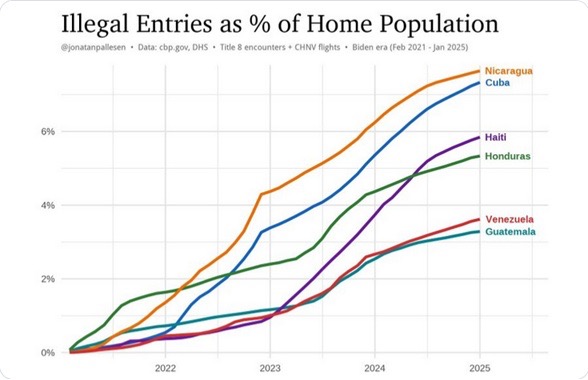
Earlier this year, a chart appeared on social media sites like X claiming that during President Biden’s four years in office, 8% of Nicaragua’s population entered the US illegally. The chart displayed comparable percentages for five other Latin American countries — Cuba, Haiti, Honduras, Venezuela and Guatemala. It appeared to confirm Trump’s claims that “Biden’s open border policies” had attracted people in such huge numbers that their countries had lost significant proportions of their populations.
Source: Pallesen’s chart, since deleted but found in various posts on Facebook and X.
The chart in question, with 4.6 million views on X, was the work of data scientist Jonatan Pallesen, so it might have been considered statistically accurate. Let’s look at how it was produced.
Pallesen used publicly available data from US Customs and Border Protection (CBP) showing numbers of CBP “encounters” with people entering the country. An “encounter” can refer to a person who crossed the border unlawfully or who claimed asylum at a border post. But it can also refer to someone who arrived at the border and was turned away by officials, failing to enter the US at all. Furthermore, someone making repeated attempts to enter the country may have several “encounters” and be separately logged each time by CBP officials.
CBP statistics, therefore cannot be used to show the number of people making “illegal entries” because they have a significant but unknown element of double counting.
For his chart, Pallesen also added in the half-million people who traveled to the US under a Biden-era parole program that applied to four of the six countries. This raised two further problems. One is that, by definition, these entrants to the US were – at the time – perfectly legal. But, more importantly, the CBP had already included these entries in their data showing encounters. So there was an additional, even bigger element of double-counting in Pallesen’s chart.
It is not surprising that Pallesen ended up with huge figures for “illegal entries” over the years in question (2021-24). He must have decided that they would seem even more dramatic if they were expressed as a percentage of each country’s population. This pushed Nicaragua to the top of the chart, whereas in terms of actual numbers of encounters, it would be at the bottom.
Pallesen’s X account reveals his motivation in posting such patently bogus data. His screeds are full of anti-immigrant talking points. He has published articles jointly with academics criticized as “eugenicists, or scientific racists” whose work is being “appropriated in the service of alt right and White nationalist ideas.”
The chart may be wildly wrong, but it has served its purpose in feeding an anti-immigrant message. Indeed, it has been reproduced many times, including by Donald Trump Jr who said Pallesen’s chart showed Biden’s policies to have been “absolute insanity.”
In April, Pallesen’s work was examined by the rumor fact-check site Snopes. Analyst Jack Izzo described it as “meaningless” and the chart as full of “flaws.” Expressing the numbers as percentages of each country’s population is the equivalent of “dividing apples by oranges,” he added. The chart has been withdrawn, but Snopes found plentiful examples of it still being used.
The political misuse of data like Pallesen’s is not confined to anti-immigrant nationalists. Similar exaggerated claims are used to criticize the governments of three of the countries from which the migrants originate.
Let’s look first at Nicaragua. An NGO based in Costa Rica claims that an even higher proportion of Nicaragua’s population – 11.6%, equivalent to 800,000 people – left the country over the period 2018-2025. This NGO has received over $282,000 in US federal grants to create anti-Nicaragua propaganda, so naturally it attributes this exodus to the government’s “systematic repression.”
Prominent opposition figure Manuel Orozco goes further, accusing Nicaragua of the “expulsion of almost a million people between 2018 and 2024” – a startling 15% of the population. As well as emigrants to the US, these figures include a substantial number said to have fled to Costa Rica where 300,000 Nicaraguans have claimed asylum.
The absurdity of these claims in Nicaragua’s case can be demonstrated by simple analysis of the country’s population figures, available in the UN data portal. In 2018, its resident population was 6.4 million; over the period 2018-25, the “natural” population growth (births minus deaths) was 790,000, so without migration the 2025 population would have been 7.2 million. In fact, it was around 180,000–190,000 below that figure, at just over 7 million. The balance is explained by net migration (the difference between people leaving and people entering): at around 180,000–190,000, it was just 3% of the population over a longer period, 2018-25.
The real loss of population is therefore much less than half of Pallesen’s percentage and far below the figures claimed by opposition pundits. Apart from double counting, the main reason for this huge discrepancy is that large numbers of Nicaraguans return home. They do not stay permanently in either the US or Costa Rica. While data for people leaving the US (for example, around 10,000 have been deported by Trump) are only partial, UN figures show that migration to Costa Rica is circular – as many Nicaraguans leave as enter on a weekly basis.
Another of Pallesen’s claims is that over one million Venezuelans entered the US “illegally” in the four years 2021-25. Writing in the Anti-Empire Project, Joe Emersberger and Justin Podur examine a range of estimates for Venezuelan emigration, including a BBC estimate that over seven million have emigrated since 2015. They conclude that “nobody should accept the migration figures for Venezuela that the western media constantly cites.” They quote a typical US media figure as saying that “the misery and repression that Venezuela has suffered at the hands of Maduro’s dictatorship has caused millions to flee.” Yet analysis by the Centre for Economic and Policy Research shows that four million Venezuelans have emigrated as a direct result of US policy in the form of “sanctions” – unilateral coercive measures imposed by the US and its allies.
Pallesen also suggests that over 800,000 “illegal” entrants to the US since 2021 came from Cuba. Scrutiny of the data suggests that in the period 2021-24 some 600,000 Cubans attempted to enter the US, and many of these will be double-counted or have made failed attempts. However, Cuba’s case is somewhat different because it is not the scale but the reasons for migration that are disputed. Cuban government officials accept analyses by experts such as Juan Carlos Albizu-Campos Espiñeira of the University of Havana, who assesses Cuba’s population loss since the end of 2020 at 10.1 per cent. The primary driver is arguably the enormous damage caused by the six-decade US blockade of the country. Yet academic commentators outside Cuba, such as Agustina Rodríguez Granja, blame migration entirely on the government’s economic mismanagement and on “political repression.”
The real picture then is that migration from Nicaragua is minimal, once returnees are taken into account. In the case of both Venezuela and Cuba, outward migration is very significant, but it is driven by hostile policies pursued by successive US administrations, including Trump’s.
As is clear from his background, Pallesen’s exaggerated claims about “illegal entrants” to the US and their repetition in social media come from anti-immigrant or White supremacist sentiments. Writing in Black Agenda Report, Margaret Kimberley points out that Trump’s immigration enforcement is a doomed attempt “to make America whiter again.” Accepting handfuls of refugees appears to be acceptable, she adds, if they are White people “escaping” South Africa.
Similar claims to Pallesen’s from opponents of socialist governments in Nicaragua, Venezuela and Cuba have different political perspectives, although there may be some degree of overlap. Their attacks on their own countries of origin feed Trump’s narrative about excessive numbers of Latino immigrants in the US. In the case of one of the most prominent opponents of socialist governments, Venezuelan Maria Corina Machado, her support for Trump’s policies was unconditional even when he was illegally deporting her compatriots to prisons in El Salvador.
Migration as an issue has been deeply weaponized. Alarmism about the number of migrants who have arrived in the US from Latin American countries has brought together two previously distinct elements of right-wing politics. Both are purveying myths, not facts, and it is important to challenge them.
John Perry lives in Masaya, Nicaragua, where, perplexingly, he writes and edits books on British housing and social policy.



