

By Asif Showkat Kallol (Dhaka Bureau)
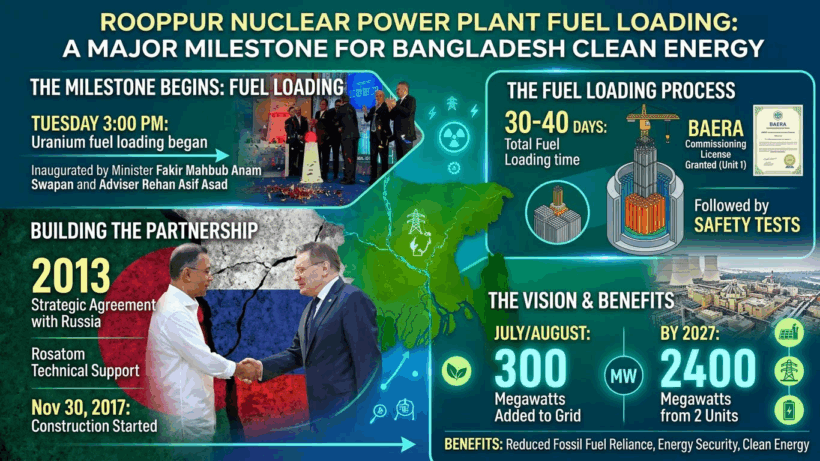
Bangladesh, a rising economic power in South Asia, has witnessed a historic milestone. On Tuesday at 3:00 PM local time, the official loading of uranium fuel into the first unit of the Rooppur Nuclear Power Plant (RNPP) commenced. With this transition, the nation is set to join the elite global club of nuclear energy producers as its 33rd member.
The journey that began with a bilateral agreement with Russia in 2013 has reached its fruition today. The inauguration of this critical phase was led by the Minister of Science and Technology, Fakir Mahbub Anam Swapan, and the Adviser to the Prime Minister, Rehan Asif Asad. The progress of this project, overcoming hurdles such as the COVID-19 pandemic and global geopolitical instabilities, stands as a testament to Bangladesh’s indomitable political will.
The virtual presence of Rafael Grossi, Director General of the International Atomic Energy Agency (IAEA), further reinforced the project’s international credibility and adherence to stringent safety standards.
The project utilizes Russia’s state-of-the-art VVER-1200 reactors (Generation III+). This advanced technology features automated safety systems, including a ‘core catcher,’ specifically designed to contain radioactive material and prevent environmental impact even in the event of a severe accident.
The Rooppur project is more than just an energy installation; it is a cornerstone for the country’s future:
1. Energy Diversification: By generating a massive 2,400 MW at full capacity, it will significantly reduce the nation’s reliance on coal and natural gas.
2. Climate Commitment: As a clean energy source, nuclear power will help bring carbon emissions toward net-zero, marking a major contribution by Bangladesh to the global fight against climate change.
3. Regional Transformation: The areas surrounding Rooppur and Ishwardi have evolved into hubs of economic activity, creating thousands of jobs and improving the standard of living for local communities.
Authorities expect that by late July or early August, at least 300 MW of electricity from the first unit will be integrated into the national grid. The project is on track to reach its full generation capacity by 2027.
While celebrating this milestone, experts have emphasized the importance of long-term radioactive waste management and transparent regulatory oversight. The Bangladesh Atomic Energy Regulatory Authority (BAERA) has reaffirmed its commitment to ensuring the highest levels of safety throughout the plant’s operational life.
As Bangladesh marches toward the centenary of its independence, the Rooppur Nuclear Power Plant stands not merely as a power source but as a symbol of a nation’s technological prowess and its transition toward a modern, sustainable future.
##########
The Author:
 Asif Showkat Kallol: Works for a German-based online outlet, The Mirror Asia, as Head of News and Contributor, Pressenza- Dhaka Bureau.