

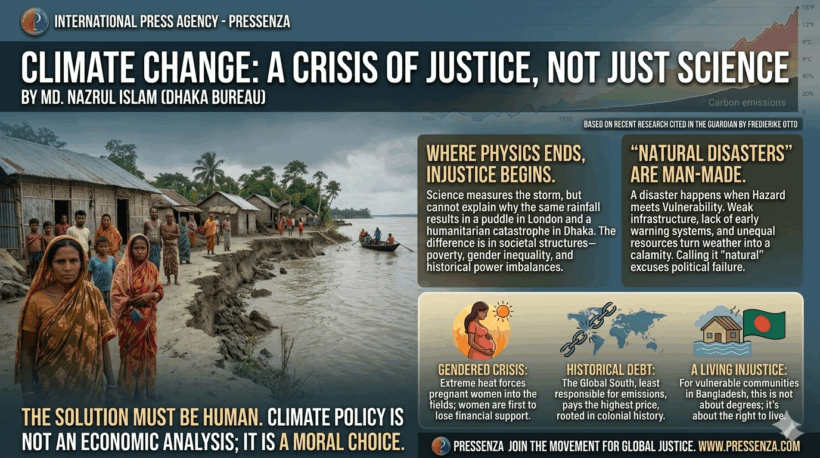
By Nazrul Islam (Dhaka Bureau)
We generally measure climate change through carbon emission graphs, global warming statistics, or images of melting glaciers. However, in light of recent research by climate scientist Friederike Otto, published in the British media outlet The Guardian, it becomes clear that climate change is not merely a ‘scientific problem’- it is, in fact, a deep and escalating crisis of justice.
Modern science can now determine with precision how much human activity has intensified weather patterns. However, science cannot explain why the same amount of rainfall merely causes a waterlogging nuisance on the streets of London, while washing away the homes of thousands in Dhaka or Lagos.
The difference lies not in the science of weather, but in the political and economic structures of society. When a natural disaster strikes, it cannot be measured solely by the volume of rain or the speed of the wind. That disaster reflects our existing poverty, gender inequality, and historical power structures.
Research shows that famines caused by droughts or floods are often influenced more by social context than by climate change itself. Gender inequality, in particular, exacerbates this crisis. When a pregnant woman is forced to labor in a field during extreme heatwaves, or when women are sidelined from receiving financial aid, climate change becomes a tool of gender-based exploitation.
Historical Responsibility and the Global South
Climate injustice is a global moral crisis. The nations of the Global South, which have contributed the least to global carbon emissions, are paying the highest price today. At the root of this crisis lies colonial history. In many cases, the control of climate research remains in the hands of developed nations in the North, who often overlook the social and historical realities of the South.
The Bangladesh Context: A living Injustice
The picture of this injustice is vivid in Bangladesh. The people of our coastal and riverine regions- who have never worked in large factories or led luxurious lives- are the ones being displaced by river erosion and salinity. Here, climate change is not just a rise in temperature; it is the stripping away of a marginalized person’s right to live.
A Human-Centric Solution
Relying solely on technology or science to tackle climate change will not suffice. While international climate discussions remain confined to the limits of 1.5°C or 2°C, we must remember that behind every degree lies the survival of millions of people.
Climate policymaking is no longer just an economic analysis; it is a moral choice. If we cannot restructure our social and economic frameworks on the foundation of justice, we may save the planet with science, but we will fail to save humanity.
International Press Agency Pressenza believes it is time to rethink climate change. This is not just about a warming planet; it is the ultimate test of our humanity and sense of justice.
##########
 Nazrul Islam: Journalist and Researcher. Contributor, Pressenza- Dhaka Bureau.



