

A Commitment to Building a Gender-Sensitive Society
by Rita Bhowmick (Dhaka Bureau)
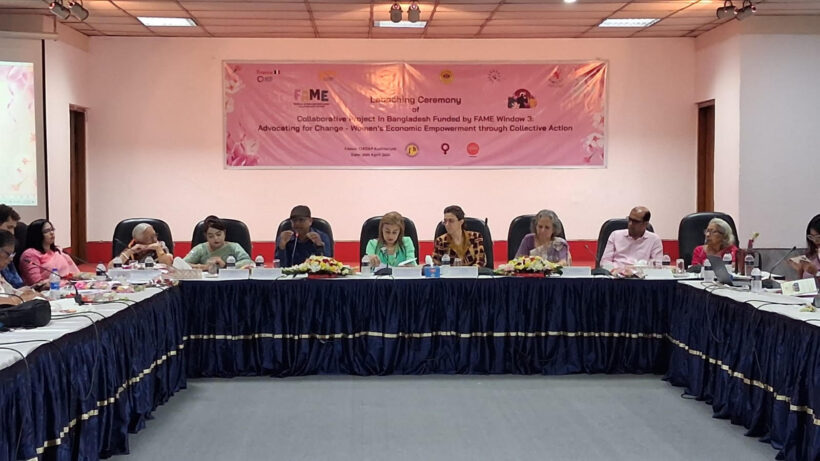
A new integrated network and platform has been launched in Bangladesh to foster an inclusive and gender-sensitive economic environment and to ensure sustainable development and social justice. At an event held on Monday (April 20) at the CIRDAP Auditorium in the capital, speakers emphasized the eradication of gender inequality and the necessity of true economic independence for women.
The project was inaugurated through the joint initiative of the Center for Women and Children Studies (CWCS), Concerned Women for Family Development (CWFD), and Purnima. Supported by financial assistance from Fame Window-3, the initiative will work towards implementing the CEDAW charter in four districts: Dhaka, Gazipur, Satkhira, and Khulna.
In her welcome address, Professor Ishrat Shamim, the founding president of CWCS, remarked, ‘Empowerment is not ensured simply by providing microcredit. In many cases, the loan is spent by the husband while the burden of installments falls on the woman. Our goal is to view society through a gender lens and eliminate social superstitions through institutional education and awareness.’
Presided over by Naz Farhana, President of the Dhaka Women Chamber of Commerce and Industry, the event highlighted that this initiative is not limited to Bangladesh. It will work in coordination with Nepal, Sri Lanka, and Pakistan to strengthen the working environment for women. A robust network will be established at both local and national levels to identify the barriers faced by women entrepreneurs in the market system.
Cynthia Mela, Country Director of Agence Française de Développement (AFD) Bangladesh, noted the ‘feminist’ stance of French diplomacy, stating, ‘An inclusive society is essential for sustainable peace. Men must also become active partners in this journey.’
During the open discussion, Shahnaz Sharmin, Special Correspondent of Channel 71, highlighted the grim reality of women’s contributions to agriculture. She noted, ‘Women provide 62 percent of the labor in agriculture, yet the money from crop sales goes into the pockets of men. Real development is impossible unless this structural inequality is removed.’
Key Objectives of the Project:
- Gender Lens Assessment: Ensuring gender equality in the workplace based on existing policies and laws.
- Inclusion: Creating justice and economic opportunities for women, Hijra, and transgender communities.
- Training: Skill development and rehabilitation for returning female migrant workers.
- Integrated Protection: Raising awareness for children and their families through the 1098 helpline.
Representatives from the Department of Women Affairs, the Ministry of Social Welfare, and leaders of the Bangladesh Employers’ Federation applauded this coordinated effort. Speakers reached a consensus that cultivating a worldview through the eyes of women and fostering collective awareness are the only ways to build a discrimination-free economic structure.
As an international press agency, Pressenza consistently advocates for non-violence and human rights. This new initiative in Bangladesh is considered a significant step toward achieving those goals.
##########
The Author:
 Rita Bhowmick: Senior Journalist and Staff Correspondent, Pressenza- Dhaka Bureau.


