

By Nazrul Islam (Dhaka Bureau)
Standing in the mid-2026s, tobacco control has become a major point of discourse in Bangladesh, one of South Asia’s most densely populated nations. On December 30 last year, the interim government issued the ‘Smoking and Tobacco Products Usage (Control) (Amendment) Ordinance, 2025.’ While this ordinance has tightened existing laws and increased fines several-fold, the question remains: has this progressive step on paper actually reached the lungs of the common people?
Bhutan: Where Law is a Social Contract
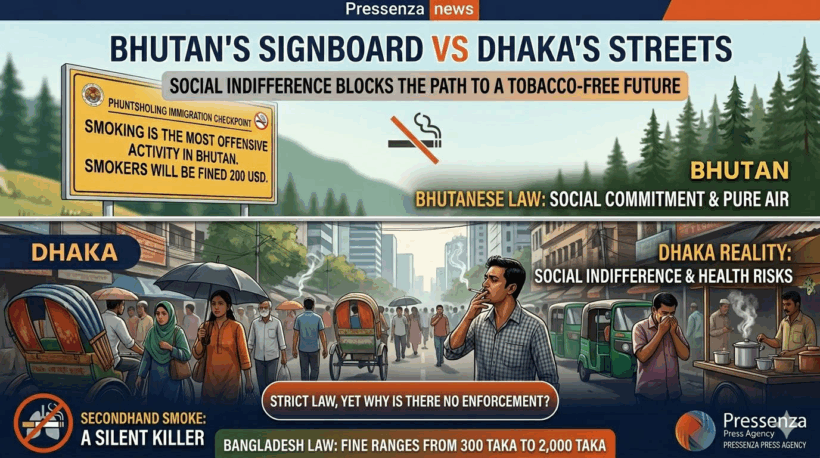
Upon entering Bhutan’s Phuentsholing immigration checkpoint, one is greeted by a massive signboard that reads- ‘Smoking is the most offensive activity in Bhutan. Smokers will be fined 200 USD.’
This is not merely a warning; it is a guarantee of Bhutan’s pristine air. There, a smoker thinks ten times before lighting a cigarette in public, as both respect for the law and the penalty are highly effective. The scent of pine forests remains intact in Bhutan’s air because their law is not just a state mandate, but a social commitment.
Bangladesh: Strict Laws vs. Gritty Reality
The contrast in Bangladesh is stark. According to the newly amended ordinance:
- Increased Fines: The fine for public smoking has been raised from 300 BDT to 2,000 BDT.
- Product Bans: All modern tobacco products, including e-cigarettes, vapes, and ‘Heat-Not-Burn’ (HNB) devices, are strictly prohibited.
- Protected Zones: Selling tobacco products within 100 meters of educational institutions, hospitals, and playgrounds is now a punishable offense.
Despite these measures, the scene on Dhaka’s footpaths, public transport, and parks remains unchanged. Public smoking is so ubiquitous that the general public no longer views it as an offense. While the law exists, the presence of law enforcement agencies to implement it is rare.
Secondhand Smoke: The Silent Killer
Smoking is not just a personal harm; it is a social injustice. An alcoholic primarily damages their own liver, but a public smoker damages the lungs of hundreds of non-smokers around them. Secondhand smoke causes pneumonia and asthma in children and severely hampers the development of unborn babies in pregnant women. Furthermore, the thousands of harmful chemicals in a single cigarette’s smoke pose a long-term curse to the environment.
What Lies at the Root of Failure?
The primary reasons for the failure to implement anti-tobacco laws in the Bangladeshi context include:
- Weak Monitoring: A lack of regular supervision by mobile courts or specialized task forces.
- Accessibility: The easy availability of tobacco products near educational institutions.
- Lack of Awareness: The absence of a user-friendly digital platform or app to report violations.
- Lack of Support: Inadequate government counseling or programs to help addicts quit smoking.
The Way Forward: Our Responsibility
Building a tobacco-free Bangladesh is impossible through legislative gazettes or the fear of fines alone. It requires:
- Joint Task Forces: Coordinated operations between City Corporations and the Police.
- Technological Solutions: A mobile app for citizens to report public smoking instantly.
- Social Resistance: A shift in mindset similar to that of Bhutan.
The next time you see someone smoking in public, every citizen should say calmly but firmly: ‘Brother, your smoking is harming me too.’
Bhutan’s signboard reminds us that if a state desires, it can keep its air toxin-free. Bangladesh’s new law is a significant step toward that goal, but its full realization depends on our social awareness and government willpower. A tobacco-free Bangladesh is not a luxury; it is a fundamental right for our next generation.
The Author:
 Nazrul Islam: Journalist and Researcher. Contributor, Pressenza- Dhaka Bureau.



