

by Asif Shaowkat Kallol (Dhaka Bureau)
Bangladesh is preparing to unveil its largest-ever national budget for the 2026-27 fiscal year, as policymakers attempt to balance ambitious political commitments with mounting economic pressures at home and abroad.
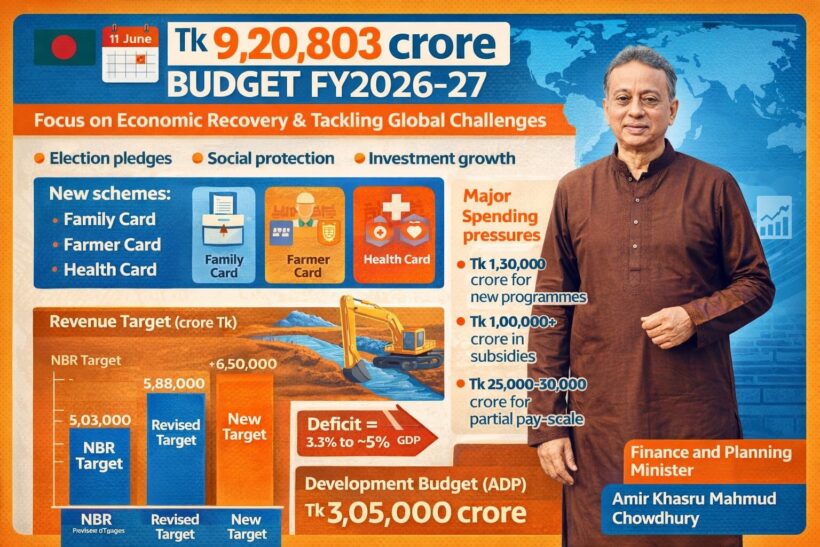
Officials at the finance ministry have provisionally set the budget size at Tk 9.2tn (£66bn approx.), a sharp increase on the current fiscal framework and a departure from earlier expectations of a more restrained, austerity-driven approach. The proposal is expected to be presented in parliament on 11 June by Finance Minister Amir Khasru Mahmud Chowdhury. The budget outlay for the next fiscal year was finalized recently at a Coordination Council meeting held on Zoom, presided over by the finance and planning minister.
The scale of the planned spending reflects a complex policy landscape. The government faces rising subsidy demands, a widening revenue gap, and the economic fallout of global instability- particularly the ongoing conflict in the Middle East, which has pushed up energy costs and intensified pressure on foreign exchange reserves.
Despite these constraints, the draft budget prioritises expansionary measures aimed at stimulating recovery and delivering on electoral pledges. Central to this strategy are four flagship welfare programmes: family cards, farmer cards, health cards, and a canal excavation scheme. Together, these initiatives are designed to channel direct support to households, boost agricultural productivity, and address structural weaknesses in water management and employment generation.
Initial estimates suggest that the family card scheme alone could cost Tk 130bn in its first year, targeting around 4 million households, with plans to expand coverage to 10 million families in subsequent phases. Additional allocations are expected across agriculture, healthcare and rural infrastructure, pushing total new spending requirements to over Tk 1.3tn.
At the same time, the government is under pressure to partially implement a new public sector pay scale, which could add a further Tk 250bn-300bn to expenditure in the short term. Energy subsidies are also projected to exceed Tk 1tn, driven by volatile global fuel prices and increased domestic demand.
On the revenue side, the outlook remains uncertain. The current fiscal year’s target of Tk 5.88tn is unlikely to be met, according to officials from the National Board of Revenue. For the upcoming year, the government is considering raising the revenue target to Tk 6.5tn, though economists caution that structural inefficiencies in tax collection could undermine these projections.
As a result, the fiscal deficit is expected to widen to around 5% of GDP, up from an earlier target of 3.3%. While such a gap is not unprecedented, it raises concerns about debt sustainability and financing strategies, particularly in a context of slowing foreign aid inflows.
Economic indicators present a mixed picture. The government aims to raise GDP growth to 6.5% while containing inflation at 7%, but external forecasts are more subdued. The World Bank has projected growth of just under 4% for the current cycle, citing weak investment, energy constraints, and global trade disruptions.
Analysts argue that the effectiveness of the budget will depend less on its size than on its execution. ‘The priority should be a balanced and implementable framework,’ said one Dhaka-based economist, noting that overambitious projections could strain already limited administrative capacity.
Business leaders have echoed calls for a focus on employment generation and energy stability, warning that prolonged uncertainty in these areas could dampen private sector investment.
The proposed budget marks the first full fiscal blueprint of the current administration, and with it, a critical test of its economic management. Whether it can reconcile political ambition with fiscal discipline remains an open question.
————————————————————————————————————
The Author:
 Asif Showkat Kallol: Works for a German-based online outlet, The Mirror Asia, as Head of News and Contributor, Pressenza- Dhaka Bureau.