

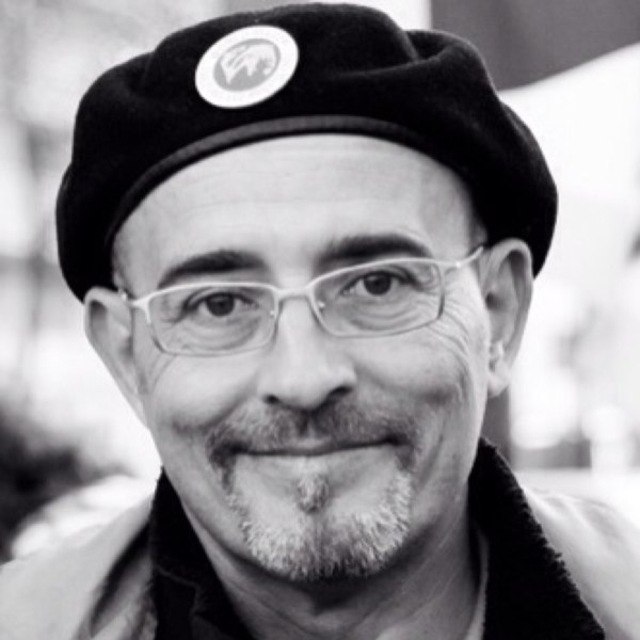
We have lost an Andalusian deeply rooted in his homeland yet possessing a universal outlook.
Interview by Álvaro Orús below
The humanist Luis Silva García (1964–2026) has departed to another place and another time: a committed father, a loyal brother, a faithful friend, a strong and cheerful companion, an entrepreneur in various fields, a tireless activist for peace and non-violence… a profoundly generous and compassionate soul.
Luis was also enormously welcoming and hospitable to people he didn’t even know, never failing to help in any situation where he could.
Cheerful, with a great sense of humour and that Andalusian irony that always accompanied him, he was the opposite of solemn. With that easy-going, or very serious tone, and drawing on the value he placed on friendship, he stood up for what he believed in before friends and strangers alike, and could tell you what almost no one else dared to say, helping you to face a difficult situation. He would break down any problems that arose with a light touch and had no fear of direct communication; his courage also showed in those situations where others felt uncomfortable.
Luis was deeply down-to-earth and yet, at the same time, capable of genuinely noble deeds, understanding these to be acts that seek to help others without expecting anything in return. Someone described him with a very meaningful saying: “What one hand did, the other didn’t know.”
Moreover, he was a clear example of having a universal outlook whilst never neglecting to attend to matters in his immediate surroundings.
Because of the kindness and love that filled him, he devoted himself unconditionally to his family – incidentally, he was extremely proud of his son, Kim – he was always available to help his neighbours; he cared for patients with immense affection in his role as a nurse, helping them to pass away if necessary (something that initially seemed unusual even to his fellow healthcare workers at the hospital where he worked, and for which they later called on him to do ‘that thing he did’ to comfort the dying and help them come to terms with their lives so they could depart in peace).
Driven by that same kindness and compassion, he entered politics to help his neighbours, becoming a councillor for his village, La Rinconada, for the Sí se puede party, where today those who knew him mourn his passing and have expressed their grief in the media and on social media.
He also spearheaded the March for Dignity in Andalusia, played a part in halting evictions, and helped to occupy properties owned by large landlords for families left homeless, amongst many other actions that always began and ended with grassroots support.
And because of his commitment to humanity, he served as a nurse on the Base Team of the 1st World March for Peace and Nonviolence, which travelled through more than 100 countries. From the testimonies we have received, it is clear to us that he took care of people’s physical needs as well as their relationships, helping to ease the small, inevitable tensions that might have arisen during so many shared days and nights. He was a master of relationships.
From that experience, we have retrieved this interview, which was conducted with him in Punta de Vacas Park at the end of the World March. We recommend watching it and listening to Luis in his purest form. In any case, we would like to highlight two of his quotes:
“We undertook this march to try to instil hope in people, and ultimately it is the people who give us hope”
[After this March] “It has changed my view of the world; you can no longer feel alone because you are surrounded by people who aspire to the same things as you.”
From this adventure, we have gathered some testimonies from comrades who marched with him at some point during those three months that the 1st World March for Peace and Nonviolence lasted
François Dauplay (Paris, FRANCE) “What a shining light he was! And I am enormously grateful for this testimony [the interview above], which reminds me that I have always dreamed of doing the same as him: travelling the world for peace and non-violence.”
El Kodadi-Tanger (MOROCCO) “I remember him as a deeply humane man, always attentive to the well-being of others and fully committed to the team.”
Magaly Navarrete (GERMANY) “A dear fellow marcher, he would wake us up with songs from the World March blaring at full volume during our journey through Latin America, with joy and a very powerful energy.”
But also, like so many of our comrades, he helped bring humanism to other countries, including Cameroon, where the Bahá’í Community of Douala held a ceremony in his honour, with one of its members describing him as a “great soul”—a sentiment we share.
Luis, you were the great caretaker of everyone close to you. Always with your rucksack of basic medical supplies when we asked for your support. A first-aid course at Toledo Park as part of the Summer University of Universalist Humanism remained pending. It will no longer be possible, but we treasure your unconditional dedication with enormous gratitude and as a guiding principle for our actions.
Luis, dear friend, your words in the interview accompanying this piece have reminded us of these lines that close the little book, “Silo’s Message”:
“Do not imagine that you are enchained to this time and this space”
“Do not imagine that in your death, loneliness will become eternal”
We are sure you have already experienced this, but we need to be reminded of it.
Peace in the heart, light in the understanding!



