

by Asif Showkat Kallol (Dhaka Bureau)
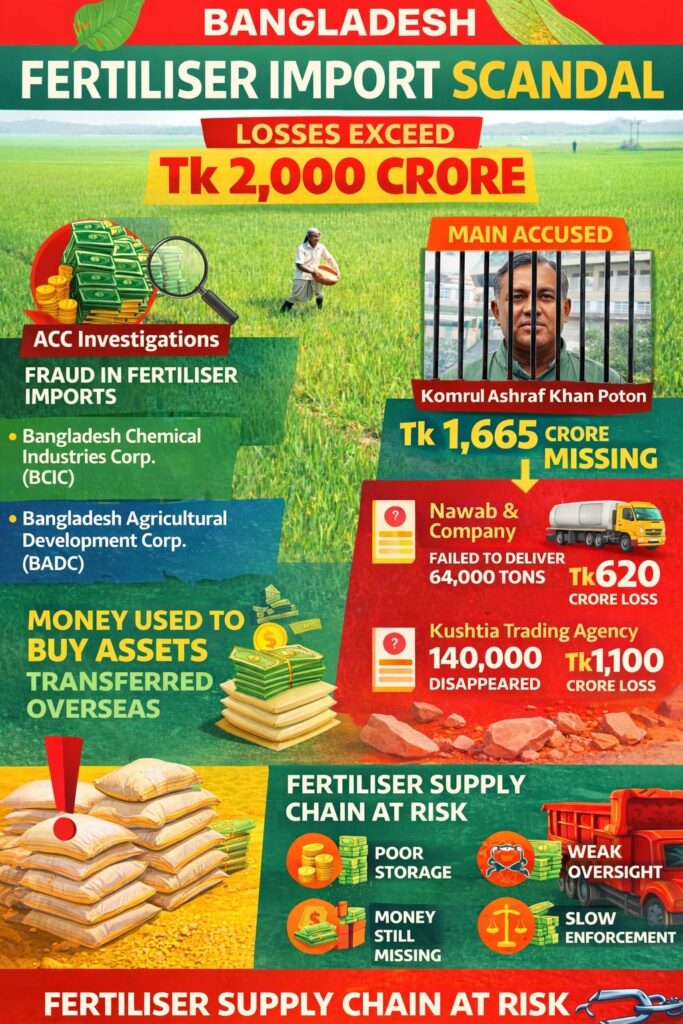
Bangladesh’s two main state agricultural agencies have failed to recover losses from alleged large-scale irregularities in government-imported fertiliser purchases worth nearly Tk 2,000 crore (£145m), according to findings by the country’s anti-corruption watchdog.
The Bangladesh Chemical Industries Corporation (BCIC) and the Bangladesh Agricultural Development Corporation (BADC) remain unable to reclaim funds linked to disputed urea and non-urea fertiliser imports made under government-to-government procurement deals over the past five years, investigators from the Anti-Corruption Commission (ACC) say.
The alleged fraud has raised fresh concerns over governance and accountability in Bangladesh’s agricultural supply chain, with experts warning that mismanagement in fertiliser procurement could threaten food security in a country heavily reliant on subsidised agricultural inputs.
Among those under scrutiny is former Awami League MP Komrul Ashraf Khan Poton, currently in jail over related allegations. ACC investigators accuse him of orchestrating irregularities involving more than Tk 1,665 crore in public assets through contracts linked to BCIC and BADC.
In one case filed in November 2023, Poton and four others were accused of misappropriating Tk 581.58 crore tied to 72,000 metric tonnes of fertiliser under BCIC. A second case filed in May 2025 alleges irregularities worth Tk 1,400 crore involving 184,000 metric tonnes under BADC.
Investigators believe some of the missing funds may have been used to acquire domestic and overseas assets in the names of Poton and his family, while the remainder is suspected to have been laundered abroad through informal transfer networks.
Several private contractors have also been implicated. Chittagong-based M/S Nawab & Company is accused of failing to deliver 64,000 metric tonnes of fertiliser to government warehouses despite securing a transport contract in 2021, allegedly causing losses of nearly Tk 620 crore.
Kushtia Trading Agency faces allegations over the disappearance of 140,000 metric tonnes of fertiliser worth approximately Tk 1,100 crore, while Pacific Consumer Goods Limited is under investigation for failing to deliver 15,000 metric tonnes of MOP fertiliser over a three-year period.
Despite multiple criminal cases filed by the ACC on charges including fraud, breach of trust, and abetment, several suspects remain beyond the reach of law enforcement, fuelling criticism over weak accountability.
The allegations have also exposed structural weaknesses in Bangladesh’s fertiliser management system. Although BADC’s storage capacity is around 200,000 metric tonnes, annual fertiliser imports have at times exceeded 2m metric tonnes, forcing authorities to rely on inadequate external storage facilities.
Analysts warn that poor storage conditions and procurement irregularities risk not only financial losses but also the distribution of degraded fertiliser to farmers, potentially undermining crop yields and agricultural productivity.
The government has yet to announce a timeline for recovering the missing funds or completing the ongoing prosecutions.
————————————————————————————————————————————————————————
The Author:
 Asif Showkat Kallol: Works for a German-based online outlet, The Mirror Asia as Head of News and Contributor, Pressenza- Dhaka Bureau.


