

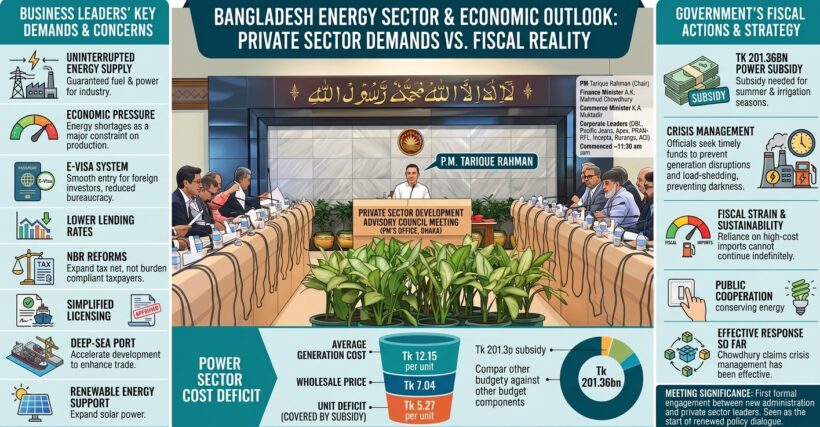
The government manages Tk 201.36bn power subsidy for uninterrupted power
by Asif Showkat Kallol (Dhaka Bureau)
Top business figures attending a meeting of the Private Sector Development Advisory Council, chaired by Prime Minister Tarique Rahman, raised concerns over mounting pressure on the economy from the ongoing energy crisis and called for assurances of uninterrupted fuel and power supply.
Finance minister Amir Khasru Mahmud Chowdhury, speaking to reporters after Saturday’s meeting at the Prime Minister’s Office in Dhaka, said business leaders highlighted energy shortages as a major constraint on industrial production and overall economic activity. They also urged government support for expanding renewable energy, particularly solar power, to reduce long-term dependence on conventional fuel sources.
Officials pointed to growing fiscal strain in the power sector. The power division has sought Tk 201.36bn in subsidies from the finance ministry to maintain an uninterrupted electricity supply during the upcoming summer season and irrigation season. Without timely disbursement, officials warned of severe disruptions to power generation and the risk of widespread load-shedding across the country.
Questions have emerged over how such a large subsidy burden could fit within the national budget. A day earlier, Chowdhury described crisis management efforts as effective so far, noting that supply chains for fuel and food grains have remained intact despite sustained pressure. He called for public cooperation in conserving energy, while cautioning that reliance on high-cost imports could not continue indefinitely without affecting broader fiscal stability and reform priorities.
Business leaders also called for the introduction of an e-visa system to facilitate smoother entry for foreign investors, reducing bureaucratic hurdles at airports. They pressed for lower lending rates, reforms in the National Board of Revenue, and expansion of the tax net rather than increasing the burden on compliant taxpayers.
Further recommendations included simplifying licensing procedures to support mid-level exporters and accelerating the development of a deep-sea port to enhance trade capacity.
According to the finance minister, the prime minister sought direct input from business leaders on the challenges they face. Authorities documented their concerns, with some issues already addressed and others remaining under discussion.
Bangladesh’s power sector continues to struggle with a widening gap between production costs and consumer tariffs. Average generation cost stands at Tk 12.15 per unit, while the wholesale of electricity price remains around Tk 7.04, leaving a deficit of Tk 5.27 per unit covered through subsidies.
Analysts attribute much of the subsidy burden to structural inefficiencies, including capacity payments to privately owned power plants. Many of these facilities, built during the previous administration, remain underutilised, yet contractual obligations require payments regardless of actual electricity purchase. Over the past 15 years, such payments have reached Tk 1.33tn.
Rising costs have also followed currency depreciation against the US dollar and a sharp increase in gas prices, which climbed from Tk 5.02 to Tk 15.50 per unit, alongside expansion in installed generation capacity beyond demand levels.
In a letter sent on 16 March, the power division requested subsidy allocations for the period মার্চ to December, citing the need to operate three newly added power plants- a 160MW HFO-based plant in Sreepur, a 1,320MW coal-fired plant in Patuakhali, and the Matarbari ultra-supercritical coal plant. These three alone require Tk 82.44bn in subsidies.
Additional funds include Tk 82.75bn for settling electricity import bills from India and Tk 36.17bn for state-owned generation facilities and the Bangladesh Power Development Board.
Meanwhile, the International Monetary Fund has maintained pressure on Bangladesh to reduce energy subsidies. Under a $4.7bn loan programme, the previous administration committed to gradual tariff adjustments aimed at phasing out subsidies, a target that now appears increasingly difficult amid current economic pressures.
The Author:
 Asif Showkat Kallol: Works for a German-based online outlet, The Mirror Asia as Head of News and Contributor, Pressenza- Dhaka Bureau.