

4 April 2026, Quezon City. The environmental health watchdog group EcoWaste Coalition decried the uncontrolled littering that once again sullied some pilgrimage sites and public spaces as the faithful recalled the passion and death of Jesus Christ, particularly on Maundy Thursday and Good Friday.
While most churches visited were found generally clean, littering marred the Maundy Thursday Alay Lakad (walk offering) to the International Shrine of Our Lady of Peace and Good Voyage in Antipolo City, the Good Friday procession of the Minor Basilica and National Shrine of Jesus Nazareno, and the Way of the Cross at the Our Lady of Lourdes Grotto Shrine in San Jose del Monte City.
“Despite the oft-repeated reminders to leave only footprints, rampant littering again tarnished the Holy Week as if it has become a tradition in itself,” said Ochie Tolentino, Zero Waste Campaigner, EcoWaste Coalition. “As old habits die hard, we urge everyone, especially our faith leaders and the faithful, to persevere in promoting shared responsibility towards ecological conversion, so we dispose of practices that disrespect and harm Mother Earth.”
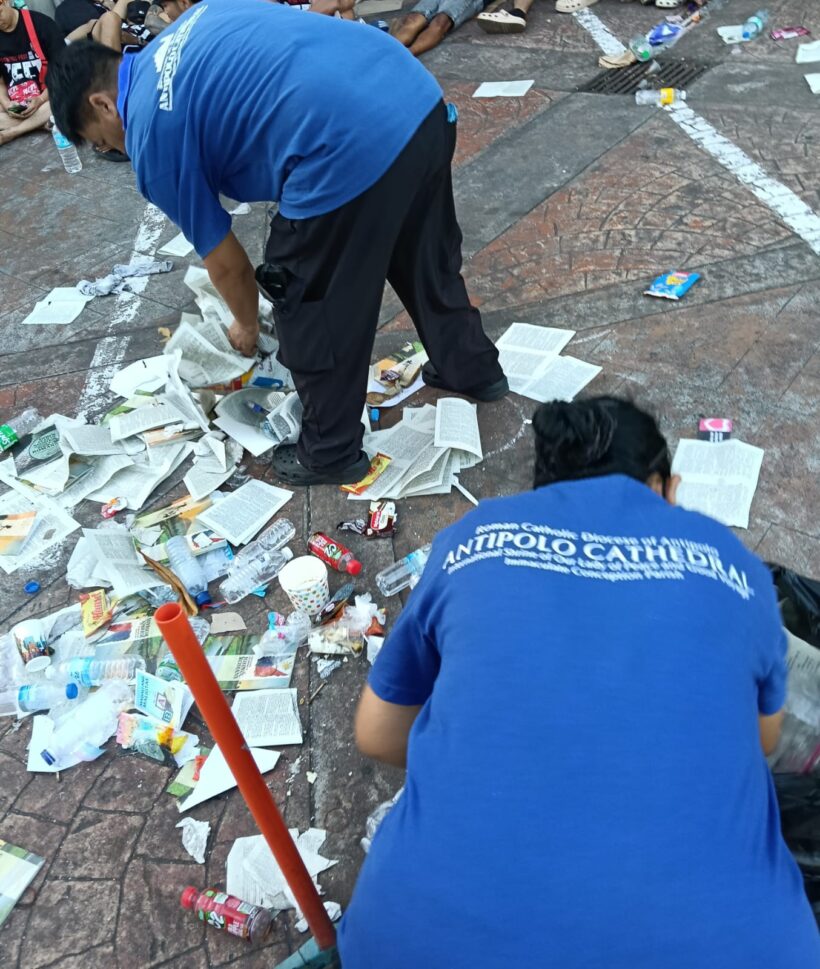
Devotees, estimated at over six million, who trekked to Antipolo City for penitential and thanksgiving walks left a trail of garbage that kept the waste and sanitation workers of at least four local government units (LGUs) in Pasig, Cainta, Taytay, and Antipolo preoccupied, with the Tikling Junction as a particular littering hotspot.
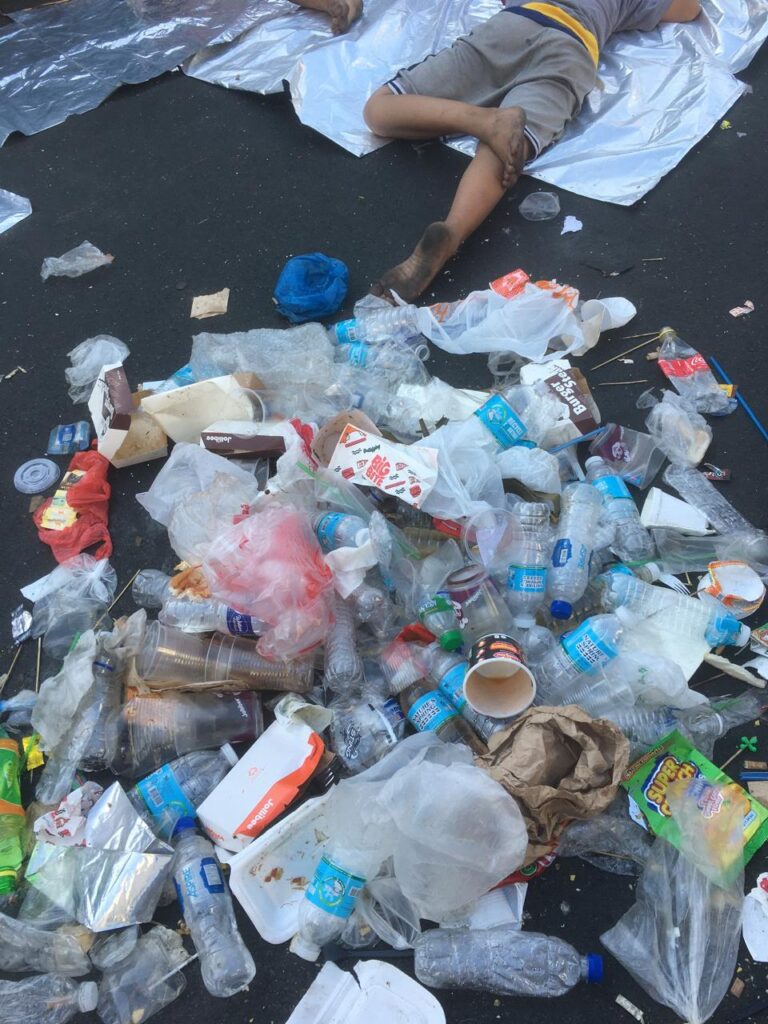
Plastic waste piles up at Quezon Boulevard as the Good Friday procession of the Black Nazarene gets underway.
In the early morning of Good Friday, the patio of the Antipolo Cathedral was teeming with litter, such as discarded plastic bottles and, of all things, religious literature distributed by non-Catholic groups to Alay Lakad participants.
Rampant littering was also observed in Quiapo district, particularly along Quezon Boulevard, Recto Avenue, and adjacent streets, as the 13-hour procession of the revered Black Nazarene drew over 500,000 devotees.
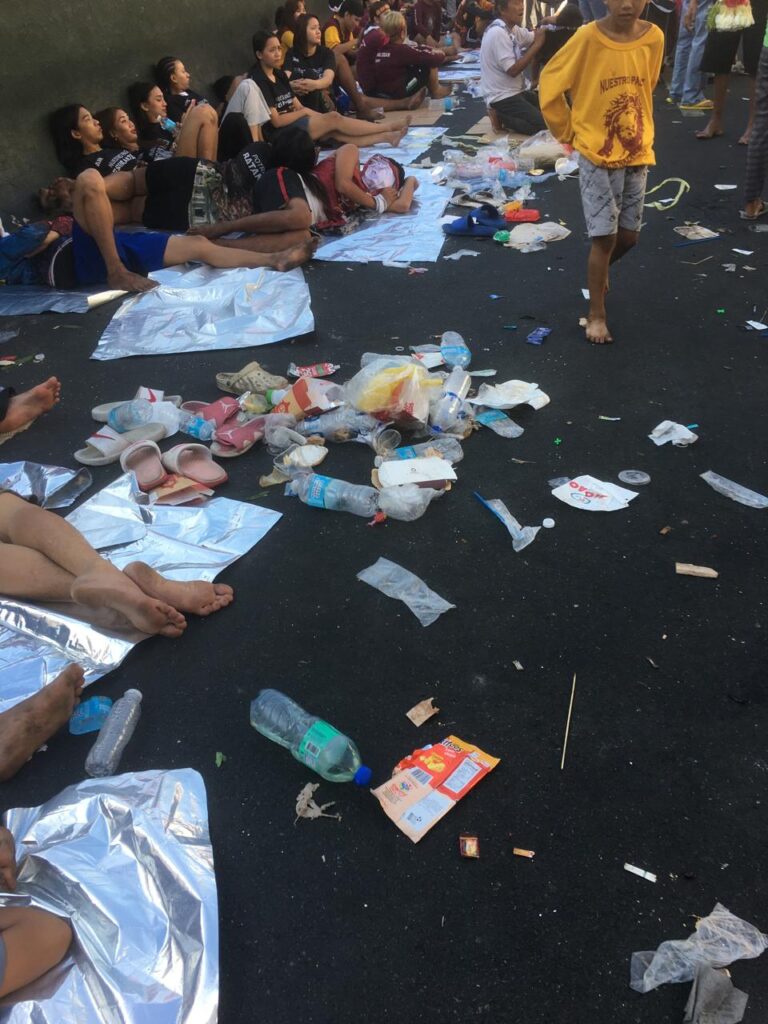
Tired Black Nazarene devotees take a break, leaving trash scattered on the street.
At the Our Lady of Lourdes Grotto Shrine, pilgrims who visited the site to perform the Way of the Cross left a load of rubbish, as evidenced by overflowing bins and Calvary Hill dotted with patches and piles of litter. The picnic area, in particular, was swarmed by visitors, some of whom simply tossed used food containers and plastic bottles on the ground.
While not as bad as in previous years, littering was also observed at the National Shrine and Parish of the Divine Mercy in Marilao, Bulacan.
For this year’s Lenten monitoring, the EcoWaste Coalition’s Basura Patrollers braved the scorching heat and visited some 42 churches in Bataan, Batangas, Bulacan, Cavite, Rizal, and the National Capital Region, particularly in Caloocan, Makati, Malabon, Mandaluyong, Manila, Navotas, and Quezon Citis.
Among the places that stood out for cleanliness at the time of monitoring were the Cathedral-Shrine and Parish of St. Joseph (Balanga City, Bataan), St. Catherine of Sienna Parish (Samal, Bataan), Minor Basilica of the Most Holy Rosary (Orani, Bataan), Archdiocesan Shrine and Parish of St. James the Greater (Ibaan, Batangas), Metropolitan Cathedral of St. Sebastian (Lipa City), Minor Basilica of St. Martin of Tours (Taal, Batangas), Saint Gregory the Great Parish (Indang, Cavite), St. Augustin Parish (Mendez, Cavite), and, most notably, the Holy Spirit Chapel at the SVD Seminary (Tagaytay City) where strict ecological solid waste management, including segregation at source, is enforced in line with RA 9003 or the Ecological Solid Waste Management Act.
Also cited for being litter-free were the National Shrine and Parish of Our Lady of Aranzazu (San Mateo, Rizal), Mary Immaculate Parish Nature Church (Las Piñas City), St. Andrew the Apostle Parish (Makati City), San Bartolome Parish (Malabon City), San Felipe Neri Parish (Mandaluyong City), Santuario de Santo Niño (Mandaluyong City), and Santo Domingo Church (Quezon City),
The EcoWaste Coalition further recognized and thanked the LGU and church waste workers and volunteers, as well as the members of the informal waste sector, for their roles in keeping the pilgrimage sites and public spaces clean and for diverting recyclables and other useful resources away from dumps and landfills.



