

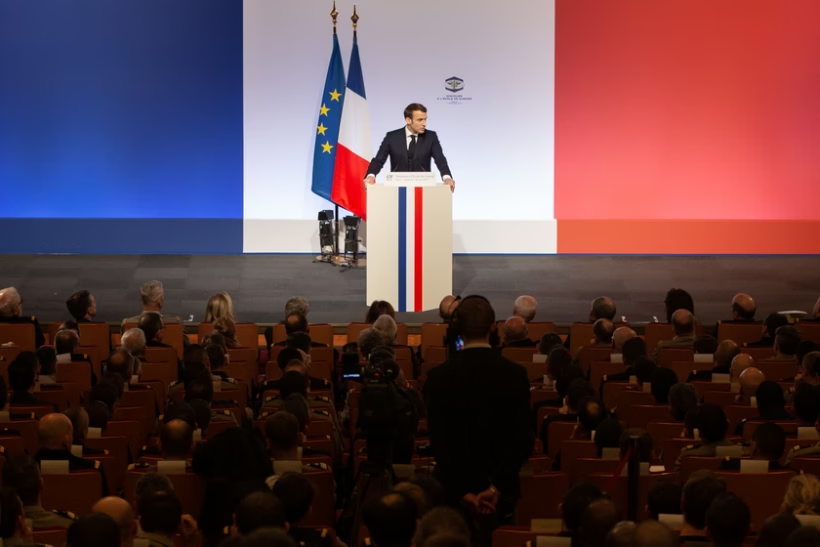
President Emmanuel Macron’s solemn speech on French nuclear deterrence, delivered on March 2, 2026, from the Île Longue submarine-launched ballistic missile (SLBM) base, manages the remarkable feat of combining, in a “both-at-once” manner, a clear retreat from the traditional doctrine inherited from Gaullism and Mitterrandism and a dangerous headlong rush toward an increased risk of using nuclear weapons—weapons that are supposed to be purely for deterrence. This is not the only contradiction in this latest missed opportunity to contribute to a safer and more peaceful world.
By Marc Finaud, Vice President of IDN
It has become a distinctly French tradition: every president of the Republic feels compelled to leave his mark during his term in office by asserting the power associated with the possession of nuclear weapons. Emmanuel Macron did so during his first five-year term on February 7, 2020, at the École de Guerre. Like other commentators, IDN had judged at the time that, despite his clarity regarding the new causes of insecurity, the president had offered fundamentally conventional and inadequate responses, even though he had already shown openness toward European countries. It was conceivable that the deterioration of the international situation six years later would lead the head of state to an updated analysis, but, once again, the conclusions that he and his “defense” advisors drew from it and the measures he announced are marred by their intrinsic contradictions.
Rejecting the arms race and the expansion of arsenals
On the one hand, the president’s remarks reiterate this: France continues to affirm its rejection of the nuclear arms race. Emmanuel Macron harshly criticizes the expansion of Russian, Chinese, Indian, Pakistani, and North Korean arsenals, as well as defensive systems such as the Golden Dome deployed by the United States. But, on the other hand, his response is: “An expansion of our arsenal is essential.” He then announced an increase in the number of nuclear warheads comprising it—currently estimated at 290—as well as the qualitative modernization of nuclear weapons systems: the deployment of the new M51.3 submarine-launched missile, the new ocean-based nuclear warhead (TNO), the “upgraded” cruise missile for the strategic air force and naval aviation, the program for strategic hypersonic and maneuverable missiles, and the launch of the third-generation SSBN in 2036.
Admittedly, the president insists that this is by no means a matter of engaging in a “costly arms race” or seeking “arsenal parity.” In effect, by abandoning the “strict sufficiency” of France’s long-standing doctrine and replacing it with the more ambiguous notion of “thresholds strictly consistent with the operational effectiveness of our deterrence,” he now aims for the capability to retaliate against an aggressor so that the latter cannot “recover” or “bounce back,” regardless of its power or size. He thus mentions for the first time the destructive capacity of a single SSBN: that of all the bombs of World War II or a thousand times the first atomic bombs. A former SSBN commander had, in fact, preceded him by drawing a parallel with 1,000 times the Hiroshima bomb. If we estimate the number of victims of the latter at 200,000, we can easily calculate that a submarine such as the future Invincible, carrying 16 missiles each equipped with 10 nuclear warheads, could cause the massacre of 200 million innocent people. Why, under these circumstances, would we still want to increase this capacity?
The “field of ruins” of the “field of rules” and France’s violation of treaties
President Macron is right to observe that “international arms control agreements are struggling,” given the termination or expiration of several bilateral agreements between the United States and Russia (ABM, INF, and New START treaties) or the non-ratification of multilateral agreements (Comprehensive Nuclear-Test-Ban Treaty), as well as China’s absence from these processes. He emphasizes France’s commitment to its international obligations, particularly the Treaty on the Non-Proliferation of Nuclear Weapons (NPT), which is threatened by North Korea’s nuclear programs (even though Pyongyang has in fact withdrawn from the NPT), the Iranian crisis, and the ambitions of countries seeking alternatives to current security guarantees—that is, those tempted to acquire nuclear weapons in Asia, Europe, or elsewhere. All in all, he asserts, “the field of rules is a field of ruins.” He obviously makes no mention of the Treaty on the Prohibition of Nuclear Weapons (TPNW), a civil society initiative now supported by the majority of the world’s states (including several European countries) but still rejected by the nuclear powers and their allies.
In response to this assessment, the president calls for new rules and a new security framework (particularly between Europe and Russia)—goals that are difficult to imagine under current circumstances and can only be pushed back to an unspecified future date. On the other hand, he ignores—and for good reason—the flagrant violations of international law that his own policies and statements constitute:
₋ Article VI of the NPT obliges France, like all other States Parties, to “pursue in good faith negotiations on effective measures relating to cessation of the nuclear arms race at an early date and to nuclear disarmament, and on a treaty on general and complete disarmament under strict and effective international control.” How can the March 2 speech—which does not contain the word “disarmament” even once but merely mentions in passing “the ultimate goal of a world without nuclear weapons”—claim to be in compliance with this obligation? How are the French announcements, which actually contribute to the nuclear arms race, compatible with “effective measures to end” this race “at an early date” (a requirement for France since 1992, even as the president envisions a “half-century of nuclear power” and the operation of future SSBNs well into the 2090s, for the 100th anniversary of its accession to the NPT)?
₋ At the 2010 NPT Review Conference, France had also agreed, like the other nuclear powers, to “further reduce the role and significance of nuclear weapons in all military and security concepts, doctrines, and policies,” even though France, according to the president, makes nuclear weapons “the cornerstone of its security”;
₋ In its Advisory Opinion of July 8, 1996, the International Court of Justice (ICJ) concluded that “the threat or use of nuclear weapons would generally be contrary to the rules of international law applicable in armed conflict, and in particular the principles and rules of humanitarian law.” Does threatening millions of people with extermination while boasting about the destructive capabilities of one’s arsenal constitute respect for these rules?
As we can see, these announcements—whether regarding the increase in the number of warheads and the deployment of new systems, or the abandonment of transparency regarding the arsenal and the concept of “strict sufficiency”—represent a serious step backward from the status quo ante. Yet, paradoxically, this regression is coupled with a dangerous headlong rush.
Defensive Nature and Final Warning
The speech at Île Longue once again emphasizes the “defensive” nature of French nuclear deterrence. The president proclaims that France’s arsenal is “exclusively strategic” and “strictly defensive” and that France therefore rejects “nuclear warfare.” At the same time, he reiterates the option of a “single, non-renewable nuclear warning (…) to signify very concretely that the nature of the conflict has just changed and that France intends by this means to preserve a final chance to reestablish deterrence.” It is clear that this would no longer be a defensive action intended to deter an attack, but rather the launch of a first nuclear strike in response to the failure of deterrence, which one hopes to “restore.” The president affirms his intention to use nuclear weapons first to restore deterrence when in fact he is preparing to trigger a nuclear conflict! Indeed, proponents of nuclear weapons sometimes accuse advocates of disarmament of being naive or utopian, but in this case, how can one seriously imagine that a nuclear-armed state suffering a nuclear strike—even if it were “a single, non-repeatable” one— would not retaliate with a devastating nuclear strike against France, especially if the “warning” is delivered by 300-kiloton ASMP-A missiles (20 times the power of the Hiroshima bomb)—which are impossible to restrict to military targets only without causing massive civilian casualties?
This lowering of the nuclear threshold—and thus this increased risk of nuclear weapons being used—also stems from the investment by most nuclear powers, including France, as confirmed by President Macron, in maneuverable hypersonic missiles capable of evading any defense system and, consequently, providing an incentive for first strikes.
French Deterrence and “Forward Deterrence”
Hailed by the authorities and propagandistic commentators as “historic”, “significant”, or even a “turning point,” the section of the speech devoted to the European dimension of deterrence also contains major contradictions. On the one hand, the president reaffirms—a constant since the Chirac presidency in 2001—that the French “vital interests” that would justify the use of nuclear weapons in the event of an attack include a “European dimension.” What is new is the concept of “forward deterrence,” which seeks to embed French nuclear deterrence in a strategic depth extending beyond national borders. Thus, the speech refers to cooperation projects with several non-nuclear-armed European countries (Belgium, Denmark, Germany, Greece, the Netherlands, Poland, and Sweden) and the United Kingdom: joint exercises, the participation of allied conventional forces in support of French nuclear missions, the deployment of French strategic forces abroad, and the dispersal of fighter-bombers and/or tankers from the Strategic Air Force (FAS).
On the other hand, the head of state asserts that, while “taking into account the interests of [its] allies,” France, according to its “sovereign judgment,” “will always act alone in deliberately crossing the nuclear threshold.” This serves as a reminder, if one were needed, that the “nuclear button” remains the sole prerogative of the President of the Republic. Without dwelling on domestic political aspects, this speech appears to be a risky balancing act between the notion of sharing or Europeanizing nuclear deterrence—unthinkable for the right and the nationalist far right—and the ambition of the leader of the continent’s sole Western nuclear power to appear as the guarantor of its security. But it must be clear to the allies that “there will be no guarantee in the strict sense of the term.” Is this a way to preempt the accusation—which is sure to surface at the 2026 NPT Review Conference—that this form of “forward deterrence” constitutes another violation, if not of the letter, then at least of the spirit of the NPT?
In any case, the same question remains that General de Gaulle posed to Kennedy to cast doubt on the American nuclear “umbrella”: Is the United States prepared to sacrifice New York for Paris? Today, the question is: Is France prepared to sacrifice Paris for Tallinn or Warsaw?
The result is certainly a display or a “signal” intended to impress Putin’s Russia, whose reaction is to note that not only is this rhetoric “detached from reality” but that this “claim to nuclear leadership in Europe” also constitutes a “threat” to Moscow. However, the main impression one gets is one of ambiguity, particularly regarding the relationship with NATO. Aside from the United Kingdom, which possesses nuclear weapons but is heavily dependent on the United States, three of the European countries considered for “forward deterrence ” (Germany, Belgium, the Netherlands) already host American B-61 nuclear bombs on their soil and would be involved in their use. The others (Denmark, Greece, Poland, Sweden) already participate in conventional missions in support of NATO’s nuclear operations.
Here again, a glaring contradiction can be observed: on the one hand, President Macron notes that “alliances” (implying NATO) are “faltering”—a euphemistic way of describing a shaken confidence in U.S. support for European security—calling for greater “strategic autonomy.” However, he asserts, “our American allies (…) have played and will continue to play a key role in the defense of Europe (…) and in terms of deterrence, they are directly involved in our protection through NATO’s nuclear mission.” On the other hand, he emphasizes, the effort required for “forward deterrence” “would be in addition to NATO’s nuclear mission [in which] we do not participate,” but “in full transparency” with our American allies.
This ambiguity is also reflected in the official English translation of the term “forward deterrenc.” From “dissuasion avancée.” This choice distinguishes it from the United States’ “extended deterrence” but echoes the term “forward-deployed,” which describes the U.S. tactical nuclear weapons deployed on the soil of five NATO countries.
The ambiguity also extends to the relationship between conventional and nuclear weapons, as the statement refers to “early warning to detect threats, expanded air defense to guard against them, and deep strikes to counter and act offensively (…), what is known as ‘shouldering’.”
He asserts that “to be strong in our nuclear deterrence, we must be strong in our conventional capabilities in all their dimensions.” In this regard, he laments “the glaring lack of supporting capabilities in Europe.” However, past experience has clearly shown, especially during periods of budgetary austerity, that any increase in spending on nuclear deterrence comes at the expense of conventional forces. European defense budgets have certainly increased dramatically as a result of the war in Ukraine, but there is no evidence that the countries included in “forward deterrence” are willing to compensate France through conventional spending for the additional costs incurred due to nuclear cooperation with Paris.
All in all, far from consolidating or even shaping European defense and its unity, this “forward deterrence” is instead divisive and a source of disagreement, as not all European countries and their citizens share the enthusiasm of certain leaders in this regard.
Conclusion: Toward Genuine European Security
Beyond the setbacks, the headlong rush, and the legal violations noted in the March 2, 2026, speech, the main criticism that can be leveled against it is, in the tradition of the Fifth Republic, that it was delivered by a self-assured head of state, brandishing nuclear fire like Jupiter brandishes lightning, without the slightest consultation or debate with Parliament, society, or its representatives (associations, unions, think tanks, etc.). At most, one can detect the influence of advisors or technocratic and military elites, whose beliefs are reinforced by a powerful military-industrial lobby and public subsidies.
Like the guards of medieval fortresses shouting to the citizens, “Sleep in peace, good people, we are watching over your safety!”, our leaders ask us to trust them even though they themselves do not trust in nuclear deterrence—despite it being the “foundation of our security”—since they anticipate its failure and the need to “restore” it. As the film A House of Dynamite clearly showed, no one can feel safe in a room filled with TNT where children are playing with matches, in the words of former French Defense Minister Paul Quilès.
It is not thousands of nuclear weapons capable of destroying humanity that will ensure our security, but thousands of diplomatic efforts and dialogues aimed at mutual control of arsenals and nuclear disarmament. We already have the example of the Organization for the Prohibition of Chemical Weapons, which, through international law and cooperation, has virtually rid the planet of these weapons of mass destruction, and examples of leadership such as that of Reagan and Gorbachev, who could have freed the world from nuclear weapons had the warmongers not prevented them, or the spiritual authority of Pope Francis, who called the possession of nuclear weapons a “crime.”
To the question, “Isn’t the nuclear bomb the best deterrent today?”, the German philosopher Peter Sloterdijk replied: “The best nuclear bomb will be the one we destroy before it has a chance to destroy us, by explicitly deciding never to use it.”



