

By G M Forhadul Mozumdar (Dhaka Bureau)
The Sundarbans, the world’s largest undivided mangrove forest and a UNESCO World Heritage Site, is now in a battle for survival. Due to the devastating impacts of climate change, this ‘natural shield’ of Bangladesh faces an existential threat, pushing the lives of millions in the southwestern coastal region and its rich biodiversity toward an uncertain future.
Salinity Intrusion and Ecosystem Shifts
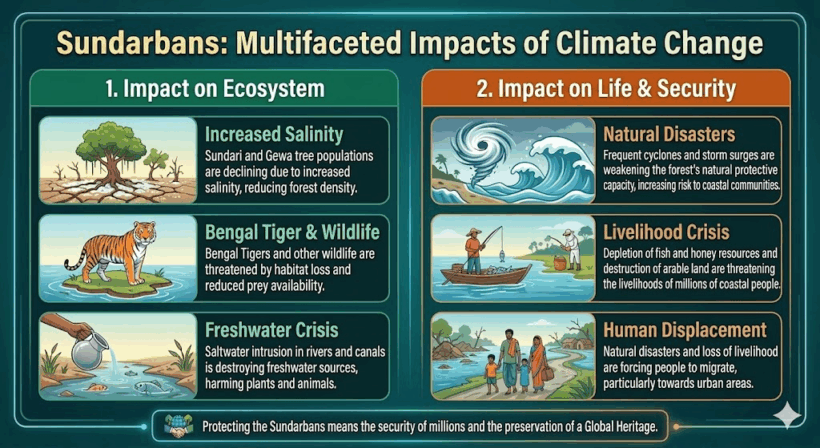
As sea levels rise, saline water from the Bay of Bengal is penetrating deep into the forest. The ecosystem of the Sundarbans thrives on a delicate balance between freshwater and saltwater. Increasing salinity is causing the depletion of iconic Sundari and Gewa trees, thereby reducing forest density. With the scarcity of freshwater sources, numerous wildlife species, including the Royal Bengal Tiger, are losing their natural habitats. This environmental shift has triggered significant disruptions in the food chain and hunting patterns.
Cyclones and Storm Surges: A Weakening Defense
Historically, the Sundarbans has acted as a barrier, neutralizing the fury of powerful cyclones like Sidr, Aila, or Amphan to protect mainland Bangladesh. However, the increasing frequency of natural disasters is stripping the forest of its capacity to regenerate.
‘The Sundarbans is not just a forest; it is a life insurance policy for millions. But paying the premium for this insurance is becoming impossible against the wrath of nature’- A local environmental researcher.
Livelihood Crisis and Humanitarian Disaster
Hundreds of thousands of people, including honey collectors (mouals), woodcutters (bawalis), and fishermen, depend directly or indirectly on the Sundarbans. As forest resources dwindle and arable land is ruined by salinity, these communities are on the verge of becoming ‘climate refugees.’
Scarcity of Fish and Honey: Rising salinity in rivers and canals is hampering fish breeding.
Migration: People from coastal districts like Khulna and Satkhira are being forced to migrate to cities in search of work, sparking a humanitarian crisis.
Global Responsibility and Local Efforts
The Government of Bangladesh and international organizations have intensified afforestation and community-based protection programs. Research is ongoing regarding salinity-tolerant mangrove species. However, experts warn that local initiatives will only succeed if effective global actions are taken to reduce carbon emissions.
The Sundarbans Crisis at a Glance
1. Submergence Risk: If sea levels continue to rise at the current rate, a large portion of the forest may be submerged by 2050.
2. Loss of Species: Freshwater fish and flora are nearing extinction due to the alarming rise in salinity.
3. Habitat Shrinkage: The shrinking habitat of the Royal Bengal Tiger is upsetting the ecological balance.
4. Weakened Protection: A fragile natural shield means catastrophic loss of life and property during coastal storm surges.
A Race Against Time
The fate of the Sundarbans no longer rests solely in the hands of Bangladesh; it is now a focal point of global climate politics. Losing this mangrove lifeline does not just mean losing a forest- it means losing one of humanity’s strongest defenses against climate change. Only if the Sundarbans survives will this vast delta of South Asia endure.
The Author:
 G M Forhadul Mozumdar: Correspondent, Pressenza- Dhaka Bureau.