

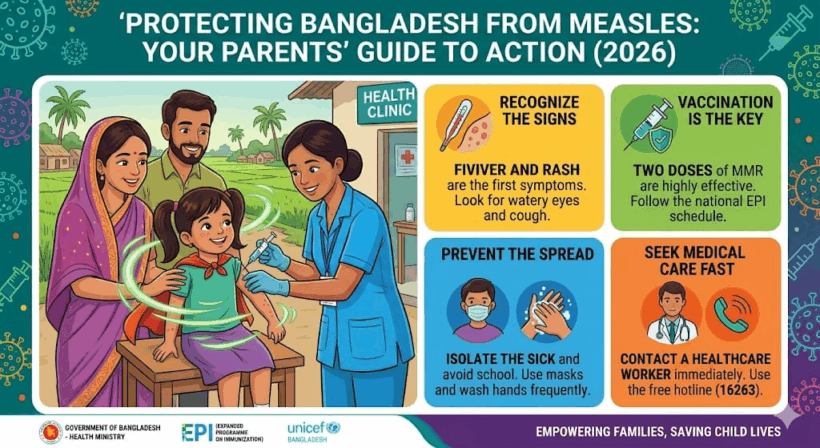
Bangladesh’s Vaccination Program
by S. M. Abul Hossain (Dhaka Bureau)
In 2026, Bangladesh finds itself facing an unexpected and tragic reality. A nation once globally recognized as a ‘role model’ for its immunization programs is now witnessing child deaths due to measles, sparking widespread public anger and concern. Recent fatalities, coupled with a controversial remark by the Health Minister, have ignited a firestorm on social media. The pressing question remains: Is a glorious history of success beginning to fade?
A History of Success at a Glance: From Zero to ‘Vaccine Hero’
Bangladesh’s Expanded Programme on Immunization (EPI) was launched on April 7, 1979. In the early years (1979–1984), measles vaccination coverage was less than 2%. From a time when children relied on nature and fate, the country began a steady transformation in the 1990s.
1990: Vaccination rates reached approximately 50%.
2010: Coverage surged to 85-90%.
2015-2023: Bangladesh consistently surpassed the international benchmark of 95%, achieving up to 97% coverage.
The nation’s remarkable milestones- eradicating Polio (2006), eliminating Maternal and Neonatal Tetanus (2008), and controlling Rubella- led the global vaccine alliance GAVI to honor the then-Prime Minister with the ‘Vaccine Hero’ award in 2019.
The Current Crisis: Financial Shortage or Negligence?
Under all previous administrations, the EPI remained a point of unquestioned success. However, in 2026, the death of children due to a shortage of measles vaccines has brought a grim reality to the forefront. Allegations have surfaced regarding the proper utilization of government funds allocated for immunization.
Vaccine management in Bangladesh is a collaborative effort involving the Ministry of Health, the World Health Organization (WHO), UNICEF, icddr,b, and GAVI. GAVI, the vaccine alliance established in 2000, ensures free or low-cost vaccine supplies to developing nations.
According to experts, it is simply not credible that Bangladesh could not import vaccines due to a lack of funds. It is widely believed that the crisis stems from gross mismanagement and a failure to treat the matter with the necessary urgency.’
Ministerial Remarks and Public Outrage
A recent comment by the Health Minister regarding the child deaths has further inflamed the situation. Instead of a unified effort to resolve the crisis, the Minister’s dismissive or controversial stance has drawn sharp criticism from grieving families and civil society. On social media, citizens are asking: how can a country that conquered Smallpox and Polio allow children to die today due to a lack of basic vaccines?
The Challenge: Remote Areas and ‘Zero-Dose’ Children
While statistics show that vaccine coverage remained stable at 96-97% through 2022 and 2023, these high national averages often mask the reality in suburban slums, hard-to-reach terrains, and marginalized communities. These ‘zero-dose’ children- those who have not received a single vaccine- remain the most vulnerable to the current outbreak.
The EPI stands as one of the most successful pillars in the history of public health in Bangladesh. Since 1979, the program has evolved to include modern protections such as Pentavalent and HPV vaccines. However, the current measles crisis serves as a stark reminder that past achievements alone cannot safeguard the future. Only transparency, the correct utilization of funds, and strong political will can restore the protective shield for the children of Bangladesh.
————————————————————————————————————————————————————————
The Author:
 S. M. Abul Hossain: Senior Journalist and Contributor, Pressenza Dhaka Bureau.


