

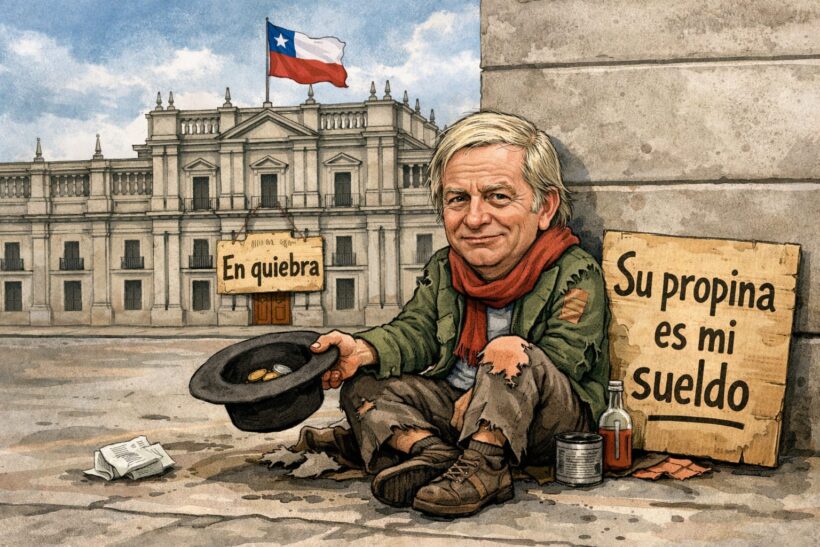
Chile has a fiscal buffer designed precisely to absorb external shocks. However, in the face of rising fuel prices, the government not only chooses not to use it, but also pushes for its structural redefinition in Congress. The episode escalates when an official publication of the Government of Chile itself uses the expression “bankrupt state” to describe the fiscal situation, a phrase that was later publicly disavowed by the Minister of Finance, who distanced himself from that language, considering it inaccurate and technically incorrect. In that breakdown of communication emerges something deeper than a technical disagreement: a dispute over the meaning of scarcity.
No, Chile is not bankrupt. And precisely for that reason it is so serious that such a statement comes from within the State’s own institutional apparatus.
Because “bankruptcy” is not a technical description. It is a closure of debate. If a country is bankrupt, there are no decisions left to discuss: only unavoidable adjustments. Language does not inform; it organizes the field of what is possible. And when that language is introduced through official communication, it is not a slip: it is a way of constructing public reality.
Chile is not a bankrupt state. It has debt levels around 40% of GDP, well below the OECD average, stable access to financing, and a fiscal institutional framework historically regarded as prudent. It also has a sovereign fund specifically designed to face external shocks such as rising fuel prices. It is not a country without tools. It is a country with tools it chooses not to use.
The official explanation relies on fiscal discipline and the structural rule. But what is presented as impossibility is, in reality, a decision: not to activate stabilization mechanisms, even though they exist and were created for precisely this kind of scenario. Between “there is no money” and “we will not use the available funds,” there is a fundamental political difference.
The problem begins when that decision is wrapped in a narrative of absolute scarcity. Because if there is no money, then there is no alternative. And if there is no alternative, then every cut is mandatory, every adjustment is inevitable, and every reduction in social spending stops being a choice and becomes a natural consequence.
That is the turning point. The construction of the “bankrupt state” does not describe Chile’s fiscal reality. It reorganizes it. It turns a political decision into an apparent necessity. And in doing so, it installs a framework in which cuts cease to be debatable.
The effect of this framing is clear. If the State is bankrupt, then someone bankrupted it. And if someone bankrupted it, then the present is no longer the result of current political decisions, but the inevitable consequence of a previous administration. The debate ceases to be about what to do today with available resources and becomes a search for those responsible in the past.
This is not a technical analysis. It is a narrative operation. A way of presenting as inevitable what is, in reality, a political choice.
And that framing has material consequences. Because when the idea is installed that there are no resources, what is enabled is not only a narrative of fiscal responsibility, but an agenda of cuts, reduction of programs, and containment of social spending that directly impacts everyday life.
This is not an abstract debate. It is a political decision with concrete effects.
And the cost of that decision is not paid by official statements or macroeconomic balances. It is paid by people. It is paid by the users of programs that are reduced or eliminated. It is paid by sectors that depend on public spending to maintain basic conditions of welfare. And it is paid, as always, most heavily by those with the least capacity to absorb it.
This is not a technical description of the Chilean economy. It is a political operation that uses the language of bankruptcy to justify an austerity agenda. And its material cost is being paid by all Chileans, especially the poorest.