

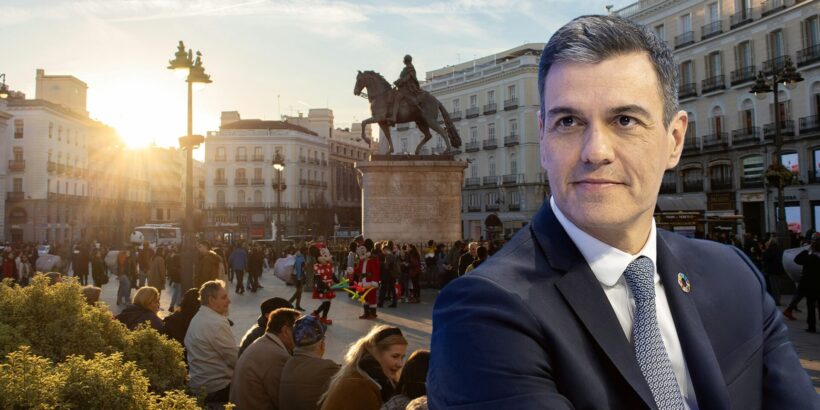
Spain has one of the best public healthcare systems in Europe. In recent years, electricity bills have also remained comparatively low thanks to government price controls and a cap on gas prices. The situation on the labour market has also improved: unemployment is at its lowest level since the 2008 financial crisis. At the same time, there have been developments in other areas: the number of murders of women has fallen by around a third, General Franco’s fascist dictatorship is being critically re-examined, and the transition to an environmentally friendly energy supply is working better than in almost any other EU country. None of this is a coincidence, but is partly thanks to the astute social policies of Prime Minister Pedro Sánchez. Most recently, he attracted attention on the global political stage by taking a clear stance towards US President Trump: namely, no to war. An overview of his background and policies.
Following the end of General Franco’s long-standing military dictatorship, Spain was marked by a succession of governments and conflicts. The transition from dictatorship to democracy did not happen overnight, but was a gradual process, often hard-won. Not least, Pedro Sánchez, Prime Minister of Spain since 2018 for the social democratic PSOE party, has brought stability and economic recovery to the previously battered country. An overview of his background and politics.
Sánchez studied economics and has long been politically active
Pedro Sánchez Pérez-Castejón was born on 29 February 1972, the son of a senior civil servant and a lawyer. His academic career began in 1990 with a five-year degree in economics in Madrid. In 1998, he completed a Master’s degree in Political Economy at the Free University of Brussels and obtained his PhD in 2012 at the University of Madrid, where he eventually also taught as a professor. From 2011 onwards, he also worked as an economic adviser.
During his studies, he joined the social-democratic PSOE (Partido Socialista Obrero Español) in 1993. He was first elected to the Spanish Congress of Deputies in 2009. In 2014, he stood as a candidate for the post of General Secretary of the PSOE. Following internal party criticism, he resigned in 2016, but was re-elected by the party membership in 2017. In 2018, he was elected Prime Minister of Spain following a vote of no confidence. The then head of government, Mariano Rajoy, was voted out by a majority. However, this only worked with a direct successor – and that was Pedro Sánchez. A vote against the conservative Rajoy was therefore simultaneously a vote for Sánchez.
He governs in coalition with the left-wing party “Movimiento Sumar” and small autonomous parties. In 1999, he was chief of staff to the UN Special Representative for Bosnia during the Kosovo War, making him his most important adviser. He is also President of the Socialist International, a global alliance of all socialist and social democratic parties and organisations.
Economic growth in Spain above the EU average: price controls, gas price caps and rent controls
Spain is regarded as one of the countries that has weathered the pandemic, inflation and the energy crisis best. With economic growth of 3.2% in 2024, Spain exceeded even the most optimistic forecasts. This places the country in the top third across Europe. And this is despite the fact that global crises have had a negative impact on the world economy. By way of comparison: in Austria, economic growth contracted by 1.2% in 2024 and in Germany by 0.2%.
Spain owes this economic growth primarily to the Sánchez government’s price interventions during the inflationary period. The introduction of the gas price cap and the rent freeze were particularly decisive. These measures helped keep prices low. Sánchez also suspended VAT on basic foodstuffs, thereby keeping inflation in check.
Increases in the minimum wage and the lowest unemployment rate since the 2008 financial crisis
Pedro Sánchez has rectified some of the mistakes made by the conservative government that preceded him – which had allowed Spanish companies to ignore collective agreements. Shortly after taking office, he raised the minimum wage by 22%. Previously, the minimum wage in Spain was one of the lowest in Europe; it now ranks in the top third.
Furthermore, the unemployment rate in Spain is currently at its lowest level since the 2008 financial crisis. More than 1.5 million jobs have been created. Since the 2022 labour market reform, there have been fewer fixed-term contracts. In 2025, the Spanish government reduced the working week from 40 to 37.5 hours with no reduction in pay and introduced legislation to protect workers from being contacted outside working hours. This has a direct impact on people’s quality of life: they have secure jobs, higher wages and more free time. Such people are healthier and happier; they consume and invest more, thereby boosting the economy in turn.
Open migration policy yields positive results: recognition of foreign qualifications and swift integration measures instead of isolationism
Unlike most EU countries, Spain pursues a more open migration policy. The country is one of the world’s main destinations for migration. For Sánchez, immigration is not only a matter of humanity, but also an economic driver. Specifically, Spain aims to recognise foreign qualifications more easily and reduce the bureaucratic burden associated with residence permits. This will enable highly qualified individuals to pursue their professions more quickly.
“Throughout history, migration has been one of the most important driving forces behind the development of nations, whilst hatred and xenophobia have been and remain the greatest destroyers of nations,” said Pedro Sánchez. “The key is to manage this effectively.”
The government is investing in integration measures and has recently passed a decree aimed at granting legal residency status to around 500,000 undocumented migrants. Applicants must prove that they have no criminal record and that they have been residing in Spain for at least five months prior to 31 December 2025.
Public healthcare system for all: Spaniards have some of the longest life expectancies in Europe
Spain ranks among the EU countries with the highest life expectancy. Data from 2024 show that women live to an average age of 86.6 years and men to 81.3 years. By comparison, in Austria, women live to an average age of 84.5 years and men to 80 years.
By 2050, life expectancy is set to rise to an average of 87 years (overall). This is partly due to the Spanish public health system, which is regarded as one of the best in Europe. The basic principle is: public healthcare for all. 99% of the Spanish population are insured and are assigned a GP who looks after them for years and refers them to specialists where necessary. There are over 13,000 tax-funded health centres spread across the country. However, the relaxed lifestyle and healthy Mediterranean diet also contribute to the high life expectancy.
The focus on primary care, i.e. GPs, has the advantage that they decide who needs to see a specialist. Only then are patients referred directly. Of course, Spain also faces challenges in its healthcare system – particularly since the coronavirus pandemic. In some regions, these mainly involve staff shortages and long waiting times for specialist appointments. Some Spaniards therefore take out additional private insurance.
Spain is investing in renewable energy, thereby combating climate change and keeping electricity prices low
Spain, too, is increasingly grappling with the consequences of climate change. Not least for this reason, the country has been investing in renewable energy since 2019, thereby doubling its wind and solar capacity. As part of a comprehensive plan, the Spanish government has agreed to transition from fossil fuels to climate-friendly electricity generation. The Spanish people are feeling the effects of this, too. Whilst electricity prices are skyrocketing worldwide due to the war in Iran, prices in Spain remain low. The expansion of renewable energy has reduced the dependence of electricity prices on fossil fuel power stations by 75%. Since 2025, the share of electricity generated from coal in Spain has fallen to zero.
Pedro Sánchez also wishes to go beyond local measures and collaborate with neighbouring countries France and Portugal to draw up a plan comprising climate protection measures. The aim is a “state pact” covering several areas: fire prevention, new water infrastructure for flood control, stricter building and land-use regulations in vulnerable regions, and better protection for workers during heatwaves.
Feminist politics: Equality is making great strides & femicides have fallen by a third
During the dictatorship under General Franco (1939–1975), an image of women was propagated that was based on obedience, family and housework. Women were forced into the role of mother and had fewer rights, often requiring the consent of their
To take preventive action against gender-based violence, topics such as gender equality and violence prevention have been incorporated into the curriculum. The “VioGén” monitoring system collates information on perpetrator profiles. Electronic tagging is used to check whether perpetrators are complying with restraining orders. Women affected by violence in Spain have easy access to financial support, emergency accommodation, employment programmes and psychological support. In 2022, sexual criminal law was reformed and an important law was passed: “Only yes means yes”. Sexual acts are only legal with clear consent.
Spain is also one of the safest countries in Europe for queer people. Same-sex marriage was recognised as early as 2005. Comprehensive anti-discrimination laws are supported by a broad social consensus. Spain has also managed to reduce femicide by a third through targeted measures. In 2004, violence against women was defined as a separate criminal offence for the first time – with severe penalties for perpetrators. The package of measures is based on the recognition that violence against women is a structural problem.
Culture of remembrance: coming to terms with the atrocities under the fascist Franco regime
The Spanish Civil War and the Franco Dictatorship
The Spanish Civil War began on 17 July 1936 with a military coup against the government of the Second Spanish Republic. The war pitted the Nationalist forces, led by Francisco Franco, against the Republicans, who included socialists, communists, anarchists and other democratic groups from across the world. The Nationalists were supported by Adolf Hitler and Benito Mussolini, amongst others. The war ended in 1939 with half a million casualties and Franco’s victory. He ruled through terror. He had at least 120,000 opponents killed, hundreds of thousands of people fled, and millions were imprisoned. The Franco regime, also known as ‘Francoism’, relied on the fascist party, the nationalist military and Catholicism.
The repressive military dictatorship under Franco came to an end with his death in 1975, after 36 years of oppression and violence. The guiding principle at the time for a peaceful transition to democracy, the “transición”, was: forget. Perpetrators of the military dictatorship were not prosecuted, and little was said at the political level about the violence of the dictatorial regime – only civil society actors made efforts to actively commemorate the past.
The government under Pedro Sánchez changed this through legislation: the “Ley de Memoria Democrática” (Democratic Memory Act), passed in 2022, stipulates that the state assumes responsibility for those who disappeared and were killed during the war. A school subject that teaches about the terror under the Franco regime has been incorporated into the curriculum. A reform to the law allows for the banning of organisations and groups that glorify Franco and his dictatorship.
Conservative parties (Partido Popular, PP) and far-right parties (Vox) are already working in parts of Spain to repeal the Memory Law.
Sánchez vs. Trump: Spain condemns the war on Iran and refuses to be intimidated by the US
At the end of February 2026, the US, together with Israel, launched an attack on Iran. Unlike some other EU countries, Spain declared the attack to be in breach of international law from the outset. Although Sánchez condemns the Iranian regime for its brutal oppression of the people, he has spoken out clearly against the military conflict and called for a diplomatic, political solution. He ordered the withdrawal of refuelling aircraft stationed at two US bases in southern Spain, which were intended to supply fighter jets over the Gulf.
“No to the violation of international law! No to the notion that the world can only solve its problems through conflict and bombing. No to war!” says Sánchez.
This was not his first clash with US President Trump. When Trump accused all NATO countries of under-investing in armaments and the military, Sánchez was the only leader who refused to be intimidated. In response to Trump’s demand to invest 5% of GDP in the military, Sánchez gave a clear rebuff – arguing that he knew of better ways to use taxpayers’ money. This is not the only instance in which Sánchez has taken a clear political stance. Back in May 2024, Spain, together with Ireland and Norway, recognised the State of Palestine in order to find a two-state solution.



