

by Asif Showkat Kallol (Dhaka Bureau)
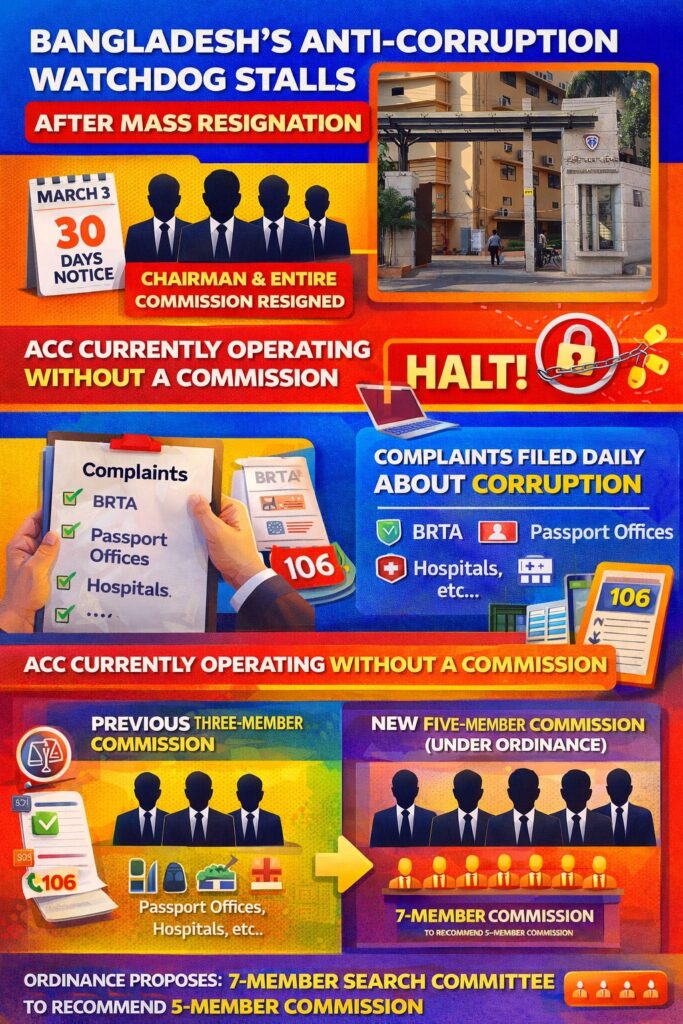
The chairman and the entire commission of the Anti-Corruption Commission (ACC) resigned on 3 March. In accordance with the law, they submitted their resignations with a 30-day notice period and simultaneously went on 30 days’ leave. As a result, the ACC is currently operating without a commission, creating a state of stagnation in its activities. In particular, no decisions can be made regarding hundreds of corruption allegations. There is little prospect of change until a new commission is appointed and assumes office.
However, ACC Deputy Director (Public Relations) Akhtarul Islam said that activities within the commission’s jurisdiction- such as previously approved inquiries and investigations-are continuing. He told a newspaper: ‘Inquiry and investigation officers are continuing to collect relevant information from various offices and are questioning concerned individuals as needed. Additionally, newly submitted complaints are being reviewed by the ACC’s screening committee. Decisions on these will be taken after a new commission is appointed and assumes office.’
Several ACC officials stated that for cases in which inquiries and investigations have already been completed, it is mandatory to obtain the commission’s approval before filing cases and submitting charge sheets. As a result, they are having to wait for the next commission to proceed. There are also allegations that, taking advantage of the absence of a commission, some officials have deliberately slowed down inquiry and investigation work, even though they could continue these activities if they wished.
Meanwhile, complaints are being filed at the ACC almost every day. Many citizens, facing harassment, hardship and bribery in public service institutions, are submitting complaints to the commission. Written allegations are being received against corruption and dishonest officials in institutions such as BRTA, passport offices, land offices, sub-registrar offices, hospitals, the housing authority, city corporations and municipalities. Complaints are also being submitted via the ACC hotline (106). Written complaints are being filed at the ACC headquarters in Segunbagicha in the capital, as well as at integrated district offices across the country.
Even after the resignation of the commission, no search committee has yet been formed to appoint a new chairman and commissioners. Based on recommendations from the ACC Reform Commission, the previous interim government amended the ACC law through an ordinance, which was presented in the first session of parliament last Thursday. According to the ordinance, the commission is to be expanded from three to five members, including the chairman.
The ordinance provides for the formation of a seven-member search committee to recommend appointments to the five-member commission. However, the Bangladesh Nationalist Party (BNP) has opposed the expansion to five members from the outset. As the party is now in government, it remains to be seen which provisions of the ordinance will be retained or removed.
If the provision for a five-member commission is dropped, the search committee will likely revert to five members, as before, to recommend a three-member commission. If the five-member structure is retained, the search committee will consist of seven members.
————————————————————————————————————————————————————————
The Author:
Asif Showkat Kallol: Works for a German-based online outlet, The Mirror Asia, and as Head of News and Contributor, Pressenza- Dhaka Bureau.



