

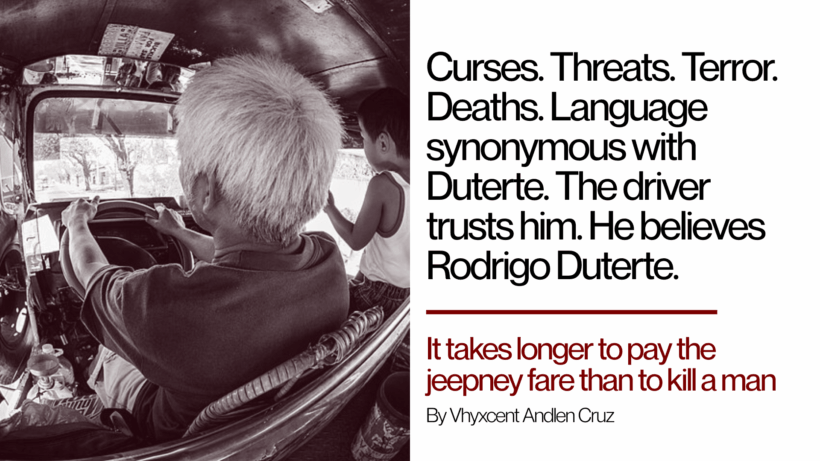
“If you destroy my country, I will kill you,” and people died.
I sat beside the jeepney driver. The signage was MRT Highway, Welcome Rotonda, and Quiapo-España. I placed my bag on my lap. Inside was my copy of Patricia Evangelista’s Some People Need Killing.
I counted my coins and handed twenty pesos to the driver, “Student, Kuya. MRT,” I uttered. I was on my way to the Philippine Book Festival (PBF) 2026 at SM Megamall.
It was quarter to one on a Sunday afternoon along Commonwealth Avenue. “Passenger volume is low today,” he said. The jeep moved toward Sandigan, then Don Antonio.
A green bus covered with ads was in front, patiently waiting to load more passengers. The jeep was closely behind it, leaving no clearance for him to overtake. Irritated, he exclaimed, “The bus is taking forever to move!”
“He’s making the most of it; the gas is expensive,” I replied. He agreed with a chuckle. Our conversation went on.
“Before, two thousand pesos for gas were enough for the entire day.” His fellow jeepney drivers hung up their keys for a while because of the oil price hike. “Now, almost half of the usual diesel I pumped is reduced, but the same amount,” he continued. I nodded as he spoke.
We were about to pass UP-Philcoa. “If it were Duterte, he would have cursed them and threatened them (pertaining to the fuel companies),” expressing his frustrations with the increase and the current administration. He paused for a second, perhaps anticipating an affirmative response. I stayed silent. “If it were Duterte,” he repeated.
Curses. Threats. Terror. Deaths. Language synonymous with Duterte. The driver trusts him. He believes Rodrigo Duterte.
The trauma of a young girl from the slums of Manila who witnessed her Dee’s brutal death. Her Ma cried and begged, handling proof that they’re clean. The man pulled the trigger on her anyway. “We are Duterte,” the vigilante declared with his gun raised.
The blood rushed from Christine’s Pa, shades darker than the ketchup sauce for the spaghetti he had prepared for his children. Pa pleaded to arrest him instead. He told the policeman he’s clean. Christine, another young girl from Payatas, saw her Pa shot in the head and chest at close range. The police later declared that Pa fought back. That he was killed in self-defense.
From the demon of Delpan, a policeman who claimed the souls of his prey with bullets, instilling fear in the streets of Tondo, and the fifth man of Payatas, who decided to survive after a bullet penetrated his chest while four others died, to the stories told by the victims, their families, and the vigilantes of the Duterte drug war plagued with threat and fear and death.
These happened. These are what the victims and their families believe.
The jeep pulled over along Quezon Avenue. “Thanks, Kuya. Safe trip!” I said before getting off. I arrived at the Mega Trade Hall in Ortigas via MRT forty-three minutes past one.
There, I met Patricia Evangelista. She’s a trauma-investigative journalist, author of a decorated book, Some People Need Killing: A Memoir of Murder in My Country. It was her book signing at PBF 2026.
I was handing her my book filled with color-coordinated bookmarks. Each color was designated. Dark crimson for case studies, pale red for language, deep midnight blue for quotes, and light gray for general highlights.
I introduced myself and asked, “How do you usually frame your stories?” “With a lot of research and writings on my bedroom wall,” she replied.
I have been dissecting her works, particularly the Impunity Series and the book. Her language awareness and mastery are top-notch. From syntax, semantics, pragmatics, functions of lexical and grammatical categories, active and passive voice, to the use of verbs.
She’s a journalist. Language is her tool, especially verbs. Disappeared. Shot. Killed. Salvaged. She’s a storyteller. She could also pass a linguist.
She’s reasonably cautious, too, of being filmed and recorded. Thus, I won’t include any of her photos taken during the book fest. In her line of duty, where life is at stake, no one can blame her.
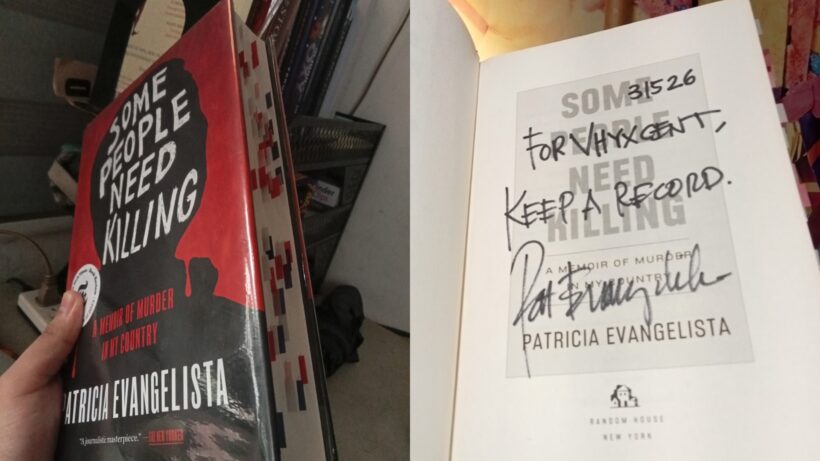
(a) Author’s copy of the book with bookmarks, (b) Signed copy by Patricia Evangelista. Image from the author.
“It’s unique to spell the name that way,” she uttered upon seeing my name on a piece of paper. I agreed with a smile. She wrote a dedication in the book in all caps, “KEEP A RECORD,” then she signed.
I know what that meant. Keep on track. Never forget. When you have a record of murder and impunity in your country, it’s difficult to forget.
A year has passed since the arrest of former President Rodrigo Duterte. Before his arrest, Duterte was strong. Duterte was fearless. Duterte was powerful. The defense requested a fitness-to-stand-trial assessment. He claimed that his client’s cognitive function is unreliable.
The court doctors certified Duterte fit to stand trial. Confirmation of charges began. He waived his right to attend the hearing. Nicholas Kaufman read his client’s reasons. Duterte is old. Duterte is tired. Duterte is frail.
He is facing three counts of crimes against humanity. The court is set to determine the sufficiency of the testimonies and evidence. This is when the records matter most.
Large red warning signs often line the long stretch of Commonwealth Avenue. In white, boldface text, it says, BAWAL TUMAWID MAY NAMATAY NA DITO. No crossing, someone died here.
The victims’ families were once told to stop— where the danger lies and where the blood was spilled— or they will be next. They know he’s not kidding. Bullets are faster than the cars in the avenue. The jeepney fare— passed through several people before the driver— takes longer to arrive than the bullet.
They can’t get off their ride yet. Not at this point. They still have a long road ahead of them. But at least the wheels are now rolling. Due process is moving. This is their hope. The price has to be paid.
“The democracy I believe in was the nation, a community of millions who saw brutality as an aberration to be condemned as often and as vigorously as necessity demanded.”(Patricia Evangelista, Some People Need Killing).



