

There is no possible ambiguity. What is happening in Lebanon is not the result of internal weakness or a spontaneous crisis. It is the direct consequence of sustained military pressure, progressive bombardments, and evacuation orders imposed by Israel on sovereign territory.
This is an ongoing coercive action.
Thousands of families have been forced to flee due to evacuation orders affecting large areas of the south of the country, the southern suburbs of Beirut, and parts of the Bekaa Valley. They have had to escape without any safe place to go. These are not evacuations organized under humanitarian standards, but forced displacements carried out under direct threat, in a context of armed violence.
There is no refuge. There are no guaranteed safe corridors. There is no possible destination.
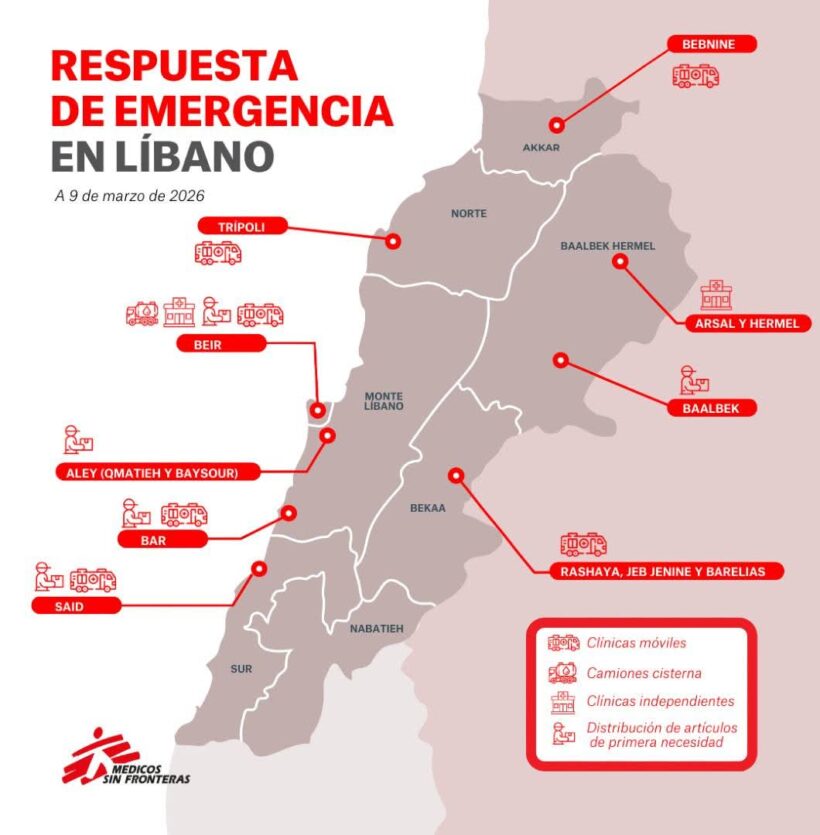
The statement from Médecins Sans Frontières describes an emergency response underway at a national scale. Across the country, the organization has deployed several mobile clinics to assist displaced people, providing medical care and distributing essential items to the most affected communities.
This deployment is not preventive or symbolic. It is a direct response to a humanitarian crisis already in progress.
The operational map released by the organization shows the territorial extent of the emergency. These are not isolated pockets, but widespread pressure across multiple regions of the country, confirming the scale of displacement and the progressive collapse of minimum living conditions for thousands of people.
When an organization such as Médecins Sans Frontières mobilizes resources of this magnitude before the formal beginning of a ground invasion, what it signals is not a possibility, but a humanitarian reality that has already begun.
The evacuation order, imposed from the southern border to densely populated areas of Beirut, constitutes in itself an act of military pressure on the civilian population. Its execution, under conditions of threat and without guarantees of effective protection, creates a scenario that various frameworks of international humanitarian law consider highly problematic, particularly regarding the protection of civilians and the prohibition of forced displacement without conditions of safety.
There is no causal vacuum here.
There is a direct relationship between military action and mass displacement.
In this context, the statements and positioning of the political leadership of Benjamin Netanyahu acquire a broader strategic dimension. This is not merely a tactical operation, but a vision of territorial reconfiguration that has been expressed at different times under references to a historical or even “divine” right.
That ideological framework is not minor.
It is the same that has been invoked in the expansion of settlements in the West Bank and that now appears as the backdrop to regional escalation. The continuity between both scenarios —Palestine and Lebanon— is not rhetorical: it is strategic.
The immediate result, however, is human.
Displaced families without protection. Health systems under pressure. Fragmented communities. A civilian population exposed in real time to the consequences of military decisions that completely exceed their control.
What Médecins Sans Frontières documents is not a potential crisis.
It is the beginning of a catastrophe in development.
And this time, unlike narratives that attempt to dilute responsibility, the origin is identifiable, verifiable, and concrete.



