

by Asif Showkat Kallol (Dhaka Bureau)
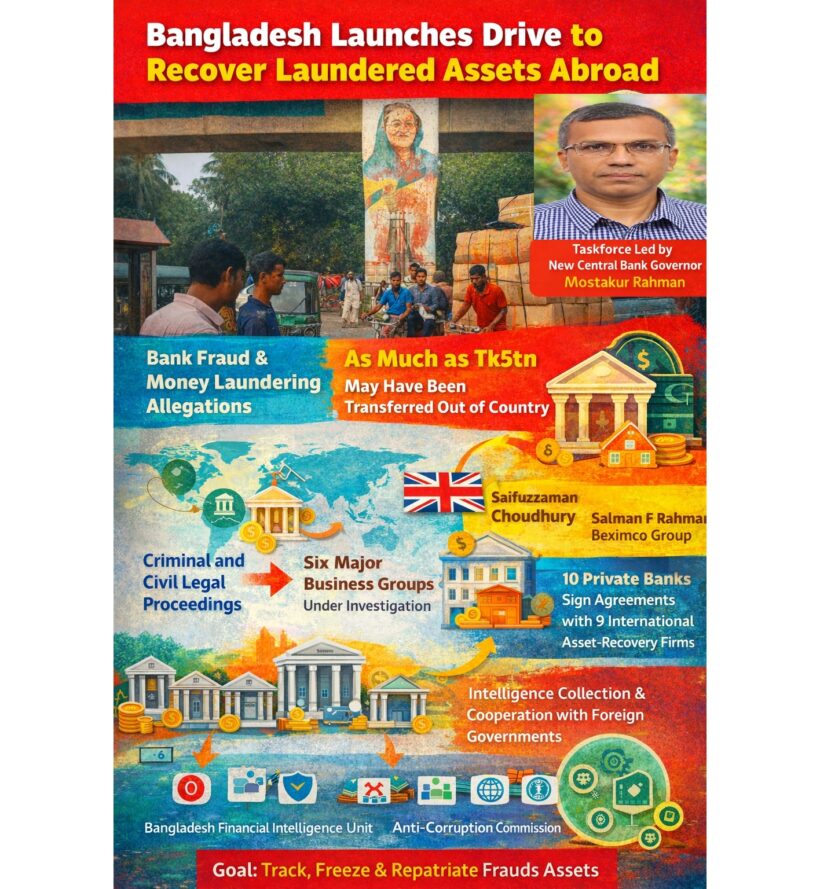
The Bangladeshi government has begun criminal and civil proceedings aimed at recovering assets allegedly siphoned out of the country during the final years of the previous administration, in what officials describe as one of the largest financial recovery efforts in the country’s history.
Authorities say the process will unfold in several stages, starting with intelligence gathering and investigations conducted under both domestic and international legal frameworks. Officials are collecting financial intelligence, verifying documentation, and building legal evidence before filing cases against suspected offenders in Bangladesh and abroad.
So far, most legal actions have taken place within Bangladesh, while international cases remain under preparation.
Officials estimate that as much as Tk5tn (about $45bn) may have been moved out of the country through fraudulent loans from banks during the final years of the government led by Sheikh Hasina, which lost power on 5 August 2024.
Earlier efforts by the interim administration led to the freezing of several overseas assets linked to individuals associated with the former government. These include properties in the United Kingdom connected to former minister Saifuzzaman Chowdhury and companies linked to the Beximco Group, a conglomerate owned by businessman and former adviser Salman F Rahman.
Investigators also uncovered cases in which export proceeds were allegedly kept abroad rather than repatriated to Bangladesh.
However, the asset recovery effort slowed toward the end of the interim government’s tenure. The current administration has since revived the initiative and declared the recovery of illicitly transferred wealth a key policy priority.
The effort is now being coordinated by a task force chaired by the new central bank governor, Mostakur Rahman.
The task force has adopted a multi-pronged strategy that includes launching civil and criminal legal actions, hiring international asset-recovery firms to pursue investigations abroad, and requiring banks to play a direct role in tracing and reclaiming funds.
Banks have been instructed to work with international recovery agencies and provide detailed information on defaulted loans linked to suspected capital flight.
So far, 10 private banks have signed agreements with nine international asset-recovery firms to investigate 36 suspected cases of money laundering.
These firms will receive commissions from recovered assets rather than upfront payments.
Bangladesh’s central bank has already identified six major business groups suspected of large-scale financial misconduct as part of the first phase of investigations. Civil proceedings are expected to precede international lawsuits against the individuals and companies involved.
Officials say that once these cases progress, a second phase will focus on more than 100 additional incidents involving top defaulters and suspected money launderers.
The Bangladesh Financial Intelligence Unit has also been collecting intelligence from international sources and sharing information with the Anti-Corruption Commission and the Criminal Investigation Department to support domestic prosecutions.
Authorities say cooperation with foreign governments will play a crucial role in identifying and freezing assets abroad, particularly in cases involving money laundering or other criminal offences.
Officials hope that by combining domestic prosecutions with international litigation, Bangladesh can begin recovering a significant portion of the funds believed to have been transferred overseas.
————————————————————————————————————————————————————————
The Author:
 Asif Showkat Kallol: Works for a German-based online outlet, The Mirror Asia, and as Head of News and Contributor, Pressenza- Dhaka Bureau.