

by Mohammed Kawser Ahamed (Dhaka Bureau)
Bangladesh’s garment exporters are facing mounting disruption as the war in the Middle East begins to affect global transport routes, delaying shipments to Europe and raising fears of further pressure on the country’s key export sector.
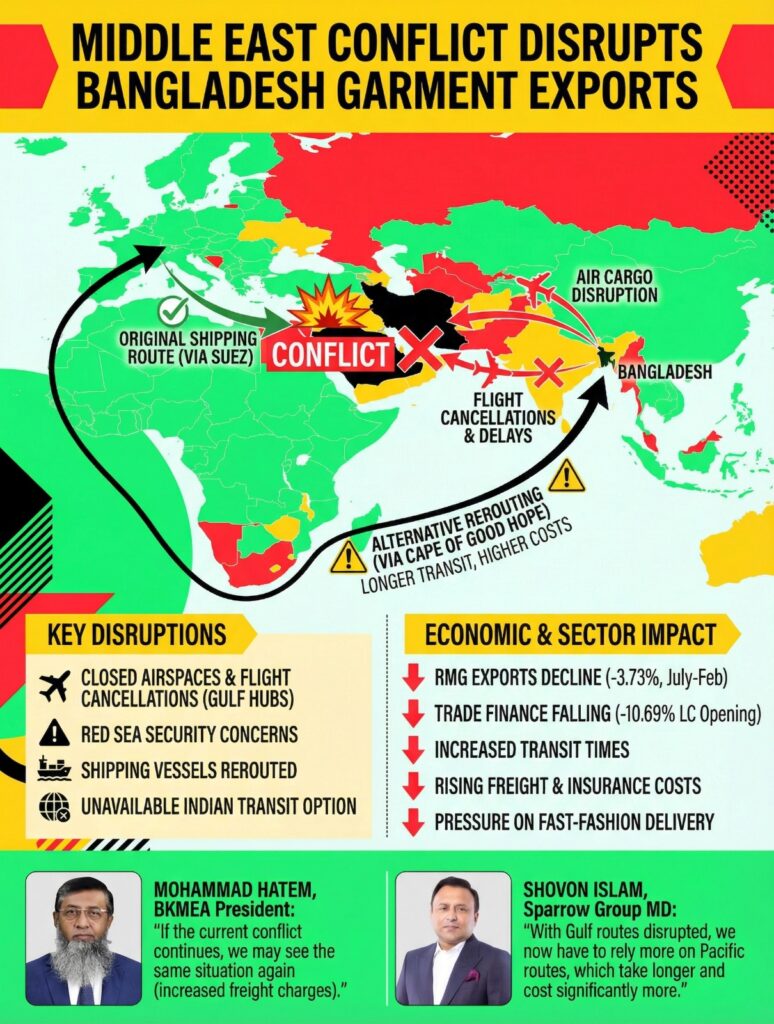
Air cargo operations across the region have been severely disrupted after several Middle Eastern airspaces were closed following the escalation of hostilities. As a result, urgent shipments of ready-made garments from Bangladesh are being delayed at airports. Major Gulf carriers, including Emirates, Qatar Airways, and Etihad Airways, have cancelled a large number of passenger and cargo flights, creating bottlenecks across South Asia’s export supply chains.
The disruption is particularly significant because Gulf hubs handle a large share of cargo moving from South Asia to Europe. More than half of Bangladesh’s air cargo shipments transit through Gulf airports, while India relies on the region for about 41% of its air freight.
The crisis is not limited to air transport. Shipping routes are also under growing pressure as security concerns intensify around the Red Sea and the Suez Canal, two of the world’s most important trade corridors linking Asia and Europe. Many container vessels carrying Bangladeshi goods to European markets normally pass through these waterways.
With risks increasing in the region, shipping companies have begun rerouting vessels along longer alternative routes, including around the Cape of Good Hope. The diversion significantly increases transit times and freight costs. Some shipping lines have also slowed new bookings or temporarily suspended them while assessing security risks and rising insurance costs.
Industry leaders say the situation could place significant strain on Bangladesh’s export-oriented garment sector, which already accounts for the majority of the country’s foreign earnings.
‘About 10% of Bangladesh’s garment exports travel by air and roughly 40-50% by sea through Gulf routes,’ said Shovon Islam, managing director of Sparrow Group, a Bangladeshi garment manufacturer. ‘Europe is one of our main markets, so these routes are crucial. With Gulf routes disrupted, we now have to rely more on Pacific routes, which take longer and cost significantly more.’
Exporters also point out that an alternative transit option through India- where goods were transported by truck to Indian airports before being flown abroad, has been unavailable since Bangladesh’s interim government suspended the arrangement.
The timing of the crisis has intensified concerns because Bangladesh’s export sector was already under pressure. According to data from the Export Promotion Bureau, total exports fell 3.15% during the first eight months of the current fiscal year compared with the same period last year.
Ready-made garment exports- the backbone of the economy- reached $25.79bn during the July-February period, a decline of 3.73% year on year. Monthly data shows the sector has recorded negative growth for seven consecutive months after strong expansion at the start of the fiscal year.
Further signs of slowing demand are emerging in trade financing indicators. Data published by Bangladesh Bank shows the opening of back-to-back letters of credit for export orders fell by 10.69% during the first seven months of the fiscal year, while settlements declined by 6.79%.
Export industry leaders warn that if the Middle East conflict continues, the consequences could extend beyond immediate transport delays.
Mohammad Hatem, president of the Bangladesh Knitwear Manufacturers and Exporters Association, said similar disruptions had occurred previously when security risks affected shipping routes in the Red Sea.
‘At that time, vessels had to travel via the Cape of Good Hope, which significantly increased freight charges,’ he said. ‘If the current conflict continues, we may see the same situation again.’
Analysts say prolonged instability in the Middle East could ripple across global supply chains, particularly in the fast-fashion industry where delivery times are critical. For Bangladesh- the world’s second-largest garment exporter- rising shipping costs, delivery delays and declining orders could pose a serious challenge in the months ahead.
————————————————————————————————————————————————————————
The Author:

Mohammed Kawser Ahamed: Staff Correspondent and Head of Admin, Pressenza- Dhaka Bureau.



