

The newly formed government in Bangladesh, a densely populated South Asian nation, is set to take a landmark step toward poverty alleviation. Prime Minister Tarique Rahman has initiated a comprehensive plan to eliminate extreme poverty by bringing ‘Zakat’- one of the five pillars of Islam- under a disciplined and formal state framework.
Historically, the people of Bangladesh are deeply religious and contribute vast amounts of Zakat privately, particularly during the holy month of Ramadan. However, due to the lack of an integrated management system, this massive capital has yet to make a sustainable impact on poverty reduction.
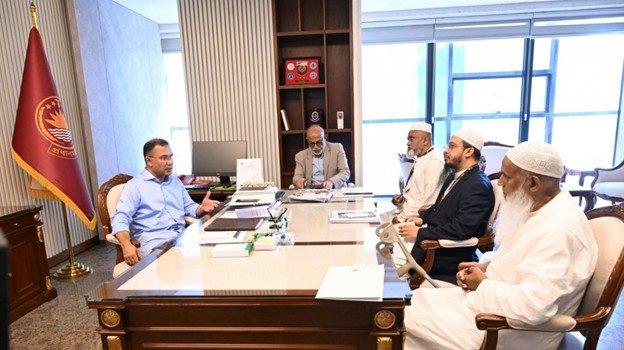
To address these limitations, a high-level meeting was held on Monday (March 9) at the Cabinet Division in the Secretariat, presided over by Prime Minister Tarique Rahman. The meeting was attended by Religious Affairs Minister Shah Mofazzal Hossain Kaikobad, Religious Affairs Secretary Munshi Alauddin Al Azad, and Shaykh Ahmadullah, Chairman of the As-Sunnah Foundation.
During the meeting, the Prime Minister issued clear directives to make Zakat management more effective and organized. He emphasized that if a disciplined management system is ensured, it is possible to eradicate poverty from the country within the next 10 to 15 years.
The most significant outcome of the meeting was the decision to reconstitute the Zakat Board, aiming to create a new economic model for poverty alleviation. A recommendation was made to form a powerful committee to bridge the gap between religious knowledge and modern economics in this fight against poverty.
The proposed committee, led by Religious Affairs Minister Shah Mofazzal Hossain Kaikobad, will include Khatib of the National Mosque Baitul Mukarram, Allama Mufti Abdul Malek, and Chairman of the As-Sunnah Foundation, Shaykh Ahmadullah, along with leading Islamic economists and prominent Ulema (scholars).
The Ministry of Religious Affairs has been instructed to propose the full names of the committee members within the next ten days. This committee will subsequently submit its formal recommendations directly to the Prime Minister.
International analysts suggest that Zakat is not merely a religious ritual but a powerful tool for the equitable distribution of wealth. Organizations like the As-Sunnah Foundation have already demonstrated successful examples of creating self-reliance through Zakat in Bangladesh. Implementing this model at the state level would be a unique milestone in establishing social justice.
Commenting on the initiative, Dr. A.F.M. Khalid Hossain, a renowned Islamic thinker, researcher, and author, stated:
‘If Zakat is collected and distributed correctly, no one in society will have to extend their hand for help- this is the core philosophy of Islam.’
The meeting on Monday is seen as the practical reflection of the commitment expressed by Prime Minister Tarique Rahman during an Iftar party held in honor of Ulema and orphans on Saturday (March 7). Islamic thinkers and economists believe that if Bangladesh succeeds with this model, it could be recognized as an exemplary ‘Poverty Alleviation Model’ for other Muslim-majority nations worldwide.



