

by Asif Showkat Kallol (Dhaka Bureau)
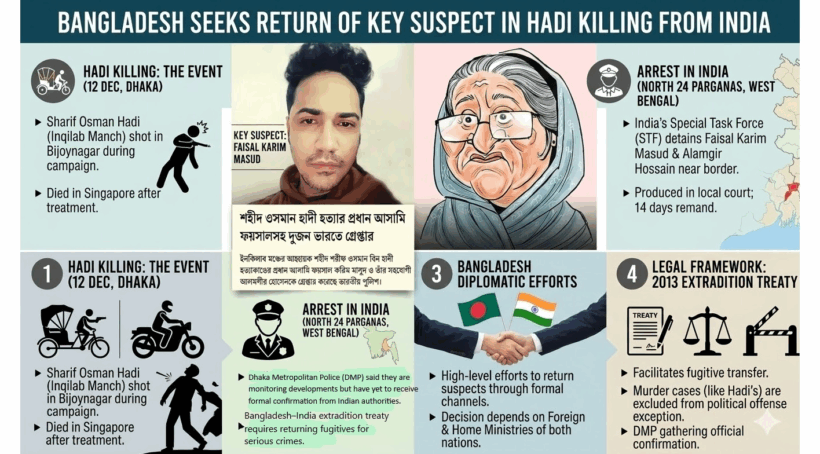
Authorities in Bangladesh have begun high-level diplomatic efforts to bring back the main suspect in the killing of political organiser Sharif Osman Hadi after Indian police confirmed his arrest near the border in West Bengal.
India’s Special Task Force (STF) in West Bengal said it had detained Faisal Karim Masud, the prime accused in the murder, along with his alleged associate Alamgir Hossain. According to a statement cited by the Indian news agency ANI, the two men were arrested late on Saturday night from Bongaon in North 24 Parganas district, close to the Bangladesh border.
Indian investigators subsequently produced the suspects before a local court, which granted 14 days of remand to allow further interrogation, according to sources familiar with the case.
Bangladeshi officials say the suspects could be returned through formal diplomatic channels between the two countries. A senior official at the Bangladesh Police headquarters, speaking on condition of anonymity, said the matter now falls under the jurisdiction of the foreign and home ministries of both nations.
‘The return of the accused will depend on decisions taken at the government level between Bangladesh and India,’ the official said. ‘Given the high-profile nature of the Hadi murder case, there is a possibility that India may hand over the suspects.’
Officials of the Dhaka Metropolitan Police (DMP) said they are monitoring developments but have yet to receive formal confirmation from Indian authorities. Additional Police Commissioner for Crime and Operations S. N. Mohammad Nazrul Islam said police were gathering information through diplomatic and law enforcement channels.
‘We have learned about the arrest through media reports. We are trying to obtain official confirmation through the appropriate authorities,’ said acting DMP commissioner Mohammad Sarwar.
Bangladesh and India signed an extradition treaty in January 2013 to facilitate the transfer of fugitives between the two countries. The agreement requires both sides to return individuals accused or convicted of crimes punishable by at least one year in prison if they are found within the territory of the other country.
The treaty was amended in 2016, but it maintains provisions stating that extradition may be denied if an offence is considered political in nature. However, crimes such as murder, kidnapping, and hostage-taking are explicitly excluded from the category of political offences.
The last high-profile prisoner exchange between the two countries occurred in 2015, when India handed over the insurgent leader Anup Chetia to Bangladesh, while Dhaka returned the fugitive politician Nur Hossain.
Hadi, a prominent figure associated with the platform Inqilab Manch, was shot during a campaign event in Dhaka’s Bijoynagar area on 12 December while preparing to contest the upcoming parliamentary election as an independent candidate from the Dhaka-8 constituency. Gunmen riding a motorcycle opened fire at his rickshaw during a public outreach visit.
He was initially treated in Dhaka before being flown to Singapore for advanced medical care, where he later died from his injuries.
Bangladesh’s Detective Branch earlier filed a charge sheet accusing 17 individuals of involvement in the attack, alleging the killing stemmed from political hostility and was intended to intimidate voters ahead of the next general election. The case is now under further investigation by the Criminal Investigation Department (CID).
————————————————————————————————————————————————————————
The Author:
 Asif Showkat Kallol: Works for a German-based online outlet, The Mirror Asia, and as Head of News and Contributor, Pressenza- Dhaka Bureau.



