Mastodon

War Drums in the Middle East: The New Government of Bangladesh Faces a Geopolitical and Economic Litmus Test

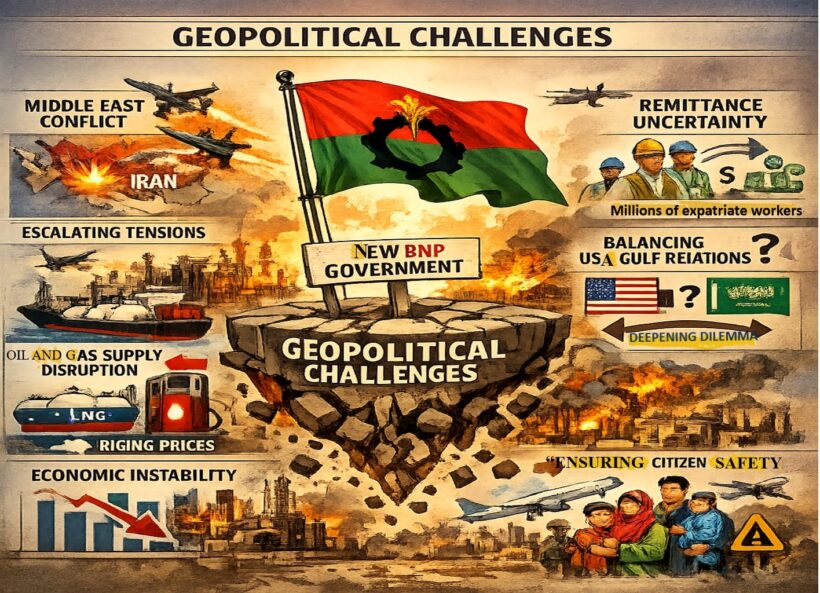
Image created by Asif Shawkat Kallol with the help of AI-Arena..
Following last Saturday’s aggressive strikes by the United States and Israel on Iran, which resulted in the assassination of the country’s Supreme Leader and head of state, a wildfire of conflict has ignited across the Middle East.
The heat of this confrontation is now beginning to reach the shores of South Asia. In retaliation for what is being viewed as an act of American aggression that defies global civilization and humanitarian norms, Iran has launched counter-offensives using drones and missiles against U.S. military bases throughout the region. This escalation is no longer merely a regional conflict; it has evolved into a massive risk for the global economy, placing emerging nations like Bangladesh at the epicenter of potential fallout.
Barely two weeks after taking office following the 13th National Election on February 17, the BNP-led administration is confronting a daunting challenge. Inheriting a weakened economy and a vulnerable energy sector, this war has emerged as a `bolt from the blue’ (or a double blow) for the new leadership.
In the aftermath of the 2024 mass uprising, remittance inflows remained the primary tool for stabilizing foreign exchange reserves and maintaining macroeconomic balance. The vast majority of Bangladesh’s labor market and remittance earnings originate from Gulf nations such as Saudi Arabia, Qatar, Kuwait, and Oman. A prolonged war threatens to disrupt this flow, which would directly impact the livelihoods of ordinary citizens at home.

Bangladesh is heavily dependent on the Middle East for its requirements of crude oil, Liquefied Natural Gas (LNG), and Liquefied Petroleum Gas (LPG). Analysts warn that the current military tension could drive global oil prices to abnormal highs and dismantle supply chains. This could lead to a surge in domestic transportation costs and commodity prices, triggering extreme inflationary pressure within the country.

In a statement, the Ministry of Foreign Affairs expressed ‘deep concern’ over the situation and urged all parties to exercise maximum restraint. Dhaka has made it clear that peace can only be restored through diplomatic dialogue rather than a display of military might. By condemning the violations of sovereignty in Bahrain, Iraq, and Jordan, Bangladesh has signaled its steadfast commitment to its long-standing non-aligned foreign policy.

However, behind the scenes, the diplomatic calculus remains incredibly complex. Just days before the election, Bangladesh signed a trade agreement with the United States. Simultaneously, the country maintains deep historical and economic ties with the Muslim world.
Former diplomats suggest that balancing relations between Western partners and the Islamic world is now a high-stakes game where the margin for error is extremely narrow.
State Minister for Foreign Affairs, Shama Obaed Islam, stated that ensuring the safety of Bangladeshi expatriates remains the government’s top priority. Various departments, including the Ministry of Labor & Employment and Civil Aviation, are actively coordinating to monitor the situation.
According to Professor Delwar Hossain of Dhaka University, ‘This is a major test for the new administration. When divisions emerge between partners, maintaining the right diplomatic tone becomes an arduous task.’
The geopolitical tremors in the Gulf are more than just news for Bangladesh; they are an ominous sign of currency volatility and energy crises. As the Middle East conflict intensifies, the leadership in Bangladesh must weigh every word and action with precision. In the current global context, well-calibrated diplomacy is as vital a lifeline for Bangladesh as its energy supply.


Newsletter

Enter your e-mail address to subscribe to our daily news service.

Donation

Support our Peace and Nonviolence journalism with your donation.

Recommended Articles