

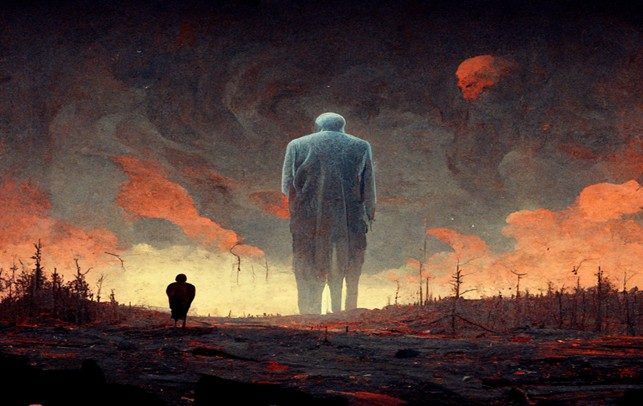
Sirens cut through the night like a scream that has forgotten how to end. Children cry in basements and stairwells; mothers clutch trembling hands; fathers scan the sky as if their eyes alone could shield their homes from fire. Across continents, from crowded cities to forgotten villages, people run in frantic search of shelter. The air carries not only the sound of explosions but the weight of dread, uncertainty, and the quiet collapse of something we once called humanity.
Cluster bombs scatter death without discrimination. Hypersonic missiles travel faster than sound, faster than thought, faster than regret. Technology has made killing efficient, almost abstract. Screens glow with maps, targets, and data; somewhere far from the impact zone, a button is pressed. Yet beneath the language of “deterrence,” “strategy,” and “dominance,” it is always a human body that breaks, a family that fractures, a child who learns the vocabulary of war before the alphabet of peace.
In moments like these, a question rises from the rubble: why are we here on this earth? Is the brief span of human life—so fragile, so singular—meant to be spent diminishing one another? We come into the world once. We are given breath once. And yet we act as though our purpose were to perfect new methods of annihilation. We speak of victory, but what victory is there in cities reduced to dust, in generations raised on trauma, in oceans and skies poisoned by our ambition?
The tragedy is not that we lack alternatives. Humanity has countless arenas for competition that do not require graves. We can strive in science and innovation, in art and literature, in sports and commerce. We can debate fiercely without drawing blood. We can race to cure diseases instead of racing to refine missiles. We can compete to alleviate poverty rather than to expand arsenals. Diversity need not be a fault line; it can be a source of strength, a mosaic rather than a battlefield.
And yet wars begin. Often they are ignited by a handful of leaders, intoxicated by power, history, or ideology. They speak of honor, security, destiny. But it is rarely their children who crouch in darkness as sirens wail. It is rarely their homes that turn to ash. The burden of their decisions falls on ordinary people—on teachers, shopkeepers, students, farmers—who never asked to become characters in a tragedy written from above.
We like to believe we are civilized. We celebrate progress, education, and global connectivity. But beneath the polished surface, something primitive stirs. Our screens fill with images of destruction, and instead of turning away in collective shame, we sometimes watch as spectators. There are those who film the incoming missile, recording the very object that may end their lives. It is a surreal spectacle: humanity documenting its own possible extinction. The camera becomes both witness and shield, as if capturing the horror might grant it meaning.
We are not far removed from the generations who survived the Second World War. There are still old men and women who can recall the thunder of bombers, the hunger, the fear, the unbearable losses. Their stories are not myths; they are living memory. And yet memory alone does not seem to inoculate us against repetition. New conflicts flare in different regions, under different flags, with different justifications—but with the same graves.
What is most painful is not only the violence itself, but the normalization of it. Hatred seeps into language, into classrooms, into political discourse. Even in our finest universities, where brilliance flourishes, we often prioritize success over wisdom, power over compassion. We teach how to accumulate wealth, how to dominate markets, how to secure advantage. Rarely do we place equal emphasis on moral courage, on empathy, on the sacredness of human life. We produce engineers of extraordinary skill—but do we produce guardians of conscience?
There is a frightening possibility that this generation may be among the last to feel war in a deeply human way. As automation advances and machines become more autonomous, the distance between action and consequence may grow even wider. A future battlefield might be populated not by soldiers who tremble and weep, but by machines that neither hesitate nor mourn. A robot will not question the morality of its command. It will not grieve the child beneath the rubble. It will not ask why we are here on this earth.
But we can ask. We must ask.
We are not condemned to be beasts disguised in the clothing of civilization. We are capable of cruelty, yes—but also of compassion that defies calculation. History is stained with blood, yet it is also illuminated by those who chose to protect rather than destroy, to heal rather than harm. The same human hand that designs a missile can design a vaccine. The same mind that strategizes war can imagine peace.
The sirens will eventually fall silent. The smoke will clear. What remains will be the measure of our humanity. If we continue to define strength as the ability to crush others, we will inherit a world of ashes. But if we redefine strength as the courage to coexist, to restrain our rage, to see in the face of the “enemy” a reflection of ourselves, then perhaps we can still change the trajectory of our time.
We are here not to erase one another, but to encounter one another. Not to dominate the earth with fear, but to share it with dignity. The choice, fragile and urgent, is still ours.



