

The Landscape of the 13th Parliament and Barriers to Equality
by Rita Bhowmick (Dhaka Bureau)
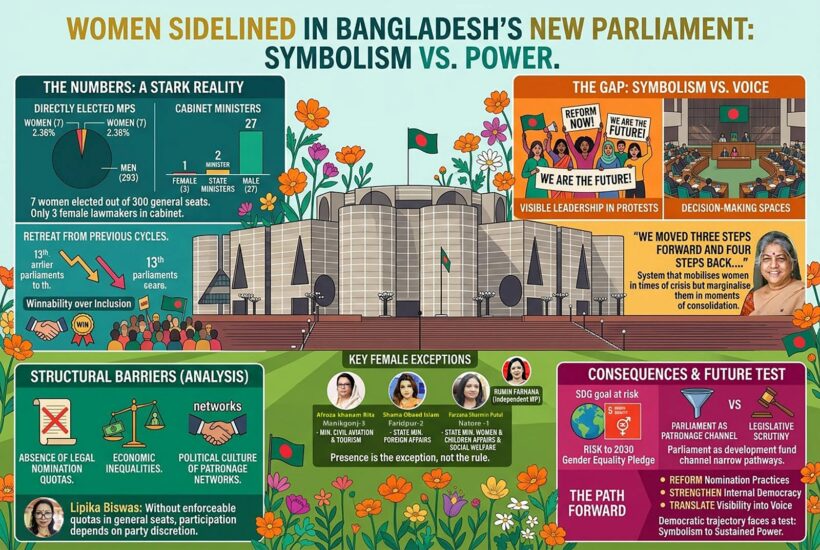
In the political history of Bangladesh, women played a pioneering role in the ’24 Mass Uprising. From the streets of the capital to the courageous students who broke through the gates of Rokeya Hall of the Dhaka University, their bold participation inspired dreams of a ‘New Bangladesh.’ However, the results of the 13th National Parliamentary Election and the formation of the Cabinet have dealt a significant blow to those expectations. Statistics reveal that instead of increasing, women’s participation at the policy-making level has shrunk, posing a major challenge to achieving the Sustainable Development Goals (SDG) by 2030.
In the Cabinet of the 13th National Parliament, women’s representation stands at a mere 6%. Out of 300 seats, the rate of women elected through general polling is only 2.36%. While the 12th Parliament’s Cabinet included 2 ministers and 6 ministers of state, this time only 3 women have found a place.
It is noteworthy that the Bangladesh Nationalist Party (BNP) recently formed the government after securing an absolute majority in the national elections. Under the leadership of Party Chairman Mr. Tarique Rahman, a 50-member Cabinet has been formed. The new Cabinet includes BNP’s Afroza Khanam Rita (Minister for Civil Aviation and Tourism), Shama Obayed (State Minister for Foreign Affairs), and Farzana Sharmin Putul (State Minister for Women and Children Affairs and Social Welfare).
In this election, only 7 women won out of 89 female candidates across 300 seats. Analysts believe the primary reason for this disaster is the decline in the number of women nominated by political parties. Among the winners are 6 from BNP (Afroza Khanam, Farzana Sharmin, Shama Obayed, Nayab Yusuf, Israt Sultana Elen Bhutto, Tahsina Rushdir Luna) and independent candidate Rumeen Farhana.
When asked, Shireen Parvin Huq, head of the Women’s Affairs Reform Commission and member of ‘Naripokkho,’ expressed deep concern to this correspondent from the news agency Pressenza:
‘Despite the leading role of women in the ’24 movement, when they are made invisible, it proves we have taken three steps forward and four steps back. We are witnessing a reflection of misogyny in the vital spheres of state governance.’
She further alleged that although the Women’s Reform Commission submitted diverse proposals, the ‘National Consensus Commission’ did not take them into account. They were not even granted time to discuss women’s issues.
Gender and governance analyst Lipika Biswas believes that the lack of legal mandates and internal party dynamics are blocking the path for women. According to her:
* There is no law making it mandatory for political parties to nominate a specific percentage of women.
* In competitive elections, parties prioritize money and muscle power to ensure ‘winnability,’ areas where women are often disadvantaged.
* Members of Parliament are currently more focused on local development and resource distribution than on legislation, making the political environment more complex for women.
However, despite these limitations, the newly elected women representatives remain optimistic. Minister for Civil Aviation and Tourism, Afroza Khanam Rita, stated she would strive to increase the number of women’s seats in Parliament. Meanwhile, independent winner Rumeen Farhana said, ‘It was extremely difficult for me to fight as a rebel candidate against the party wave after being denied a nomination. I will continue to work for the improvement of the lives of neglected and marginalized people.’
According to political analysts, if true political empowerment for women in Bangladesh is to be ensured, a radical reform of the existing quota system and gender equality in the nomination process are now the demands of the hour. Otherwise, the 2030 equality goals will remain confined to paper.
————————————————————————————————————————————————————————
About the Author:

Rita Bhowmick: Senior Journalist and Correspondent, Pressenza- Dhaka Bureau.



